Fair housing groups sue HUD over funding changes
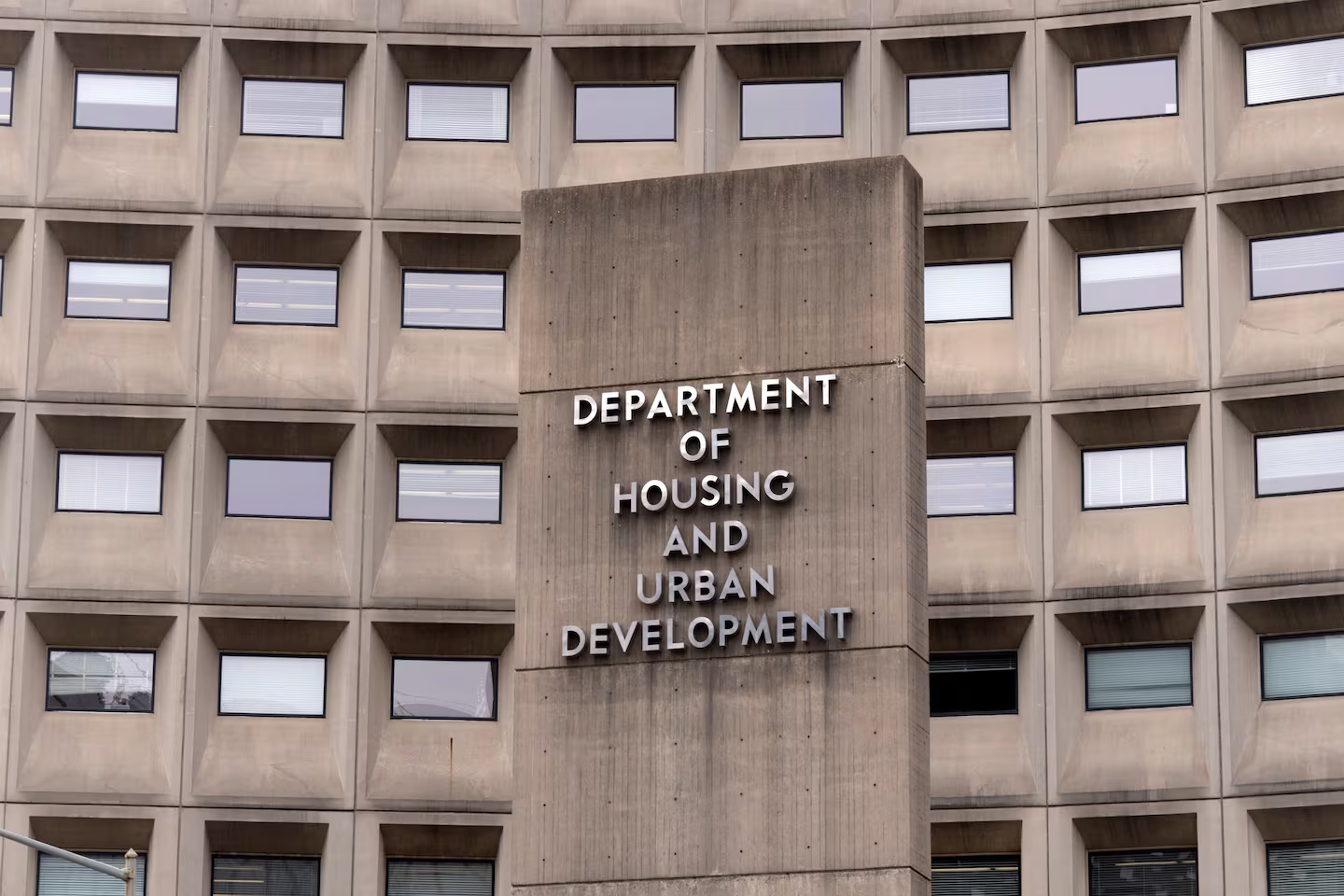
The Department of Housing and Urban Development is changing a long-standing grant program so significantly that it will vastly curtail fair housing enforcement in much of the country, according to a lawsuit filed in federal court Thursday.
Read more Trump imposes double-digit tariffs on dozens of countries as his 10 percent levies are set to expire
Most fair housing law violations are investigated by small nonprofit groups around the country dedicated to promoting fair housing. These groups rely on grants from HUD to cover large chunks of their operating expenses, and for some small groups, HUD grants make up almost their entire budget.
According to the complaint, which was filed in the District of Massachusetts, changes to that grant program, announced by HUD this month, would force fair housing groups to significantly cut back on the services they provide or shut down entirely.
“This would be catastrophic for our organization,” said Vineeth Hemavathi, the executive director of the Massachusetts Fair Housing Center, one of the plaintiffs on the case. “These fair housing laws are on the books, but they don’t mean anything if there’s no one to enforce them.”
HUD did not respond to a request for comment.
Nikitra Bailey, an executive vice president of the National Fair Housing Alliance, another plaintiff in the case, said that most complaints investigated by fair housing groups involve disability issues. In one instance, she said, a homeowners’ association outside Philadelphia would not allow a family to modify their own home to accommodate their 8-year-old daughter, who had impaired mobility and hearing.
Fair housing groups also investigate sex discrimination claims, Bailey said, like a complaint in Syracuse, New York, against a landlord who offered a rent discount to a woman in exchange for sex. A local group investigated and found more than 40 women with similar allegations against that landlord going back 30 years.
“This case does not exist without having a local organization willing to do the work and enforce the Fair Housing Act,” she said.
HUD typically awards more than 100 fair housing grants a year, generally for $500,000 or less, according to lawyers representing the fair housing groups. For the 2025 fiscal year grants — which have been extensively delayed — HUD has said it will issue only five of its traditional grants. One will be an award of $25 million, for which law schools are encouraged to apply. According to the complaint, that money could be used to develop a law school curriculum focused on fair housing, including constitutional and statutory limits on its enforcement, and on efforts like expanding the support network for property owners.
Because of new restrictions built into the remaining grants, groups will be eligible only if they have a budget of at least $5 million. This would disqualify most fair housing groups, the complaint said, because their budgets are generally between $400,000 to $2 million.
Read more Steve Kerrigan, head of Mass. Democratic Party, charged with drunken driving last month
For the Massachusetts Fair Housing Center, that would mean foregoing $425,000 of an annual budget that hovers between $700,000 and $800,000.
HUD also announced its fair housing grant program for the 2026 fiscal year, which would similarly disqualify many fair housing groups, according to Reed Colfax, a managing partner at Relman Colfax and a lawyer on the case. New applicants will receive preference, and while the grant amounts are much lower, they still cannot make up more than 50 percent of an organization’s budget. Colfax said that many organizations can’t raise more than half their budget from other sources.
One year without these grants “would be devastating,” Colfax said. “Two years would essentially be fatal to the network.”
Last year, the Trump administration tried to cancel millions of dollars in HUD grants that had already been awarded, then failed to open the application process for the next round of funding. In both instances, fair housing groups sued, and the money was restored.
But even gaps in funding that only spanned a few months were enough to damage some organizations. Martie Lafferty, executive director of the Tennessee Fair Housing Council, said that a seven-month gap in HUD funding last year forced her group to lay off two of its four employees and substantially cut back on its work. Usually, the group opens eight to 10 cases every month. In that period, they were able to open just two or three a month.
At the Tennessee Fair Housing Council, which was a plaintiff in one of last year’s lawsuits, HUD grants account for $425,000 of its $500,000 annual budget. Lafferty said they were able to make it through the seven-month gap last year because they had built up some reserves.
She said that this time, if there’s a gap in funding, that cushion is pretty much gone.
This article originally appeared in The New York Times.


Post Comment