‘And then suddenly, you’re gone’: With the searing ‘Remake,’ Cambridge documentary giant Ross McElwee grapples with the death of his son
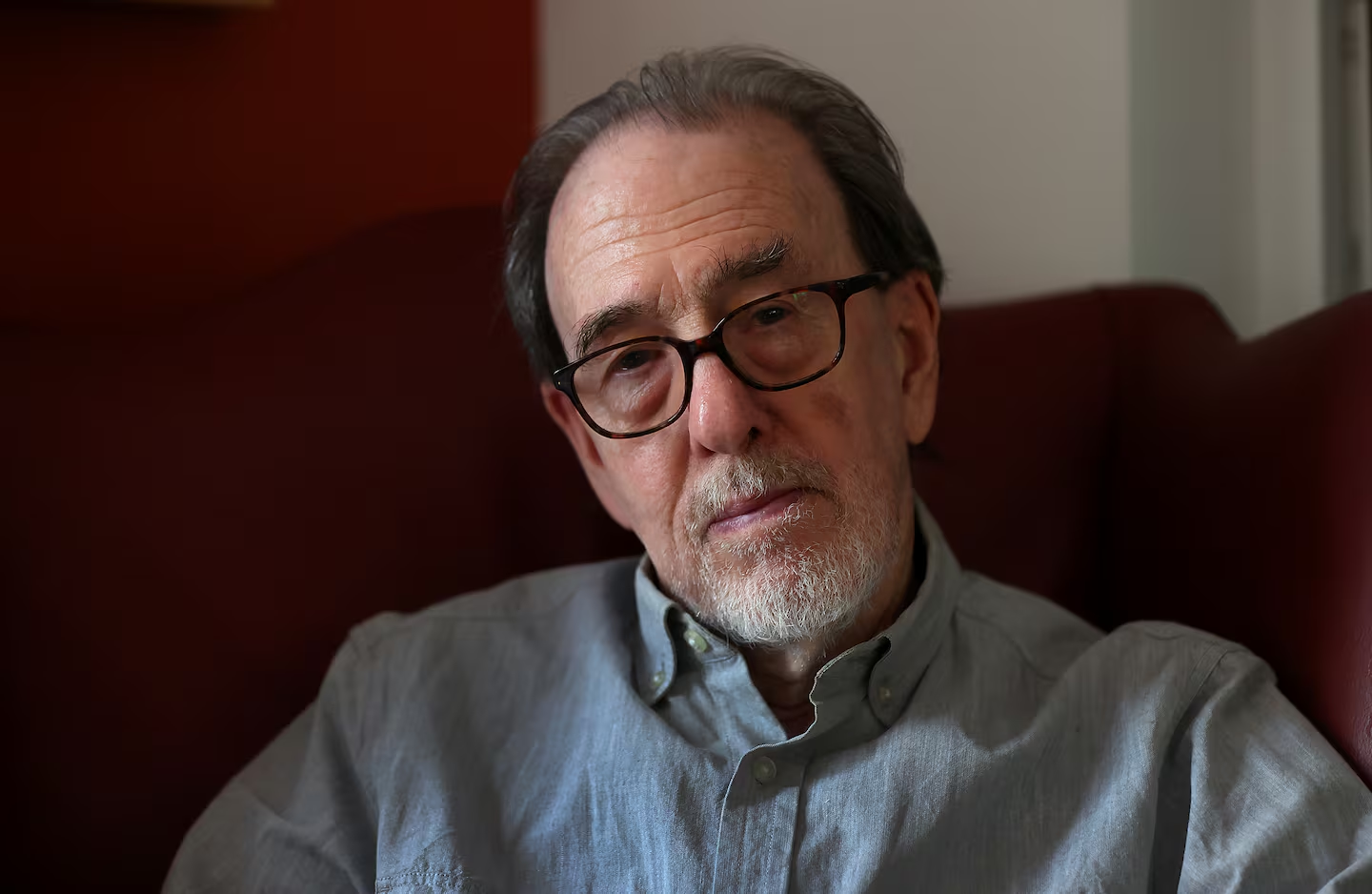
Longtime Cambridge filmmaker Ross McElwee had just watched the world premiere of his shattering new documentary, “Remake,” last fall at the Venice Film Festival, once again reliving an experience that nobody should have to endure. As is the custom at Venice, as the audience showered the filmmaker with a lengthy standing ovation, the spotlight found McElwee sitting in the balcony. Tears streamed down his face.
Read more Davis Riley closes strong, takes one-shot lead into final round of the last Rocket Classic
“It had been such a long journey,” McElwee said recently of that moment at a Cambridge cafe. “It was a little overwhelming. Fortunately I didn’t have to do any kind of discussion after the screening. They very charitably did not ask me to do that.”
When McElwee’s 27-year-old son, Adrian, died of a drug overdose in 2016, the filmmaker went through a period of immobilizing grief. Everyday life was too much to bear. Gradually, he realized he had to respond, to interpret, the way he has for more than 50 years: with a camera, his tool for interrogating the ways of time and memory, of family and love and loss.
McElwee, whose career took off in 1985 with the whimsical, digressive “Sherman’s March,” is a pioneer of the documentary essay. His films often start off being about one thing before veering into something else, something deeply personal. (A 4K restoration of “Sherman’s March” is now showing alongside “Remake” at Coolidge Corner Theatre.)
“Remake” is a story he never thought he’d have to tell. And then he realized he didn’t really have a choice.
“I think it was a film that he needed to make,” says Steven Ascher, a close friend of McElwee and, with his wife Jeanne Jordan, a longtime fixture in Cambridge’s close-knit documentary community. “I think in the long run, he’s glad he made it, but I think he finds showing it incredibly painful.”
McElwee, 79, arrived in Cambridge in 1975 to study film at MIT, and he’s been here ever since, teaching documentary filmmaking at Harvard from 1986 until he retired in 2024. Born and raised in North Carolina, his voice still carries a quiet, almost courtly Southern twang, which, Jordan says, becomes a little more pronounced after a couple of drinks. “I used to joke that he was like a Presbyterian deacon of the church,” Jordan says. “There’s this very Southern gentleman part of Ross that is really dear and extremely polite.”
Always an obsessive journal writer, McElwee began to find his voice as an essayistic filmmaker at MIT, working with faculty members and documentary giants Richard Leacock and Ed Pincus. McElwee was enamored of the direct cinema documentary style; his early influences included Robert Drew’s “Primary” (1960) and Frederick Wiseman’s 1967 film “Titicut Follies,” a portrait of Bridgewater State Hospital for the Criminally Insane that was banned in Massachusetts, after the state argued that it invaded patient privacy and human dignity, until 1991. But Pincus inspired him to move in a more personal direction, which yielded McElwee’s often-droll voiceover narration. “What was missing for me was a place for the filmmaker’s subjective thoughts,” he says. “So that’s when I started writing my narration, and that links back, I guess, to my obsession with keeping a journal.”
But none of his previous work has quite the same soul-bearing impact of “Remake.” McElwee had included Adrian in a number of his previous films. He’s there in “In Paraguay” (released in 2008, shot in 1995) as a quick-witted, imaginative child enjoying the trip with McElwee and his first wife, the filmmaker Marilyn Levine, to adopt a Paraguayan infant, Mariah. He’s a sullen young man in “Photographic Memory” (2011), a little too attached to online life and partying. We see clips of these films in “Remake” as McElwee tries to make sense of what happened, and we grapple with the fact that children turn into grown-ups with their own grown-up demons, no matter how loving and supportive their parents were.
Much of the back and forth between father and son in “Remake” is playful, even when it gets contentious. Adrian, who had a multitude of plans to make it as a filmmaker, a clothing designer — a multimedia creator — chastises his dad for not making more of an effort to cross over to a more commercial audience. “Remake” actually began as a chronicle of McElwee’s effort to do just that: A Hollywood filmmaker, Steve Carr, talked McElwee into helping to make a fictional comedic version of “Sherman’s March.” The film had established McElwee’s discursive, autobiographical style by shifting partway through shooting from a study of General William Tecumseh Sherman’s Civil War exploits to a trek through the filmmaker’s romantic travails through his native South.
Read more Revolution let two points slip away with tie in Montreal
The remake prospect pleased Adrian. “It was kind of a running joke between us,” McElwee says in “Remake.” “He’d say, ‘I like your documentaries, Dad, but it’s time to make a real movie.’”
McElwee’s films have a way of speaking to each other across time, which is appropriate for a filmmaker who uses time as a primary subject. Among my favorites is “Time Indefinite” (1993), which is also shrouded in death. We celebrate with McElwee his engagement and marriage, then watch as his father, also a frequent character in his films, dies unexpectedly, and his wife has a miscarriage. McElwee’s wry sense of humor never really leaves him, but he’s clearly shaken as he considers the unstoppable nature of time in indefinite and finite forms.
“Remake” reflects a tragedy of a different order. Nobody is supposed to outlive their child, and McElwee can be brutally hard on himself in the film. He openly wonders if he should have filmed Adrian less over the years, and if he could have been a better father.
“Sometimes when I go to one of these screenings, I feel like I’m going to my son’s memorial service all over,” he told me. “That’s the part of it that I just can’t seem to get beyond.”
It took about a year before McElwee could bring himself to look at footage of Adrian after his death. “It was just emotionally too difficult because it was hard to watch him alive and funny and breathing as a kid and not having him that way in real life,” he said. “[Seeing the footage] is still kind of hard for me. But I eventually got this idea that I need to do something to begin to process this as the autobiographical artist that I supposedly was.”
Even as he began assembling the film, he didn’t want to look at the copious footage that Adrian shot of himself and his life. Ascher and Jordan told McElwee that the film needed this footage, in order to reflect, as Jordan told me, “Adrian’s world through his own eyes.” McElwee’s second wife, the filmmaker Hyun Kyung Kim, ended up looking through the footage, much of which features Adrian either parodying or cultivating a jetsetting, party-guy lifestyle. McElwee also leaned heavily on film editor Joe Bini, who helped shape hours of footage from different time periods into a poetic, emotionally resonant whole.
Blending images from his previous films with stripped-down voiceover narration, McElwee reaches haunting emotional crescendos in “Remake.” “The story I thought I was telling with my filmmaking, the story of lives over decades, is now disjointed,” he says over footage shot in simpler times. “The reels are all out of order. First, there is a father, and he has a son. But then it starts all over. I am now the father, and I have a son. You. But something goes awry, something goes off script. And then suddenly, you’re gone.”
Born of tragedy, “Remake” plays like a stirring summation of a remarkable career. In questioning the limits and purpose of his art, McElwee ultimately reminds us how redemptive and necessary the best art can be.
Read more ‘No surprise, right?’ The rich get richer as Dodgers land Tarik Skubal from the Tigers


Post Comment