A ballot referendum could upend elections in Massachusetts. So where do its current politicians stand on it?
WASHINGTON — Massachusetts voters will have the chance to scrap the state’s party primary system this November — a decision that has big implications for the many ambitious politicians eyeing the few top-tier offices in the state.
Read more Left for dead in June, these Red Sox have become the ‘impossible team’ with 15-game win streak
The referendum, which Secretary of State William Galvin on Tuesday officially certified as Question 3, would switch elections towhat’s known as a jungle primary, where all candidates, regardless of party, run in a single, nonpartisan primary, and the two top vote-getters advance to the general.
Supporters of the change argue it could increase competition (and possibly, moderation) for top races by decreasing the power of party loyalists. Opponents say it’s a solution in search of a problem. The question has already divided Democrats within Massachusetts, and a similar schism is emerging among its federal officeholders, as well.
So far, most of the state’s congressional delegationare declining to take a position on the change. But the few who are in favor of scrapping the party primary providea telling indication of who may benefitpolitically in a heavily Democratic state.
And now that the referendum is confirmed for the ballot, efforts to shape voters’ opinions of the change are likely to heat up significantly ahead of November.
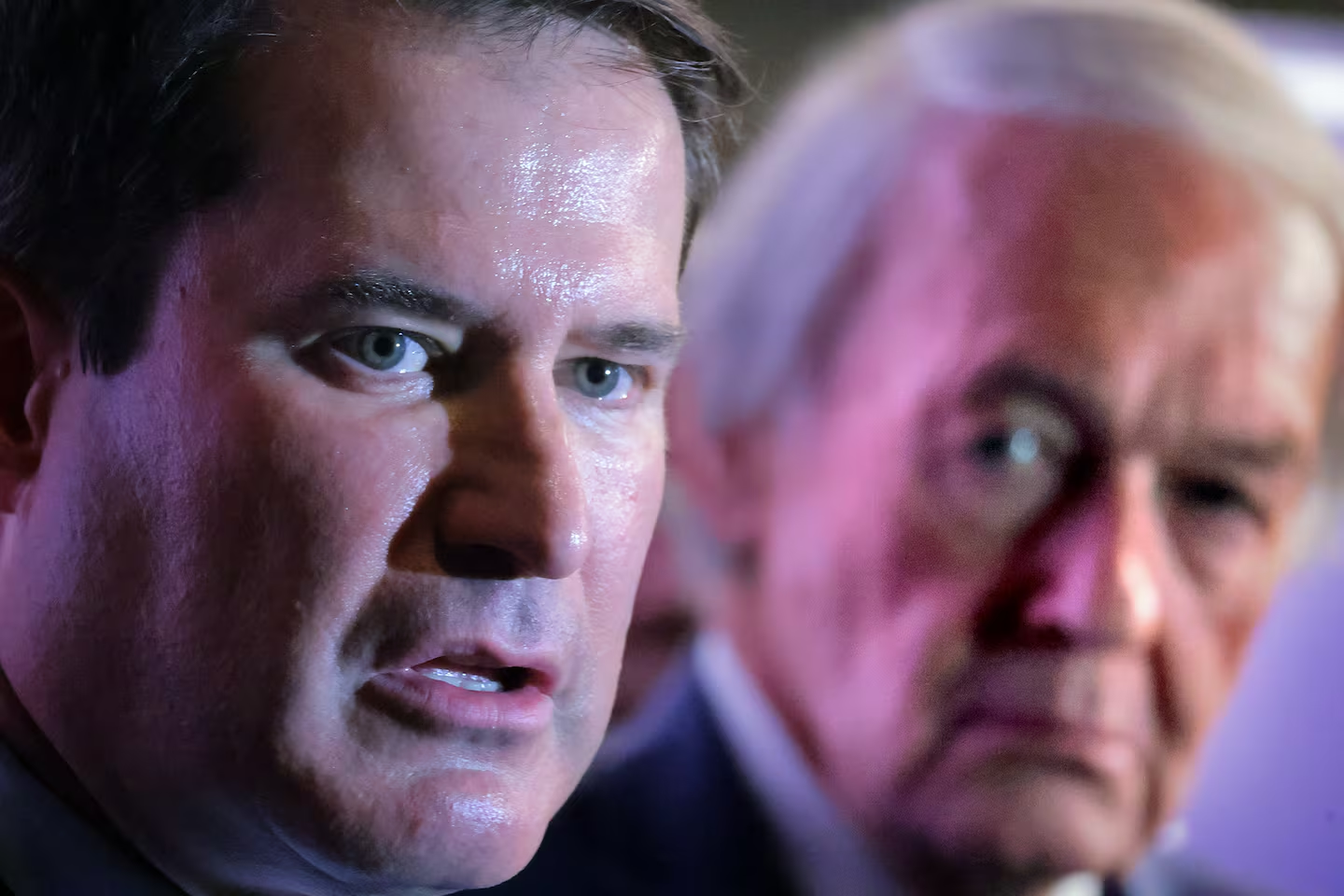
Two members of the delegation said they support a jungle primary: Newton Representative Jake Auchincloss and Salem Representative Seth Moulton.
Both are more moderate Democrats,who tend to struggle to win over the blue state’s activist-heavy primary voters. Moulton is challenging incumbent Senator Ed Markey in the Democratic primary this September, and Auchincloss considered doing so before opting against it.
Markey, on the other hand, is against the switch.
“I support keeping Democratic and Republican primaries so that each party can pick the best candidate for each office in Massachusetts,” Markey said in a statement.
Most other members of the delegation — including leading progressives Senator Elizabeth Warren and Boston Representative Ayanna Pressley — said they have yet to form an opinion. RepresentativeLori Trahan ofWestford, who is also believed to have ambitions for other offices in Massachusetts, is also reserving judgment. Others, including Revere representative and House Democratic whip Katherine Clark, declined to comment.
The implications of such a change could be vast. With the state’s political makeup, the Democratic primary is often the contest in which the eventual election winner is selected, but the pool of voters tends to skew toward the most engaged and active partisans.
But with a jungle primary, some elections could allow two Democrats to advance to a general election. Candidates would have to compete for a broader, more politically diverse electorate, not just party bases; voters, meanwhile, wouldn’t have to choose which party’s ballot to vote on.
Other outcomes are possible: in California this spring, there were so many Democrats running for governor that party figures for a time feared they would split the vote so much that two Republicans would advance. In the end, an endorsement by President Trump for one Republican and the uncovering of scandals around some Democratic candidates led to a traditional one-Democrat, one-Republican general election.
Auchincloss has long spoken in favor of all-party primaries, arguing it shifts each party’s politics toward the center.
“I think American democracy is stronger when every election is competitive in November everywhere, and this does that,” he said.
Read more ‘There is room here to dream’: Naturalization ceremony focuses on hope for brand new US citizens
Representative Bill Keating of Bourne said he opposed the change and doesn’t see any reason to alter the primary system that, in his eyes, works as is.He theorized the change could increase the cost of elections, too, by prolonging the competitive season into November.
“I think it’d be good news if you’re a political consultant, or if you were selling advertising space on TV,” Keating said. “It would be great, because it would drive the cost, which is already high, even higher.”
But the political outcomes are not so clear cut. Auchincloss himself was the beneficiary of a party primary in his race for his open congressional seat, where a crowded Democratic field stocked with progressives split the votes. Prevailing in the primary set him up for a general election race against a Republican,an easier matchup than if he had to face a fellow Democrat.
The nonpartisan primary initiative is being led by Harvard professor and former gubernatorial hopeful Danielle Allen, a Democrat, and has the backing of prominent former politicians including former governor Deval Patrick andformerrepresentative Joe Kennedy III.
Joe Caiazzo, a Boston-based Democratic consultant who has worked for Warren and the presidential campaigns of Independent Vermont Senator Bernie Sanders, said that regardless of the politics, a jungle primary would increase competition and decrease the advantages of incumbents because challengers would believe they have a greater chance of advancing to November.
The current system is “a race to the left and it’s hyperbolic gobbledygook that goes wild on Twitter but doesn’t really translate to anything for real people,” Caiazzo argued.
“I think moving to a top-two system will increase engagement, it will enfranchise those who aren’t very closely following partisan politics, and it will force the conversation to tackle not the hottest topic among activists, but actually tackle problems that real people face every day,” he said.
Of course, not everyone agrees. Political analyst and longtime Democratic adviser Mary Anne Marsh called it a “participation trophy” system that does nothing to improve democracy or candidates’ chances.
“Trying to change the rules of the game is not the answer in the end, the answer is just learning to be a better candidate, and maybe you’re just not meant to be one,” Marsh said of candidates pushing for a jungle system.
There is some evidence of what might await Massachusetts from states that have jungle primary systems for federal races. California is the most prominent, and Washington also uses such a system. Alaska has a top-four primary paired with ranked choice voting. Louisiana used to have an all-party primary but opted in 2024 to go back to a party primary for federal races, a switch that presaged the ouster of the state’s more moderate Republican senator in this year’s primary.
The architect of California’s top-two system, former centrist Republicanstate senator Abel Maldonado, told the Los Angeles Timesin June thatit should be scrapped because it’s failed to produce the moderating influence he had hoped. Democratic Senator Alex Padilla of California, who formerly administered elections there as the secretary of state, said the impacts aren’t clear cut.
“I think it’s mixed, to be honest,” Padilla said. “There’s some upside, there’s some downside. . . . At the end of the day, the vast majority of contests in California — top to bottom, statewide, local, federal — have still been one Democrat and Republican advancing to November.”


Post Comment