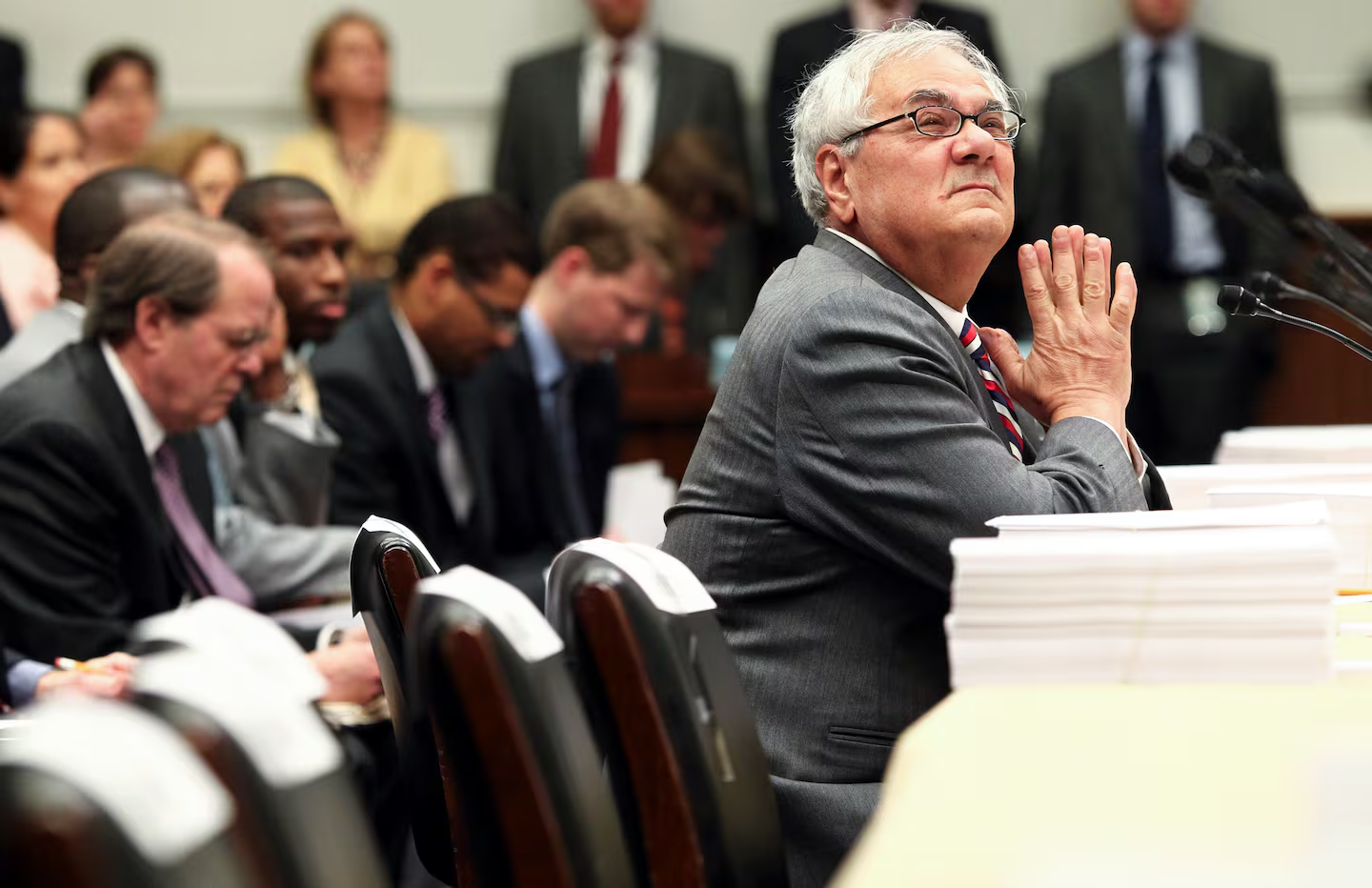
Three defining moments from Barney Frank’s decades-long career in Congress
Barney Frank, who died Tuesday evening in his Ogunquit, Maine, home, was a fixture for Massachusetts Democrats from the local level to Capitol Hill.
Read more Timeline of recent US-Cuba relations amid heightened tensions in Trump’s second term
His four-decade career — from his early days as a top aide to former Boston Mayor Kevin White to his final days in hospice warning Democrats against what he perceived as political missteps — spanned many major political moments, including moments he himself defined, such as becoming the first member of Congress to publicly come out as gay voluntarily in an interview with the Globe in 1987.
Here are three moments that helped define Frank’s tenure representing Massachusetts in the US House.
His first reelection fight
Frank first ran for Congress in 1980, and narrowly won his House seat that was vacated by Robert Drinan, a Jesuit priest,after Pope John Paul II said that clergy should not serve in public office.At the time, Frank ran on the slogan, “Neatness isn’t everything,” and told a Globe reporter during his first day in office: “I think I could stay for the next 30 years and feel my life fulfilled.”
His first real test of legislative power, however, came in 1982, when in the wake of redistricting, he faced a reelection challenge against fellow incumbent Republican Margaret Heckler. As reported by Globe writer Charles Pierce, who published a profile on Frank in October 2005, the new maps meant that Frank would also need to win over “the blue-collar city of Fall River.”
Frank, who had not come out as gay yet,jumped head first into the race, and, as Pierce wrote, “had to learn how to campaign among people he’d never really represented.” The congressman went on to win reelection in one of the most closely-watched House races in the country that year.
“The campaign humanized him,” Pierce wrote. “In a famous television commercial, Frank was shown hitting what appeared to be a line-drive double into the right-center-field gap and running the bases while a narrator recited his legislative accomplishments. The ad ended with Frank sliding in ungainly fashion into home plate. He learned to schmooze, to take some of the edge off his wit.”
A sex scandal involving his personal driver
Frank’s tenure in Congress was again tested in 1989, when StephenGobie, a male escort, told the Washington Times about an affair he had with the congressman, which included an alleged brothel service being run out of Frank’s apartment.
Frank, who came out publicly as gay two years earlier, confirmed that he was in a relationship with Gobie but adamantly denied that he knew about the escort service out of his apartment. Frank told the House Ethics committee that he had ended his relationship with Gobie in 1987, when his landlady had complained about the alleged prostitution business.
As reported by the Globe’s BobHohler in a story published in May 1995,Frank said he was “overwhelmed with guilt” when the stories about Gobie first came to light. The revelations threatened to upend his career,which he had centeredaround honesty.
In September 1989, the Globe’s Jonathan Kaufman interviewed a political analyst who weighed in on Frank’s future: “‘There is a kind of disappointment among Democrats that he did such a foolish thing,’ says William Schneider, an analyst at the American Enterprise Institute. ‘There is a shadow on his judgment. He has been a shining star of brilliant insight. People trusted him. The luster is off. The question everyone asks is: How could he do such a stupid thing?’”
Read more Pawtucket will extend school day and year to make up for shortfall in learning time
The Ethics committee eventually recommended Frank receivea reprimand by the full House, finding that the worst infraction he had committed was using his position in Congress to cancel out some parking tickets for Gobie, whom he had hired as his personal driver during their affair.
Frank’s punishment was handed out in 1990. That same yearhe ran for reelection, winning 66 percent of the vote, as reported by Pierce.
His contempt for Newt Gingrich
In 1995, a few years after surviving his Ethics investigation, Frank had established himself as the “de-facto leader” of House Democrats, according to Hohler’s reporting. That put him in opposition to Newt Gingrich, the Republican from Georgia who led the request to censure Frank for his scandal involving Gobie just five years before.
Gingrich was elected as speaker at the start of the 104th Congress in 1995, and his first day, as reported by the New York Times, was marked by a marathon House session intended to “revamp internal House rules.” Hohler reported that GOP lawmakers voted to “abolish three committees, impose term limits on committee chairmen, and eliminate hundreds of congressional jobs, most held by Democratic aides.”
The session carried well into the next morning, and Frank used the moment on multiple occasions to poke fun at his Republican counterparts.
As Hohler reported, Frank walked up to the microphone halfway through the session to drop some of his trademark wit: “When you are in the majority, you inevitably have to defend some dumb things. But in one day, you have been dumber than we were in two years.”
The story continues: “Shortly after midnight, Frank returns to the microphone. ‘Parliamentary inquiry,’ he shouts. ‘Will the speaker tell me if it is his ruling that it is still Wednesday? I just want to know what day this is, because I was told we have to do all this on the first day.’”
A few months later, in May 1995, Frank told reporters, “I can’t believe what a bleeder Newt is.” Gingrich responded, in what Hohler called “an uncharacteristically childlike response: ‘Barney Frank hates me.’”
Pierce wrote in his 2005 profilethat Frank “tormented Gingrich almost from the moment that the latter picked up the speaker’s gavel.”



Post Comment