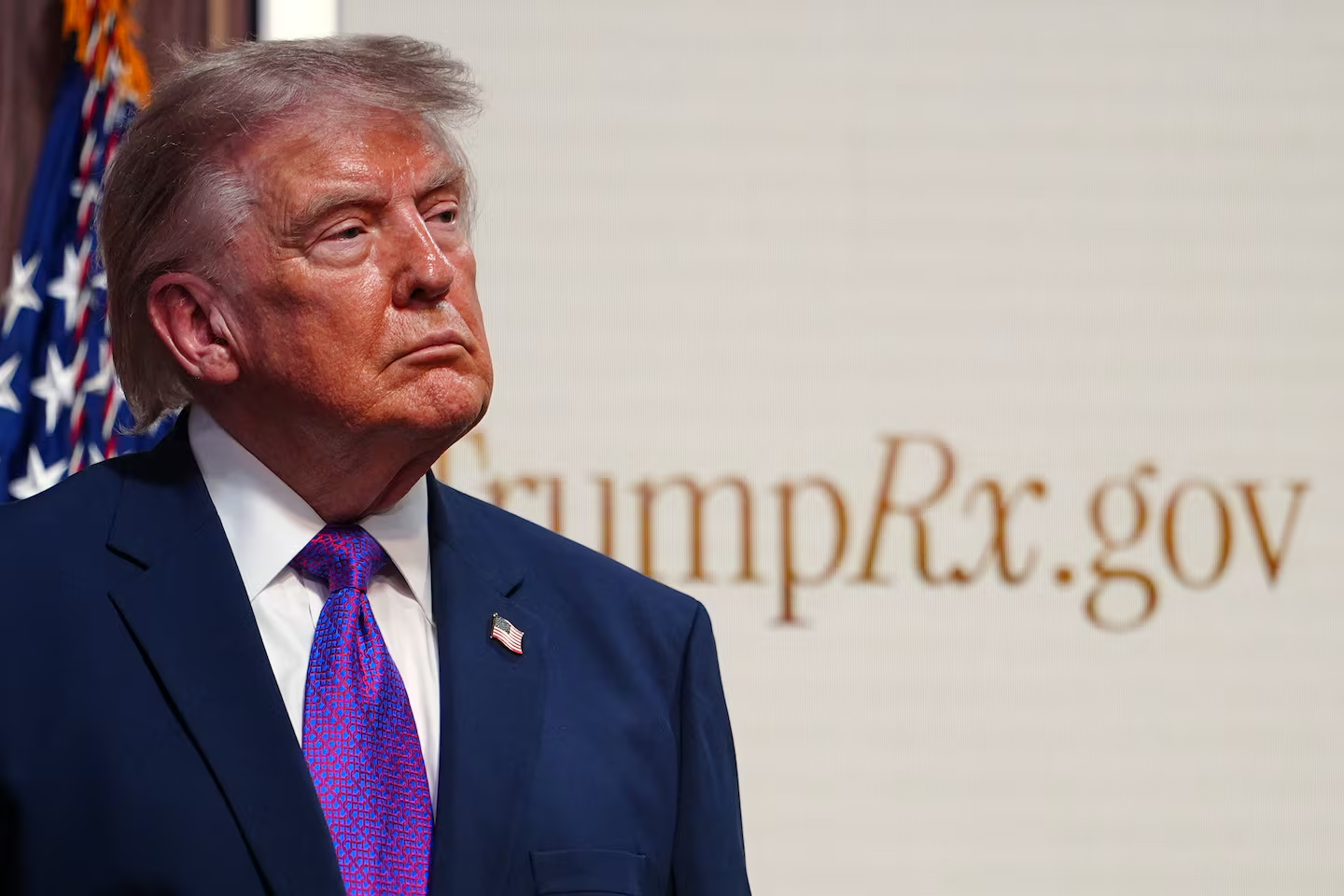
Abortion pill lawsuit leaves Trump silent, and in a political bind
With the midterm elections less than six months away, Republicans are facing challenging political headwinds, including an unpopular war, escalating inflation and President Donald Trump’s sinking approval ratings. Now another issue is putting the administration in a political bind.
Abortion.
Four years after the Supreme Court overturned Roe v. Wade, which established a national right to abortion in 1973, it remains widely available, and the number of abortions per year has actually increased slightly. Much of that is due to the availability of abortion pills. The Food and Drug Administration has so far not walked away from a decision made during the Biden administration to allow access to the abortion pill mifepristone through the mail.
But a lawsuit against the FDA now threatens that access, and the Trump administration has remained strikingly silent about it, even as the case reached the Supreme Court this month.
The suit, brought by the state of Louisiana, led a federal appeals court to temporarily bar a policy allowing abortion providers to prescribe mifepristone through telemedicine and send it by mail. Responding to emergency appeals from two mifepristone manufacturers, the Supreme Court twice paused that ruling and then, last week, restored telemedicine and mail access indefinitely while litigation continues in the lower courts.
Through all the back-and-forth, Trump, who calls himself “the most pro-life president in history,” stayed mum. His Justice Department, whose job it is to defend the FDA in the case, declined to submit a brief to the Supreme Court, a highly unusual decision.
“That they’re the folks who are most directly affected by the litigation and they’re not filing anything — that is shocking,” said Samuel Bagenstos, who was the general counsel for the Department of Health and Human Services, which oversees the FDA, during the Biden administration. “I think it reflects this very difficult political position that the Trump administration is in.”
Strategists for both parties say the president is navigating a tricky political calculus. A majority of the public favors widespread access to abortion pills. Trump can stay quiet about the case and incur the wrath of anti-abortion leaders who view his silence as a betrayal and might stay home from the polls in November — or he can voice his support for restricting access, which would inevitably fire up Democrats and independents to vote in greater numbers. For the moment, at least, he has chosen to remain quiet.
But the case is still energizing both sides.
“They don’t want this going into the midterm election? Well, unfortunately, they just got it,” said Tony Perkins, president of the Family Research Council, a conservative group that opposes abortion and has been increasingly frustrated by the president’s inaction on the issue in his second term. He added: “It’s only going to stay in the news. It’s only going to become more of the narrative going into the midterms.”
More than 100 studies and years of FDA reviews have consistently found that mifepristone is safe and that serious complications from taking it are rare. It is the first pill taken in a two-drug medication abortion regimen that has become the method used in nearly two-thirds of abortions in the United States. Pills are now mailed to about 100,000 patients per year in states that have banned or severely restricted abortion.
The FDA eased restrictions on the strictly regulated drug in 2021, dropping a requirement that patients get mifepristone in person and allowing doctors to prescribe it via telemedicine and send it through the mail.
Trump’s FDA has kept that policy intact, saying it will make a determination after it reviews the drug’s safety, a study that administration officials have repeatedly said will not be finished for months. After last week’s Supreme Court ruling, the agency promised to “press forward” to finish the study and said it would “provide updates as key milestones are reached.”
In fact, that study has not even begun, according to two people with detailed knowledge of the effort. It has been held up for months, these people said, by delays at Health and Human Services headquarters, which slowed the FDA’s effort to update a sophisticated set of databases from electronic health records and insurance carriers that are necessary for the research. Opponents of abortion have accused the agency and the president of slow-walking the study until after the midterms.
‘A losing issue’
Opposition to abortion animated Republicans for decades, helping to elect candidates and driving voters to the polls. That changed, however, after the court’s decision in 2022 to overturn Roe v. Wade.
Democrats were expected to take a drubbing that year; the party in power generally loses congressional seats in midterm elections. Instead, they suffered relatively minor losses in the House, and they picked up a seat in the Senate. Political strategists in both parties attribute the outcome to the rise of abortion as a salient issue — a finding confirmed by a postelection analysis by the California Institute of Technology.
Whit Ayres, a Republican strategist, said abortion had not been expected to be a major issue this year; voters are consumed with the economy and the war with Iran. Asked why the administration might be reluctant to talk about the mifepristone case, his answer was brief and to the point.
“Because I think they see it as a losing issue,” he said.
Sixty-eight percent of American adults oppose banning mifepristone, and 65% oppose making it a crime for healthcare providers to mail abortion pills to patients in states where abortion is banned, according to a December 2025 survey by KFF, a nonpartisan healthcare research organization.
The survey also found that 4 in 10 Americans were not sure about mifepristone’s safety. Ashley Kirzinger, who oversees polling on the issue at KFF, said the organization was conducting additional research on the perception of the drug’s safety to learn whether opinion has been shifting as opponents of abortion criticize abortion pills.
Both Kirzinger and Celinda Lake, a Democratic pollster, said that restrictions on abortion can swing close elections in Democrats’ favor. Lake said that Democratic women ages 18 to 30 were especially animated by protecting abortion rights.
“It can really mobilize young women,” she said. “And that is not trivial.”
Louisiana’s aggressive approach
Louisiana, one of 20 states that ban or restrict abortion, sued in October to block the policy allowing telemedicine and mailing. The state claimed that the policy was adopted without adequate review and that it violated the state’s sovereignty by allowing Louisiana residents to receive the medication despite the strict abortion ban there.
While some Republican strategists would have preferred to see the case remain in the lower courts and out of the headlines, in Louisiana, a red state with a large Catholic population, politicians see little risk in an aggressive approach to shutting down access to abortion there and across the country. Louisiana Attorney General Liz Murrill has been pushing the mifepristone case more aggressively than other conservative states that have filed similar suits, asking the courts to halt mifepristone mailing until the full lawsuit can be adjudicated.
The state’s push has put some Republicans elsewhere in an ill-timed predicament. The White House’s posture in the Louisiana lawsuit reflects that, said Katie Keith, director of the Center for Health Policy and the Law at Georgetown University.
“The Trump administration was trying to have it both ways,” she said, “and that’s how they got themselves into, I think, a bit of a mess here.”
Read more Former Jaguars coach Urban Meyer lost arbitration case against NFL team, AP source says
This article originally appeared in The New York Times.


Post Comment