Trump’s GOP revenge tour reaches its final tests
Donald Trump’s revenge tour through the Republican Party’s primaries is entering what may be its final stage.
Read more How do New England high school baseball prospects get discovered by MLB scouts?
Not because Trump has stopped caring about settling scores. There are simply fewer Republicans left to punish.
Earlier this month, Trump already claimed a fresh round ofvegence in Indiana, where several Republican state senators lost primaries after crossing him during a redistricting fight. Their offense was not ideological. Most were reliable conservatives from a deeply Republican state. Their sin was refusing to back Trump’s preferred congressional map.
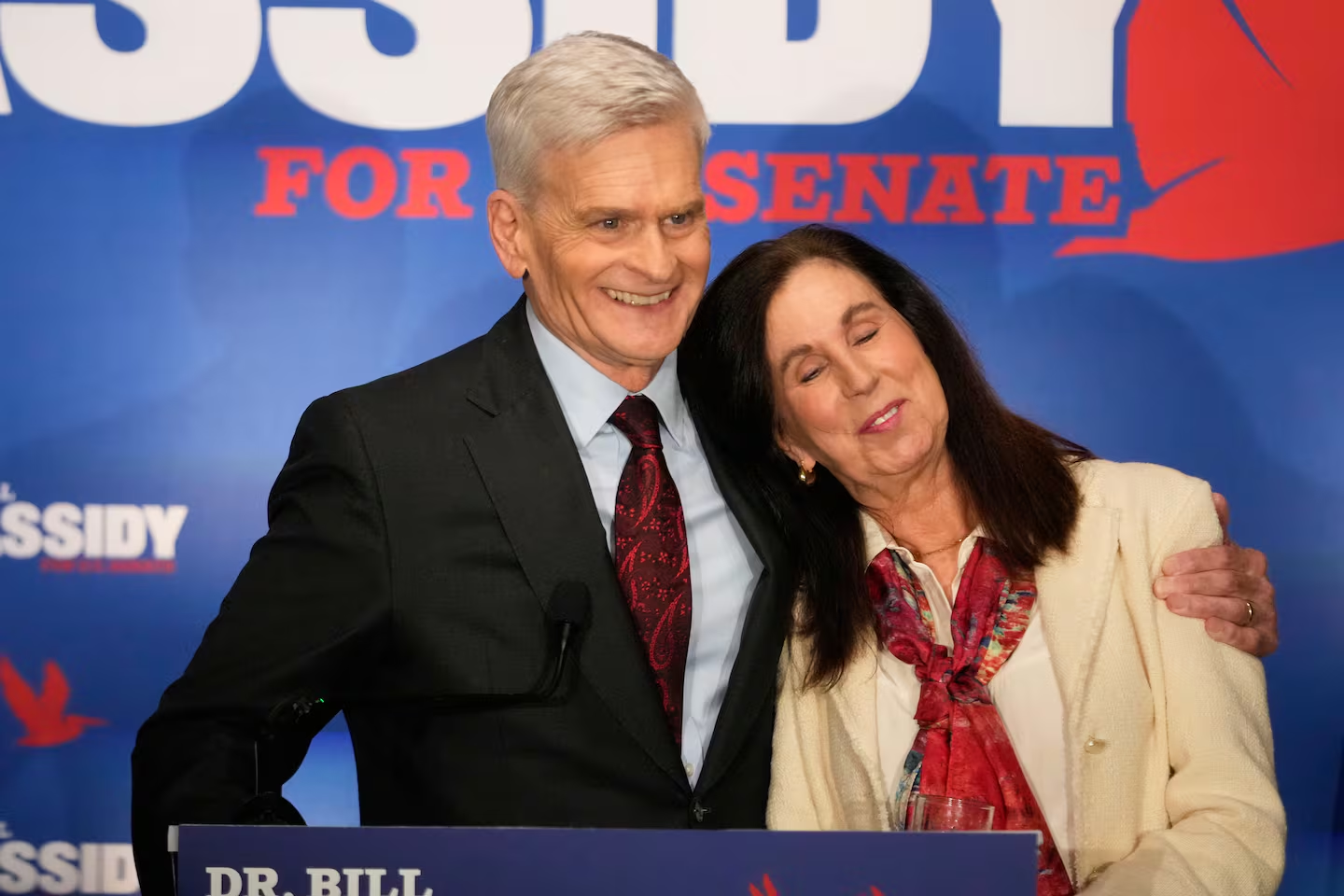
Then on Saturday, Republican Senator Bill Cassidy finished third in his primary missing the run off with the Trump-backed candidate Representative Julia Letlow. Cassidy is no moderate, he voted down the line for the Trump agenda, except that one time five years ago when he voted to remove Trump from office following the January 6th attack on the Capitol.
In the end, Letlow and state Treasurer John Fleming advanced to a runoff with neither getting over 50 percent. Letlow received 45 percent and Fleming received 28 percent, both besting Cassidy’s 25 percent, according to the Associated Press.
This sets the stage for what may be the last remaining test of Trump’s ability to enforce political loyalty inside his party: Tuesday’s Republican House primary in Kentucky involving Representative Thomas Massie.
While the Trump infractions are different in Louisiana and Kentucky races, at their core they are also about the same thing: whether there is still room in the Republican Party for elected officials who openly break with Trump, even just once or twice.
Cassidy’s political problem has been obvious sincethe moment Trump was reelected.
Most Republicans who voted to impeach or convict Trump either lost reelection, lost primaries, or retired before voters could remove them. Some saw the writing on the wall and left politics entirely. Others became pariahs inside their own party and lost their primary.
The handful who politically survived did so largely because they operated outside the traditional Republican primary system Trump dominates.
Senator Lisa Murkowski won in Alaska, where the state uses a unique top-four primary system that weakened Trump’s influence. Similarly, California Representative David Valadao hung around because his state uses a primary system where candidates from all parties are involved and only the top two advance.
The glaring exception to all of this has been Senator Susan Collins, who doesn’t face a serious primary challenger for her reelection in Maine, a state where Trump has never won.
Read more The making of AJ Dybantsa, the most exciting basketball prospect in Massachusetts history
Cassidy, however, faced a far more traditional Republican electorate in a state Trump dominates culturally and politically.
This could suggest Tuesday’s Kentucky primary involving Thomas Massie could be especially fascinating.
Massie is not a moderate. He is not an establishment Republican in the mold of Cassidy. In many ways, he is actually more conservative than much of the Republican leadership. He comes from the libertarian made noteworthy by former Texas Representative Ron Paul wing of the party and has built a following by opposing spending bills, surveillance programs, and foreign intervention.
But Massie also possesses a trait Trump has come to despise in Republican politicians: independence.
He publicly disagreed with Trump repeatedly. Namely, he has refused to give his vote on key budget bills and he helped lead the charge to disclose the Epstein files.
And unlike many Republicans, he often seemed entirely comfortable being at odds with Trump saying it was never personal but based on principle.
There is also this: Trump has unsuccessfully supported Massie opponents before. In 2020, Massie earned Trump’s ire over a COVID funding bill. Trump posted a series of tweets about Massie, including that he should be thrown out of the Republican party.
Weeks later Massie won the Republican primary with 81 percent of the vote.
This time Trump recruited retired Navy SEAL Ed Gallrein to challenge him and tried to turn the race into a nationalized test of loyalty. However, Massie has been able to muddy the discussion by making it about the billionaire donors flooding money to help defeat him. Massie is telling Republican voters that he is running against the system.
Polling shows the race basically a toss-up.
That may ultimately become one of the defining tensions of the post-Trump Republican Party.
For nearly a decade, Trump proved he could dominate Republican politics nationally. And once that happens, parties usually have to decide what they actually want to build next. But that is a larger question two years from now.


Post Comment