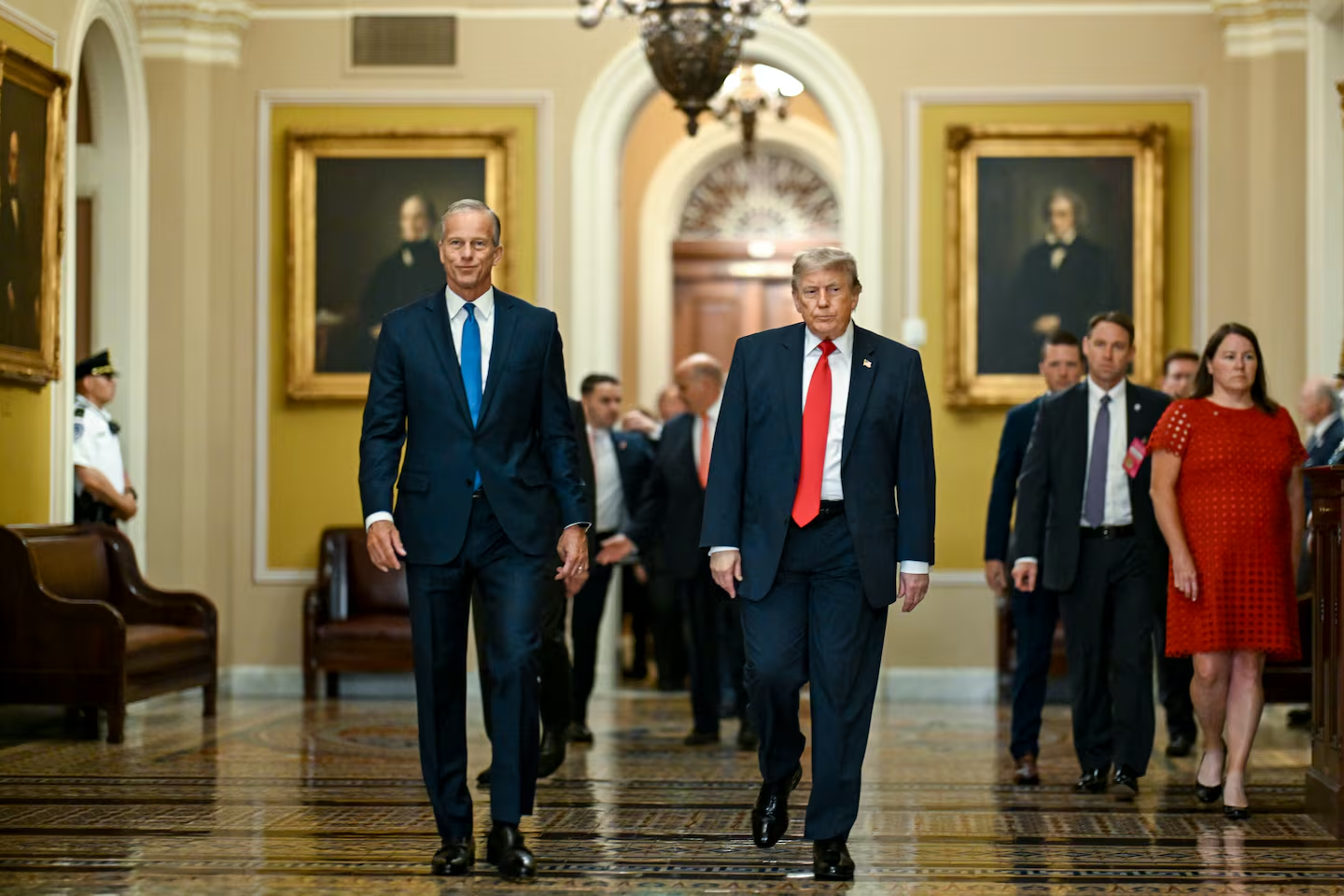
Trump-Thune rift is bubbling over amid stalled election bill
WASHINGTON — The long-simmering tension between President Trump and Senate Republicans over a stalled voting restriction bill intensified Thursday, after the president’s spokesperson said that Trump’s “patience is running out” with Sen. John Thune, R-S.D. and the majority leader, for failing to push it through.
Read more The decision is in: LeBron James is signing with the 76ers
Thune, who has faced criticism from Trump and his far-right allies for months, quickly fired back, telling reporters that if the White House wanted to see action on the federal elections overhaul — which has neither the majority it would need to pass nor the 60 votes needed to overcome a filibuster — somebody in the president’s orbit should make a more concerted effort to garner the necessary support to advance it.
“Maybe she or somebody else ought to get on the phone and get the votes,” Thune said at the Capitol, referring to Karoline Leavitt, the spokesperson who had told reporters of Trump’s dwindling patience.
“It’s 50 around here,” Thune added, referring to the minimum number of votes Republicans need to pass legislation. “And so, instead of pointing the finger at Republicans, they might think about going after the people who are stopping it on the floor, which is the Democrats. And if there are Republicans that they think are gettable, get on the phone. Let’s get them to ‘yes.’”
The back-and-forth was the latest flare-up of an extraordinary intraparty fight over the elections measure, the SAVE America Act, which Trump has called his top priority.
With the midterm elections approaching in November, Republicans have been eager to present a unified front. Instead, the president’s intense focus on the bill has divided his party, prompting repeated squabbling that has threatened the GOP’s ability to pass legislation despite its majorities in both chambers of Congress.
“I don’t know who it was that sold the president on this idea that this was attainable,” said Sen. John Cornyn, R-Texas, who lost his primary to a Trump-backed challenger. “But it’s creating a circular firing squad for Republicans, and here we are — what, 103 days before the midterm elections? — and this is not a great place for us.”
The escalating battle will likely complicate the Senate’s final two weeks before their August recess. Thune already faced a difficult to-do list, laid at his feet by House Republicans who departed Washington for their five-week break Thursday after having pushed through several bills that face dim prospects in the Senate.
Before senators depart Washington, Republicans are hoping to confirm Trump’s picks for director of national intelligence and attorney general. The House also sent over a stopgap spending bill to avoid a government shutdown at the end of September. And many Republican senators are also hoping to find a way to provide additional military funding for the war in Iran. But with Democrats opposed to both of those measures, Senate Republicans are unlikely to be able to move either.
Trump’s proposed elections overhaul would require Americans to show proof of citizenship to register to vote, impose a nationwide voter identification requirement and severely limit voting by mail.
With Democrats uniformly opposed, Trump has for months tried to cow Republican senators into eliminating or weakening the filibuster so they can ram the bill through with a simple majority vote.
“It’s like the Senate is a place you send things when you want them to die,” Trump said at an event in Georgia on Wednesday. “We can’t do this. We’re not going to take this any longer. We’re not going to take it. I’m trying to be nice.”
Then, he directed his attention to Thune.
“Everybody call John Thune at the Senate,” Trump told a crowd of supporters. “He’s the leader of the Republican Party, and tell him to get this stuff approved.”
But a Republican majority does not exist in the Senate to do what the president wants. Many GOP senators oppose changing the filibuster rules, and a few object to provisions of the voting bill itself, including the changes to mail-in voting used widely throughout the country, particularly in right-leaning rural areas.
“We just don’t have the votes, and so there’s nothing that Sen. Thune can do to change that,” Cornyn told reporters Thursday.
Nevertheless, a far-right faction of House Republicans has added to the pressure, threatening to block legislation and then successfully demanding that Speaker Mike Johnson append a version of the SAVE America Act to every major bill it sends to the Senate. This week, they adopted a $95 billion budget plan to fund the war with Iran that would also incentivize states to impose Trump’s election restrictions.
Thune has been skeptical that Senate Republicans have enough votes to pass the budget plan, and he has repeatedly maintained that there is not enough support among Senate Republicans to push through the SAVE Act.
Some of that is Trump’s own doing. Among the Republicans who oppose either the elections overhaul or eliminating the filibuster are several senators whom he has frequently targeted with his social media broadsides, including Sens. Lisa Murkowski of Alaska; Susan Collins of Maine, who is in a tough reelection fight; and Thom Tillis of North Carolina.
Tillis, who opted not to run for reelection this year, has repeatedly called efforts to pass the SAVE America Act a waste of time. On Thursday, he reiterated his support for Thune. “Anybody in the White House who thinks he’s not a good leader isn’t qualified for their job,” he told reporters.
Two other senators, Cornyn and Bill Cassidy of Louisiana, lost their reelection bids after Trump endorsed challengers, leaving them with little incentive to wholeheartedly back his priorities at the expense of the Senate’s institutional power.
Read more White House correspondents’ dinner, take two: What will Trump have to say?
This article originally appeared in The New York Times.


Post Comment