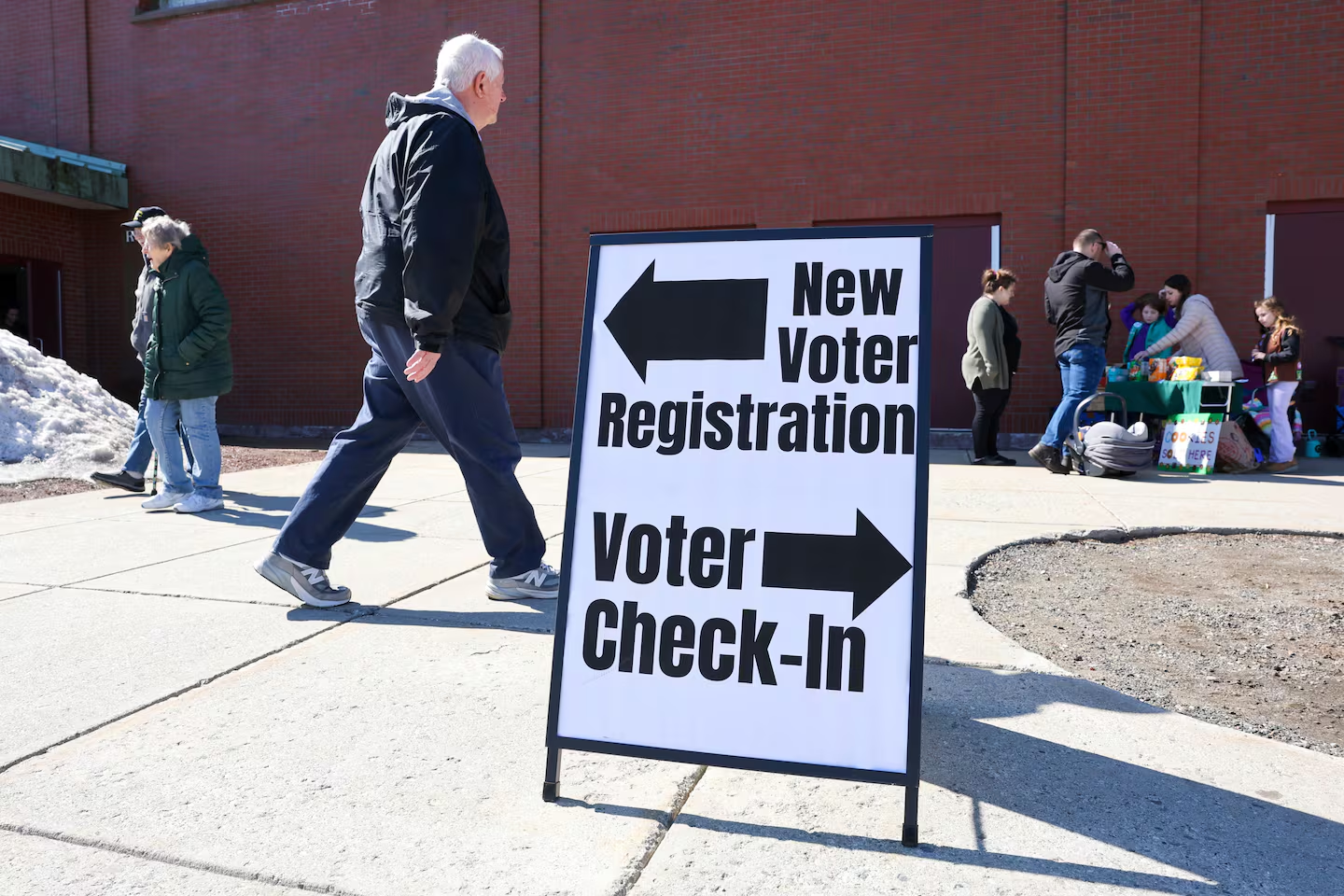
Why N.H. won’t see a N.J.-style noncitizen voter registration problem
CONCORD, N.H. — Republicans and Democrats differ heartily on matters of election integrity, but lawmakers from both parties in New Hampshire agreed this week on at least one point: A glitch like the one that added about 6,600 noncitizens to the voter rolls in New Jersey couldn’t have happened here.
Read more Singer Chris Brown pleads guilty over bottle attack at a London nightclub
New Jersey Governor Mikie Sherrill, a Democrat, said Tuesday the problem in her state stemmed from a software error. People who indicated they aren’t US citizens when they obtained a driver’s license were automatically registered to vote anyway. Nearly 400 of them went on to cast ballots, in a state where more than 4 million people voted in the 2024 election.
The major mishap came to light as President Trump has stoked uncertainty about election systems, advocated for restrictive voting legislation, and ramped up pressure on state officials to comply with his demands ahead of the midterms, while portraying noncitizen voter fraud as a widespread problem, even though it’s rare and carries the risk of steep penalties for those who commit it.
In a joint statement, the Democratic minority leaders of the New Hampshire House and Senate said Wednesday they are confident New Hampshire hasn’t been impacted by the flaw that afflicted New Jersey, given policy differences between the states. When records from the New Hampshire Division of Motor Vehicles are used for voter registration purposes, the process is completed manually by a human, not automatically by software from a vendor, they noted.
“Technology can make the process more efficient for local election officials, but these officials must review the information and ensure every voter meets the law’s requirements,” Representative Alexis Simpson and Senator Rebecca Perkins-Kwoka said. “That careful, local oversight is the New Hampshire way.”
Representative Ross Berry, a Republican who chairs the New Hampshire House Election Law Committee, said the situation in New Jersey illustrates why he and others have resisted efforts to adopt automatic voter registration policies in New Hampshire.
“This sort of stuff is kind of case in point as to why we don’t want to go down this road,” he said.
Berry said this situation also shows why it made sense for New Hampshire to add a proof-of-citizenship requirement in 2024 to the state’s voter registration process — a requirement that a federal judge rejected in May as an unjustifiable burden on voting rights.
As a result of the judge’s order, New Hampshire revived its “qualified voter affidavit,” which allows people to register to vote by attesting to their US citizenship without furnishing a birth certificate, passport, or naturalization papers.
Read more At Tanglewood, flowers have some seeing red
Governor Kelly Ayotte, a Republican, signed a new law this month authorizing Secretary of State David Scanlan to randomly audit the citizenship qualifications of those who use the affidavit. That law takes effect on Sept. 8, though it’s not yet clear whether or when such an audit will occur.
Berry said he would be surprised if an audit found zero noncitizens on New Hampshire’s voter rolls. After all, one noncitizen is currently being prosecuted for allegedly voting in Manchester.
“The most important thing is we have a process that can’t be easily undermined,” he said.
Granite Staters still need to provide documentation of their identity, age, and domicile when they register to vote. For some, the required information is already on file with the DMV, so policymakers established a new program that lets election officials search DMV records, with an individual’s consent, to prove they are qualified to vote.
Simpson and Perkins-Kwoka sent a letter to Scanlan on Tuesday with a list of questions about the new information-sharing system. Their letter said voters used the system more than 250 times on town meeting day in the spring. That surpassed expectations and suggests significantly more voters could turn to the new system during this fall’s higher-turnout elections.
“With some towns having internet access and others not, we are inquiring about what the setup will be to ensure every voter can vote,” they wrote.
Simpson and Perkins-Kwoka also asked about Scanlan’s plan to protect Granite Staters from federal overreach, as the Trump administration has unsuccessfully pressured him to release the state’s unredacted voter list and announced plans to dispatch federal election monitors to Manchester and Nashua for the Sept. 8 primaries.
Scanlan and his office have not granted requests for comment on the letter.
This story appears in Globe NH | Morning Report, a free email newsletter focused on New Hampshire, including great coverage from the Boston Globe and links to interesting articles elsewhere. Sign up here.
Read more This AI company bailed on Silicon Valley to come to Boston. Why?


Post Comment