This AI company bailed on Silicon Valley to come to Boston. Why?
Tired of hearing about how our best and brightest tech minds keep packing up and heading west?
Read more The politics of playing chess in movies
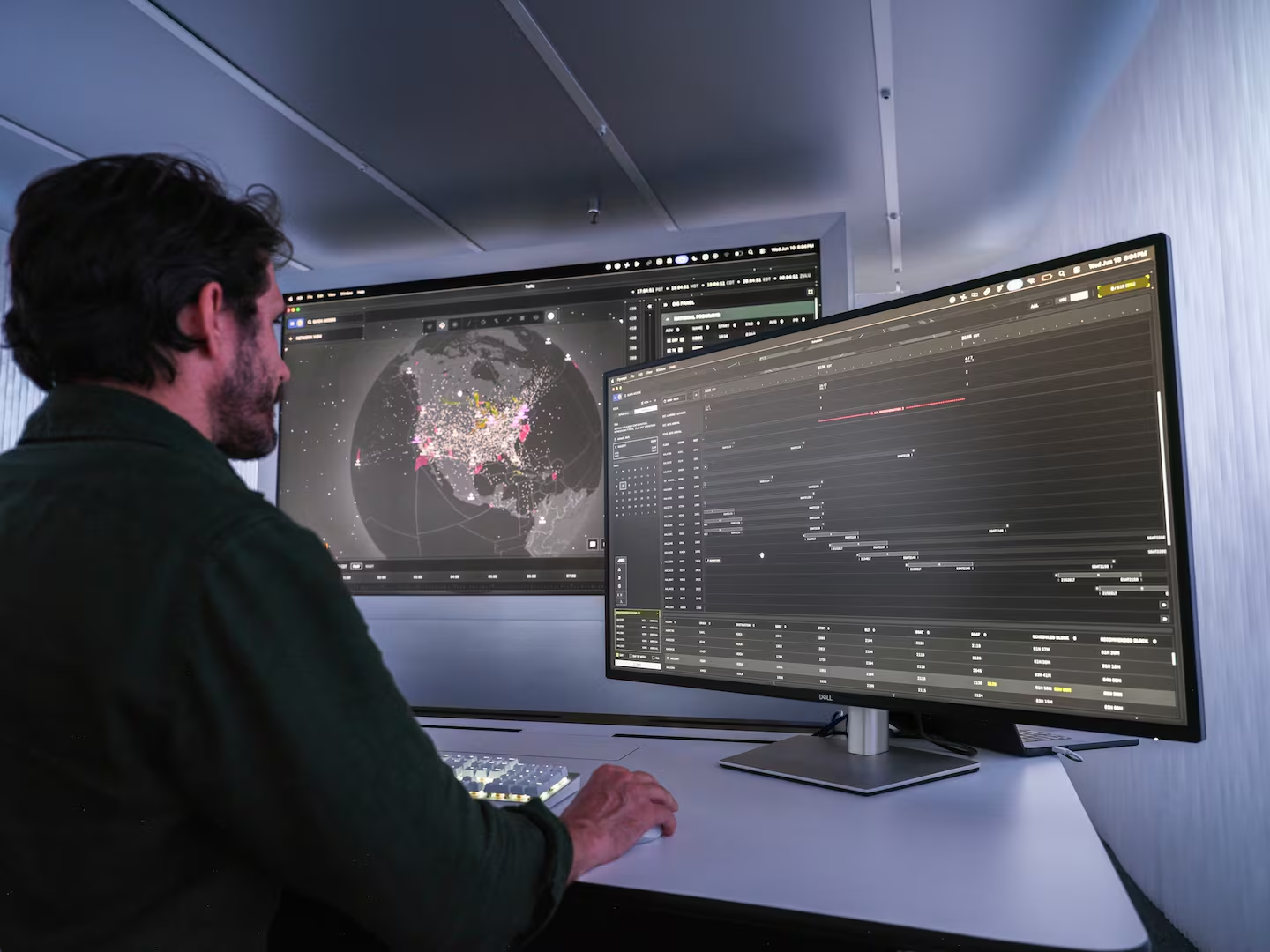
Then check out Air Space Intelligence, an AI company perched in offices above the Uniqlo store in the former Danker & Donahue Garage on Newbury Street. ASI moved to Boston in 2024 to escape Silicon Valley and, as chief executive Phillip Buckendorf puts it, the tech epicenter’s “groupthink.”
While the field’s biggest players remain ensconced in California, the decision-making behind ASI’s Boston move provides some reason to be hopeful about this region’s future, and our role in the AI economy.
Air Space Intelligence just landed its biggest federal contract yet: $875 million over 12 years to install its software throughout the Federal Aviation Administration’s air traffic control system, to improve airline congestion and safety. ASI’s software predicts how dynamic situations will change over time, and how those changes can affect operations, initially used for airlines but now also in energy and defense.
The FAA win prompted state Senator Barry Finegold to give ASI a shout-out at a State House press conference earlier this month along with Boston Dynamics’ expansion in Waltham — as two local tech success stories.
Hyundai-owned Boston Dynamics is well known — in part because of those videos of its robotic humanoids and dogs in action. ASI, meanwhile, has flown under the radar. Maybe not anymore, now that it has landed the high-profile responsibility of remaking the country’s outdated air-traffic control system across 100-plus locations.
The company isn’t a major tech employer in Boston yet, with around 60 or so people based at its Back Bay headquarters. But it is putting down roots, and apparently looking for a bigger office. Buckendorf expects his 165-plus person workforce will expand to more than 250 over the coming months as ASI ramps up to serve the FAA and other clients, with many jobs opening up here. (Other employees are in Washington and Denver, in Europe, or work remotely.)
The German native got his start in the autonomous vehicle industry in California, as did several of ASI’s other founders. Post-pandemic, as Buckendorf brought ASI employees back to the office, he had a decision to make: Should he reopen in Silicon Valley, where the firm was founded, or try someplace new?
Buckendorf had grown frustrated with what he calls a “mercenary culture” in Silicon Valley, a longstanding mentality in which engineers hop from job to job. Boston offers similar engineering talent, but a different mindset. This stark difference is exemplified in how the two states treat noncompete agreements: They are essentially banned in California, but still allowed for many white-collar jobs in Massachusetts, where the business community finds them more culturally acceptable.
Read more They shared the worst moments of their lives in hopes of expanding abortion care in Mass.
ASI, Buckendorf says, “goes deep” and needs people who get excited about applying the firm’s technologyto its core industries. That means investing time in the business, not always chasing the next big thing. Those types of workers can be harder to find, he said, in Silicon Valley. Plus, Buckendorf wanted to be in the same time zone as ASI’s federal government partners; he calls the D.C. area home but says he spends two or three days a week in Boston when he’s not flying around to meet with clients, prospects, or employees.
The FAA job is a huge win for ASI. Buckendorf says it’s akin to swapping out “Windows 95″ for “Star Trek” technology. The company had proven itself with several large airlines: Alaska Airlines, Delta, and United are all clients. And this past spring, ASI branched into energy by teaming up with National Grid to put its predictive software to use on outage detection and energy storage deployment.
Spark Capital cofounder Alex Finkelstein said Spark first invested in ASI in 2021, as it was about to sign its first customer, Alaska Airlines, and when ASI was still in Palo Alto. (California’s Andreessen Horowitz led the next round, in 2023, bringing the firm’s total announced fund-raising to $37 million.) The Massachusetts move, Finkelstein says, “is a really great Boston case study.” No tax breaks, or top-secret meetings with the governor necessary. Just a reservoir of top-notch talent coming out of MIT, Harvard, and other universities — and from the tech firms in their orbit.
Can ASI become a flagship artificial intelligence company for Greater Boston? Finkelstein, who sits on the board, thinks so. He fully expects that ASI’s success will attract more engineers to the area as it becomes one of our fastest growing companies.
It was Finkelstein who introduced Finegold, the Senate co-chair of the economic development committee, to ASI. Finegold singled out the ASI contract and Boston Dynamics news in his remarks last week, because they both came within days of each other in June. Finegold sees the twin announcements as an inflection point for the state’s innovation economy, bucking the belief that startup founders have little reason to stick around.
Beacon Hill is trying to provide more reasons for them to stay. In 2024, Finegold was a key player in an economic development bill that Governor Maura Healey signed, setting asideat least $100 million to foster AI firms here. Recently, Finegold helped craft another economic bill, this one with $75 million in grants for developing AI tech. The Senate passed its version of the new economic development bill on Thursday; the House has already approved its own version, also with those AI funds.
More important than the dollar amount is the message it sends: Greater Boston’s civic leaders are eager to spur AI companies to grow or move here. That clarion call from Beacon Hill dovetails with the work of the Massachusetts AI Coalition, a new industry group that’s courting founders and building connections in the startup community.
Don’t expect the floodgates to open tomorrow. Silicon Valley still seems like the place to be for most AI developers. But maybe it takes an executive who grew up in Germany and got his start in California to appreciate what Boston has to offer in terms of talent and corporate culture.
Read more Goal-starved Revolution expected to acquire Leeds United winger Jack Harrison this week



Post Comment