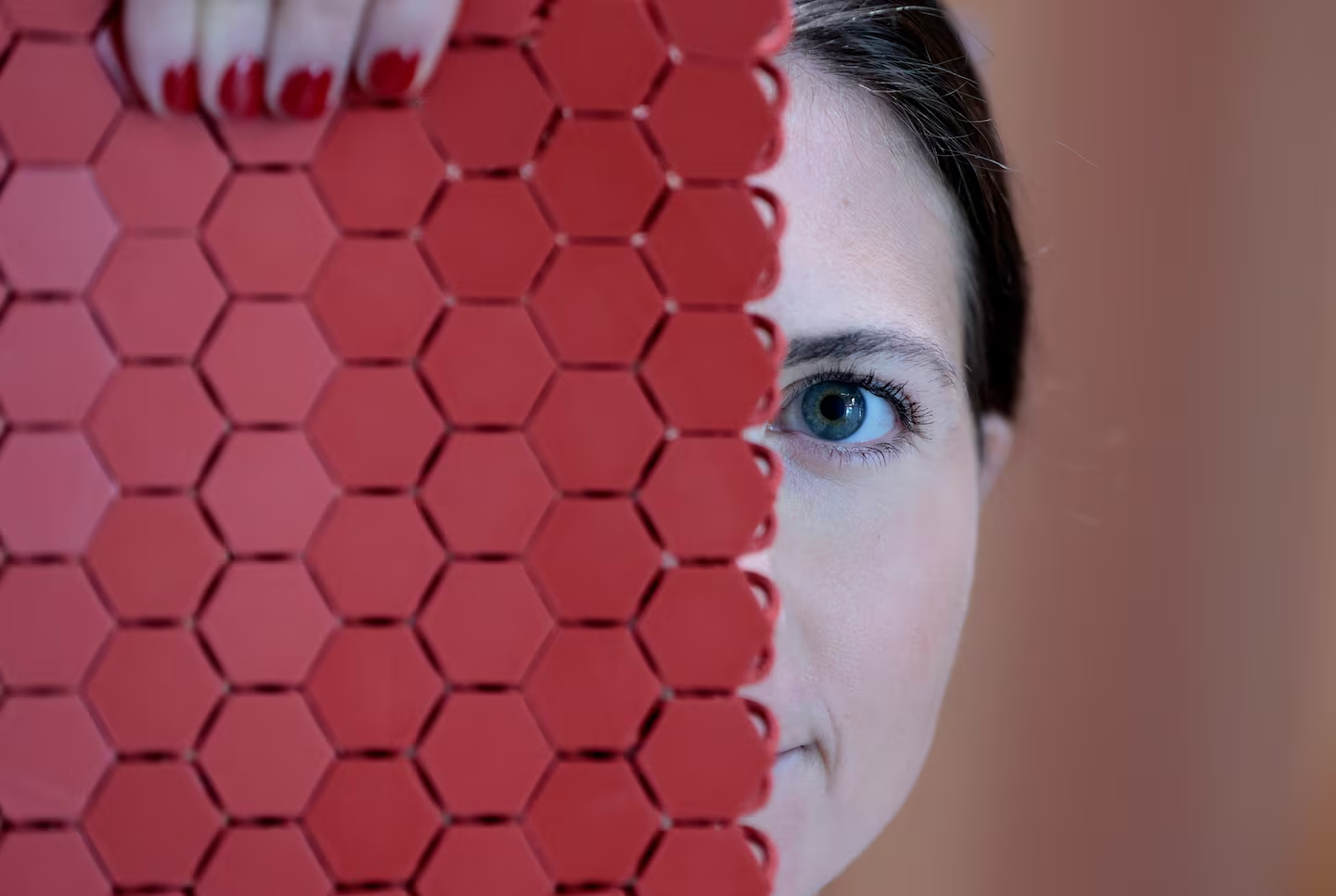
This Harvard-educated engineer is trying to keep girls from quitting sports. She’s starting by redesigning the sports bra.
Sara Falkson keeps coming back to the photo of her tweenage self standing awkwardly in a pink dance leotard, staring blankly at the camera and looking like she’d rather be just about anywhere else. She remembers feeling uncomfortable in the skin-tight Lycra, ill-fitting and unsupportive of her developing body.
Read more Ranking the Patriots position groups from least to most concerning
Shortly after the photo was taken, she quit dancing.
Years later, Falkson discovered she wasn’t alone. A recent study conducted by Dove found that 45 percent of girls drop out of sports by the age of 14 because of low body confidence. That’s the problem Falkson sought to solve when she began a master’s program at Harvard’s engineering school and one she continues to combat through her company, Robyn.
What began as a thesis project is now a full-time job for Falkson, who grew up in Dedham and attended Noble and Greenough before playing field hockey at Dartmouth.
Robyn, incorporated this year as a Delaware C Corp., has two main purposes: redesigning the sports bra to better serve female athletes of all ages, and presenting a body confidence curriculum rooted in design thinking to young athletes, parents, and coaches.
“So many people across all different sports, around the world, really resonate with these messages when it comes to the sports bra, when it comes to body-confident sport, or not finding gear that fit their body in their sport,” Falkson said. “It’s cool to see the impact of what design and engineering can have at the intersection of girls’ and women’s sports.”
Building a better bra
As an undergraduate, Falkson and her Dartmouth field hockey teammates received packages of apparel and gear ahead of each season that included two sports bras per athlete.
They had their choice of standard sizes (small, medium, large, and extra large), but beyond that, the athletes received identical bras purported to fit their non-identical bodies. Some athletes had to wear two bras at once. Others ditched them and bought their own.
Falkson argues the root of that problem is what she calls a “gear gap,” or the idea that sports bras are viewed as apparel rather than equipment, and thus not taken as seriously as, say, protective cups for boys’ sports.
Many industry leaders view sports bras as a one-size-fits-all invention, she said, a problem that could stem from a lack of women involved in design decision-making. According to the Industrial Designers Society of America, 19 percent of practicing industrial designers are women, and women hold only 11 percent of design leadership roles.
“I don’t believe that it’s done with malice, but if you live in a world that’s been designed for you, like most men do, you don’t spend much time thinking about people who are not like you,” said Karen Reuther, a former Nike and Reebok executive who has four decades of experience in the athletic apparel and design industry. “That is the reality of our product design world in general, and for sure in the sports industry.”
That divide makes it all the more important for engineers such as Falkson to design with women in mind, said Reuther, a faculty member at the Harvard Graduate School of Design who advised Falkson on her thesis project.
“We need more women at the design tables, because women won’t forget that women exist,” Reuther said.
Falkson estimates she spent $1,000 — a third of her thesis project budget — on sports bras from big-name brands — Nike, Under Armour, Lululemon — only to cut them up and reassemble them in configurations that resembled Frankenstein’s monster.
She said she felt silly at times carrying armfuls of bras into an engineering lab full of high-tech projects and robotics. Learning to sew was a classic story of trial and error — “half the battle was learning how to thread the machine” — and she felt the constant pressure that comes with being a woman in a male-dominated space.
“There were definitely some eyes being like, ‘What is she doing?’ ” Falkson said. “But that’s where I thrive and love it the most, where I’m like, ‘All right. This is different. This is cool.’ ”
After completing her master’s degree in the spring, Falkson hired a small team of executives and began the process of bringing her sports bras to market with eyes on a fall 2026 release. She enlisted Suzy Wakefield, a designer with experience in the undergarment and lingerie space, to build the Robyn bra to her specifications based on the data she gathered at Harvard.
The specifics of the design are under wraps as Falkson pursues patents and intellectual property protections, but she hopes to strike a balance between function and fashion without sacrificing one for the other.
“As girls go up in breast size, a lot of times some of the beautiful features, or cool and fun things that we look for in athleisure, get stripped down so they look really bare bones,” she said. “But no matter your size, you deserve perfect fit, perfect support, and we want to make sure that all athletes feel comfortable and confident when they wear a bra, as well.”
Building body confidence
One of the most memorable advertisements from Super Bowl LVIII in 2024 is a 30-second spot from Dove featuring a montage of young female athletes tripping, stumbling, and taking hits set to “It’s The Hard-Knock Life” from the musical “Annie.”
When the music cuts out, the ad displays a message: “The knocks don’t stop girls from playing sports. Low body confidence does.”
The ad is a frequent reference point for Falkson, who uses it in presentations at her body confidence workshops delivered to athletes, coaches, and parents around the Boston area.
Many young athletes don’t feel comfortable approaching their coaches with questions about their bodies, particularly given that only 26 percent of youth sports head coaches in 2022 were women, according to data from the Sports & Fitness Industry Association.
But Falkson said encouraging transparent conversations — even if they’re uncomfortable — about sports bras, puberty, and bodies can empower athletes to seek help and equip coaches and parents with the necessary resources to keep girls playing sports longer.
“It doesn’t have to be that every coach, if it’s a man, has the proper tools to answer those questions, but every coach who’s a man should know what services are available to him as a coach of young girls to bring the conversation into the locker room,” Reuther said. “That’s why people like [Falkson] are important.”
The workshops use a design-thinking approach to body confidence, allowing young athletes to identify a problem and work together to come up with a solution. This year, she has conducted 15 workshops with schools and teams throughout the Boston area, most of whom reached out to her through mutual friends or on social media.
At a recent workshop for middle school and high school basketball players on Shooting Touch, a local nonprofit and AAU team, athletes filled out brainstorming worksheets and created 30-second pitches for products they determined could help boost girls’ confidence. Among the ideas: candy with electrolytes for game-day fueling, positive affirmation bracelets, and adjustable sports bras.
“Talking about developing breasts and getting your period and everything else in sports is awkward,” Falkson said. “But how can we just say, ‘Hey, this is something we’re all going through, and let’s try to make it as fun as possible?’ ”
Read more ‘That’s home to me’: Marcelo Mayer to practice at shortstop as Red Sox mull position change





Post Comment