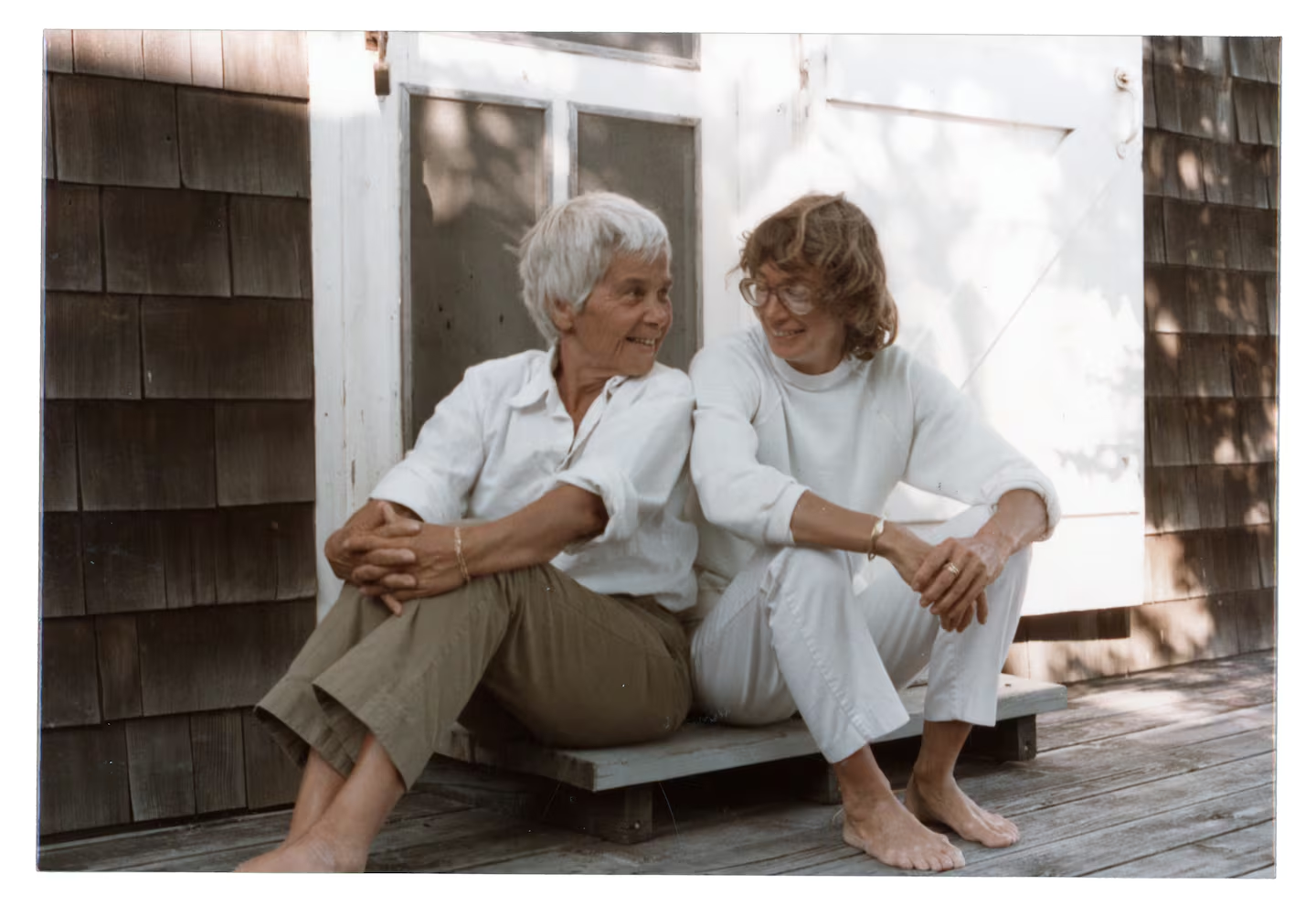
Director Sasha Waters on creating a ‘poetic visual experience’ for ‘Mary Oliver: Saved by the Beauty of the World’
When you hear a Mary Oliver poem and close your eyes, what do you see?
“Whoever you are, no matter how lonely,/ the world offers itself to your imagination,” Oliver wrote in one of her most celebrated poems, “Wild Geese.”
Oliver had a gift for transforming an evening walk into something transcendent. That quiet sense of wonder at the splendor of nature is at the heart of director Sasha Waters’s new documentary, “Mary Oliver: Saved by the Beauty of the World.”
The film, which comes out on Friday, explores Oliver’s life, philosophy, and enduring legacy through archival material, interviews, and readings of her best-known poems by some familiar faces, including Stephen Colbert, John Waters, Helena Bonham Carter, and Steve Buscemi.
Q. For those who are just discovering Mary Oliver, how would you categorize her beyond just being a nature poet?
A. She definitely did not like categories of any kind, so it’s hard to pin her down. She wrote about the natural world and was very inspired by it. She’s been called America’s best-selling poet, and I think that remains true and correct. She is as beloved as poets of earlier generations, such as Robert Frost or Walt Whitman. She speaks to people across all kinds of divides.
Q. What was the first thing that drew you into making this documentary?
A. Like many people my age or in my time cohort, I learned about a lot of poems and poets from something called “The Writer’s Almanac,” which was a short daily program on public radio in the 1990s — it might have started in the ’80s, but definitely in the ’90s and into the early 2000s — hosted by Garrison Keillor. The first poem I ever heard by Mary Oliver was “When Death Comes.” That was in the early 2000s, and I’ve just been a huge fan ever since. I’m also a really big fan of her essays; she has a collection called “Upstream”that is really wonderful.
Q. Reading poetry is a very intimate feeling. How do you translate that on the screen for us?
A. So that was a challenge: wanting to use imagery that was evocative and poetic and metaphorical, but not too literal or on the nose. But ideally we wanted the whole imagistic approach to be a collage of different kinds of images: home movies, archives, other filmmakers’ images, to open it up so that hopefully people can have their own kind of poetic visual experience with it.
Q. Mary Oliver was a notoriously private person. How did you tackle this going in, knowing this?
A. Mary Oliver was a very private person. That’s why there’s very little video of her in existence. There is a lot of audio, because she did give readings and allowed those to be recorded.
Read more Ziggy Marley on his father, finding balance, and the 30th anniversary of the ‘Arthur’ theme song
If there was something she didn’t want us to find, we didn’t find it, because it wasn’t there. As John Waters says at the end of the film, “If there was something Mary wouldn’t want me to tell you, I wouldn’t tell you,” and I’d riff on that by saying: If there was something Mary didn’t want us to find, it wasn’t in the archive.
Q. If you had to pinpoint the poetic emotional center — one poem that centers the whole documentary — what poem would you say it was?
A. I think it is “The Summer Day,” because it is literally the center of the documentary. We open with that poem, but Stephen Colbert can’t get through it, and then we come back to it at about the midpoint, with Stephen Colbert and the writer Jason Reynolds. The ending line of that poem — “Tell me, what is it you plan to do with your one wild and precious life?” — is a line that people who don’t know Mary Oliver, or who might not recognize the title of the poem, still know. So I think that’s the poem.
Q. How did your own perception of Mary Oliver’s work change while you were making this documentary?
A. I think it deepened through being exposed to so much of her work. She wrote two books on the writing of poetry — on craft — that are really books for teaching poetry. I read them initially out of a sense of obligation, like, “I’m a researcher, I need to read everything Mary wrote.” I thought, this is very specific, maybe a little niche, maybe not that relevant. But they were incredible.
Q. If there’s one thing we had to take away from Mary Oliver watching this documentary, what would you say that thing is?
A. It’s something you think about as a filmmaker: What do you want people to think and feel as they’re leaving the theater? I think if people leave feeling like they want to read more Mary Oliver, or they want to walk in the woods, then the film has done its job.
“Mary Oliver: Saved by the Beauty of the World” opens at the Coolidge Corner Theater July 17, with a national television release on Aug. 26 on PBS.
Read more Madison Square Garden sues Wired magazine over LGBTQ+ tracking report


Post Comment