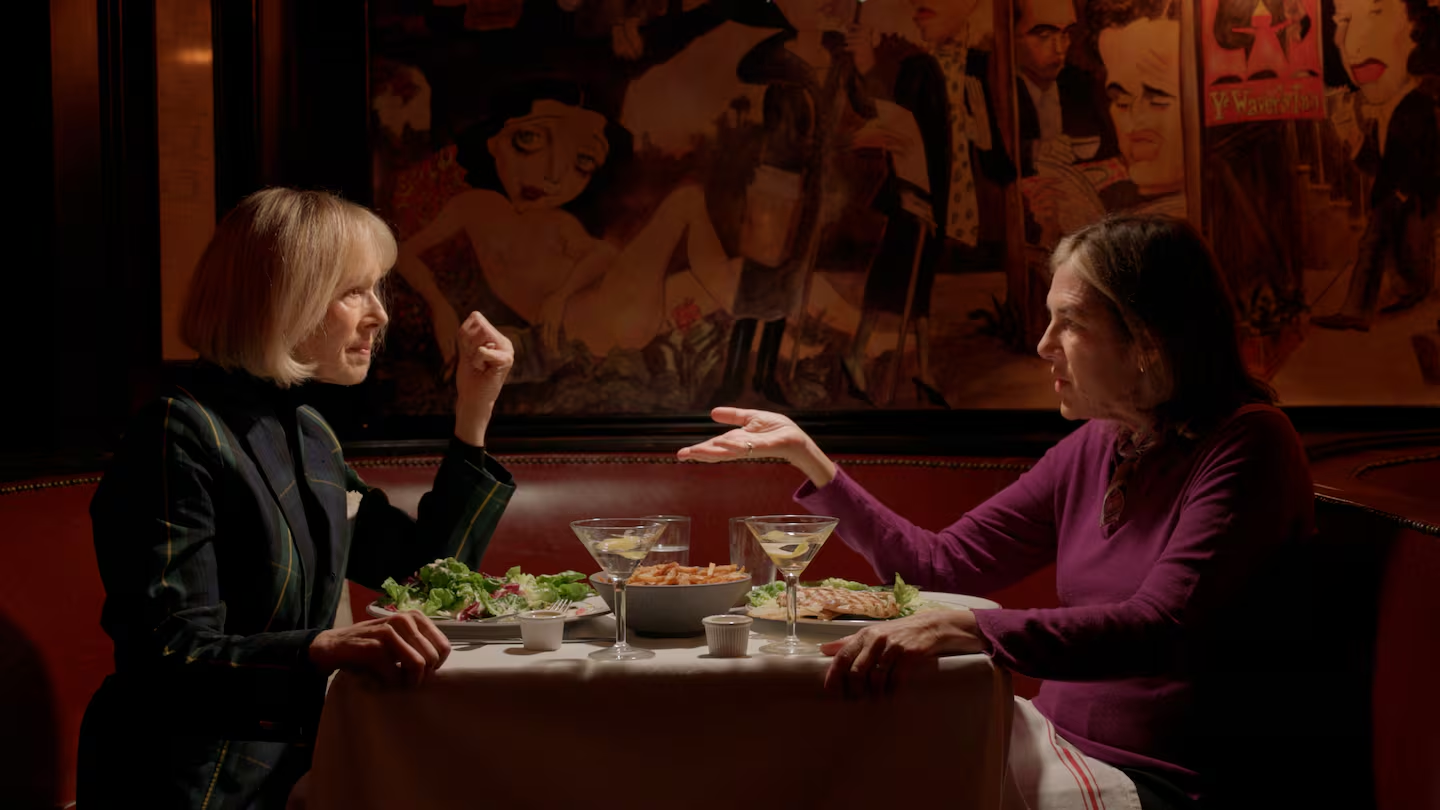
Filmmaker Ivy Meeropol talks #MeToo, Trump legal proceedings, and the making of her new documentary, ‘Ask E. Jean’
In 2019, Massachusetts-born filmmaker Ivy Meeropol read an article titled “My List of Hideous Men” in New York Magazine.
Read more Ziggy Marley on his father, finding balance, and the 30th anniversary of the ‘Arthur’ theme song
She wasn’t familiar with its author, but in the years that followed, she and her camera would come to know E. Jean Carroll intimately.
“Hideous Men” was an excerpt from Carroll’s forthcoming book “What Do We Need Men For?: A Modest Proposal,” and detailed 21 men whom she said had abused her — one such man being President Trump, who a jury found sexually assaulted Carroll in a Bergdorf-Goodman dressing room.
Meeropol, with a filmography that includes documentaries such as “Indian Point” (2015) and Emmy-nominated “Bully. Coward. Victim. The Story of Roy Cohn” (2019), sought to tell the story of not just the 1996 assault, but Carroll’s colorful life.
Carroll, a decorated reporter who is now 82, was a pioneer of Gonzo journalism — a kind of stylized, firsthand narrative writing — Playboy’s first female contributing editor, the voice behind Elle magazine’s “Ask E. Jean” (one of the longest-running advice columns in American history, published from 1993 to 2019), and the host of a daytime television show of the same name. Later: The first woman to defeat Trump in court. Twice. Once in a civil suit for sexual assault and defamation in 2023, and again in a subsequent defamation suit in 2024.
Meeropol’s documentary, “Ask E. Jean,” released in select theaters on May 22, spans Carroll’s early life all the way up to her second victory.
Ahead of a screening and visit to Coolidge Corner Theatre, Meeropol gave the Globe a behind-the-scenes look at the film.
Interview was edited for length and clarity.
Q. What was your initial reaction to reading Carroll’s excerpt in New York Magazine?
A. The #MeToo movement was such a galvanizing moment, and then it had been kind of declared dead, and I think that when I read E. Jean‘s piece, I thought, “It’s not dead.” There are so many other voices, including older women, that we don’t ever hear from, and that young women could really benefit from hearing from.
She was speaking, writing so honestly about the incident, and also in her incredibly entertaining and witty way. She was still expressing herself as an unapologetic, strong, hilarious writer, while telling this really difficult and painful story
Q. How did you get Carroll to agree to the documentary?
A. I wasn’t able to have direct conversations with her right away. It was kind of a back and forth … the question was, “Is E. Jean doing a documentary with any other filmmakers, and if she’s not, would she be interested in discussing the idea with me?”
She had told all of the filmmakers — I found out later that [there were] quite a few pursuing her, it wasn’t just me — that she wasn’t interested at all. So I kept at it, and eventually a mutual friend who worked at Elle magazine (I guess E. Jean had mentioned to her that I was one of these filmmakers who was trying to talk her into a documentary) said, “Oh, I know Ivy. I know her work. You should watch some of her films before you say an absolute no.” And so she watched a film I made that same year about Roy Cohn for HBO, and she said she was just blown away by it … now she likes to say that when she watched the film, she knew I wouldn’t be afraid of Donald Trump.
Q. Although you couldn’t have predicted the outcome of the lawsuits, how much of the film had you conceptualized when you pitched it to Carroll?
A. Oh gosh, hardly anything, really. This project was born out of an instinct I had just reading her piece. … I didn’t know the extent of her career or what an incredible character she is as a documentary subject.
Her voice really made me want to know more about her and hear more from her. … I didn’t set out with a big plan, because it was a process of discovery throughout, which is an exciting part of making documentaries, but it also can be hair-raising.
This was not just about Carroll v. Trump. I didn’t even know early on if she was going to make it to court, because the first battle was to prevent him [from] throwing the case to the [Department of Justice] … we were getting to record that in real time.
Q. You ostensibly became something of an E. Jean Carroll scholar over the years. What was it like to go back through her archives?
Read more Madison Square Garden sues Wired magazine over LGBTQ+ tracking report
A. I got to go to her storage unit, which is just a dream for documentarians — unbelievable amount of stuff packed in there, and just the life she led.
It’s hard to make a film about a writer in general, but a writer like E. Jean, who had appeared on so many shows and had her own television show during the exact time when she encountered Donald Trump at Bergdorf, it just felt like, “OK, this is meant to be.”
When we started mining [the VHS tapes], watching all those “Ask E. Jean” shows, it became a bigger story because it was about women, and what women were concerned with and asking for and fighting for. E. Jean was kind of at the forefront of that, encouraging women to be more independent, have careers, all during the ‘90s. It was so rich. I mean, there’s so much more that we could have put in.
The real sticking point was, how are we going to tell the story of the lawsuits, of that whole experience, when I had no access? … And then I learned that the depositions had been videotaped, and that if Robbie [Kaplan] and E. Jean signed them over to me, I could use them in the film. That would be the only way, and that’s what happened. And it’s just unbelievable. Those depositions are an amazing piece of material.
Q. How did you strike a balance between spotlighting the legal proceedings and spanning Carroll’s vibrant life and career?
A. That was our biggest challenge. This film was really built in the edit room. We had a rough cut at a certain point where there was too much Donald Trump. I think as a filmmaker, I had to really show some restraint.
We landed on “OK, let’s frontload the film with a lot of her career highlights and getting to know her,” and then introduce the story of what happened with Trump.
You know, you don’t see the shark in “Jaws” till three-quarters into the film.
Q. How did you build closeness, rapport, and trust with Carroll?
A. E. Jean and I became friends, and I can say that of other subjects that I’ve filmed over the years, but not like this. … I felt a real responsibility, but I think she got to know me. I mean, it was journalist to journalist. She was constantly asking me questions about my life, also.
I became part of an inner circle of just very few people who showed up at court for her who were privy to what was going on behind the scenes. Even if I wasn’t reporting it or documenting it for the film, I was experiencing it with her.
Q. In the documentary, there’s a decades-old panel in which Carroll suggests that Anita Hill was a “wimp” in the face of her assault by Clarence Thomas, and that if she were braver, she would have “dealt with it on the spot and not have brought it into the country.” How did you contend with complications in Carroll’s legacy?
A. Those are such important moments because I think they help us understand the world E. Jean was living in. … The instinct is to be like, “Oh my God, that’s so awful. How could you [say] that? How could you not understand what someone like Anita Hill was going through?” But I think it’s the perfect example of how women in general at that time had to accommodate — as Lisa Birnbach says even more clearly and devastatingly — the predations of men. They hadn’t seen a movement like #MeToo.
Q. There was a period of time during the legal proceedings when you didn’t have filming access. Why was that?
A. I didn’t want to interfere with the lawsuits in any way. One of the only things that the Trump team had against E. Jean was that somehow she was benefiting from coming forward with her story — that she was becoming more famous, that she was gonna make more money — it was an interesting realization for me that just my very interest in making a film about her could be used against her. … I’m not naive enough to think that Trump or his team wouldn’t try to go after me somehow, and they did. I was brought up in the trial.
Q. In late May of this year, shortly after the film’s release, the Department of Justice launched a criminal investigation into Carroll. Moreover, President Trump has persistently filed to avoid her $5.8 million payout from the sexual assault and defamation case and her $83.3 million payout from the second defamation case. Have you been following these appeals closely? Does it feel like the documentary is a story that could have gone on for many months more as a result?
A. Just the fight itself was the story. I’ve been in touch with E. Jean a little bit. She’s writing a new book and trying to focus on other things. But that said, [the legal proceedings were] a big surprise.
Read more Game 98: Will Red Sox make it 13 straight? Lineups and preview for series finale vs. Rays.
Q. What lasting impression do you hope to leave viewers with?
A. Taking from the title: Ask women what happened.


Post Comment