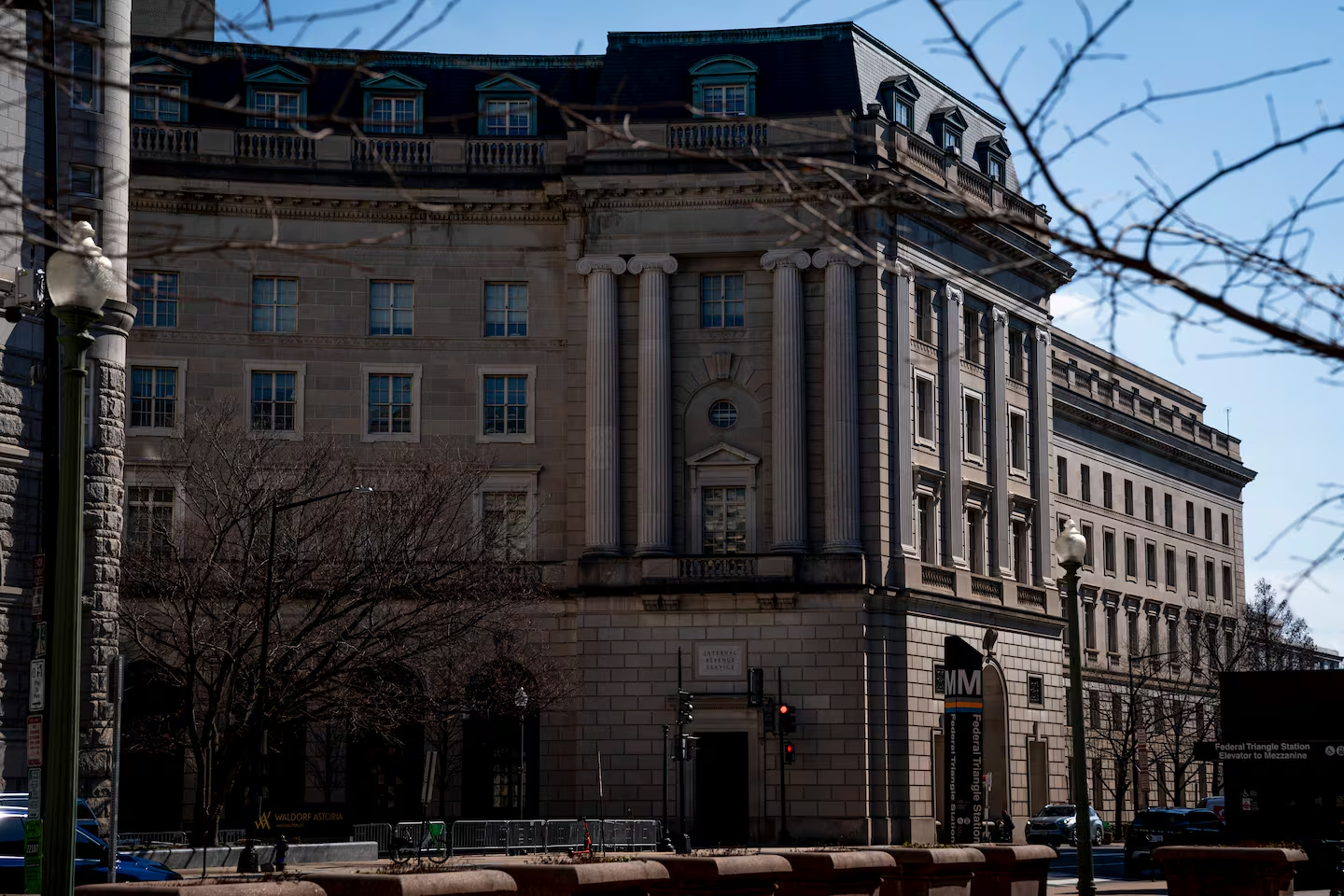
Judge denounces Trump’s IRS suit as improper exercise in self-dealing
A federal judge ruled Monday that President Trump’s lawsuit against the IRS was an improper exercise in self-dealing and barred him from claiming that the extraordinary tax protections he received were part of a legitimate settlement agreement.
Read more With threats rising, Supreme Court asks Congress to increase security funds
In the 56-page order, the judge, Kathleen M. Williams, also referred the lawyer who brought Trump’s case against the IRS to the Florida bar for potential disciplinary proceedings. She added that she would forward her decision to the New York bar for its continuing investigation of the acting attorney general, Todd Blanche, who faces a Senate confirmation hearing this week.
The decision by Williams, who sits in US District Court in Miami, did not explicitly kill the deal that Trump had worked out with his own government to receive what amounted to amnesty from IRS investigations. But the scathing ruling exposed the negotiations between Trump’s personal lawyers and senior officials at the Justice Department for what she says they were: backroom dealings that did not arise from a legitimate legal process.
“The nature of the suit itself and the conduct of the parties and counsel from its filing make plain that this was an attempt to use the court to provide some legitimacy to an agreement to confer immunity to people and entities affiliated with the president,” the judge wrote.
The ruling was the latest example of a federal judge calling out the Trump administration for twisting normal court procedures to the president’s advantage. Trump has repeatedly used the criminal justice system to pursue and punish those he believes to be his enemies. But in this case, Williams wrote, he sought to use the civil legal system to benefit himself, even though the law did not allow it.
“Whatever may be the parties’ wishes, inclinations or the dictates of their passion,” she wrote, “they cannot alter the state of the facts or evade the rule of law.”
In January, Trump sued the IRS, blaming it for the leak of his tax returns during his first term and demanding at least $10 billion in damages. But rather than taking the typical steps to defend the agency against Trump’s claims, the Justice Department instead reached what it called a settlement agreement that included two remarkable provisions.
The first created a $1.8 billion fund aimed at compensating allies of Trump who say they were the victims of so-called government weaponization. The prospect of Trump’s administration making extensive payouts to the people who stormed the Capitol on Jan. 6, 2021, immediately set off a political firestorm, and Blanche later said the Justice Department would not move forward with the fund.
But Blanche, Trump’s former personal lawyer, had also signed a separate order granting the president, his family, and their businesses wide-ranging, unprecedented immunity from tax inquiries. He directed the IRS to stop any active audits of the Trumps and told the agency to not conduct any new investigations of tax returns they had already filed.
That protection from audits, potentially very valuable for Trump, who has aggressively avoided taxes throughout his life, did not attract the same political pushback from the Republicans. Blanche has said it will remain in place.
Under Williams’s order, Trump and his family are prohibited from calling the audit protections a “settlement” in any official proceeding, but it is unclear if that will otherwise prevent Trump and the many companies affiliated with him and his family from relying on it to try to escape IRS scrutiny. An adverse ruling in just one IRS examination of Trump could have cost him more than $100 million, The New York Times has reported.
Experts have doubted whether Blanche even had the authority to direct the IRS to stop audits, and Williams said that his directive violated a federal law preventing the White House from controlling IRS investigations. It is also unclear whether the IRS has carried out Blanche’s order, now almost two months old.
In her ruling, Williams took direct aim at Blanche at a sensitive moment — days before he was to appear in the Senate for his confirmation hearing as attorney general. She wrote that she was “extremely troubled” by testimony he gave to the Senate in May when he asserted that the settlement agreement had never been submitted to a court because the case had been dismissed and there was “no mechanism” for reviewing the agreement.
“This answer is, at best, misleading and, at worst, disingenuous,” the judge wrote. “The court was available to review any pleading by any party at any time during this lawsuit.”
From the outset, Williams, an Obama appointee, had profound questions about Trump’s suit against the IRS. Because the president was seeking damages from a part of the federal government that he controlled, the judge was concerned that he was effectively suing himself and was on both sides of the case.
She spent much of her order fleshing out why that was indeed true, ultimately concluding that this suit lacked what all valid lawsuits must have: an actual controversy between two opposing parties. Williams pointed to the fact that the Justice Department never raised several possible defenses to Trump’s claims, including that he filed the suit after the statute of limitations for doing so. She also highlighted that Trump has sought total control over the executive branch.
“Whether executive branch actors can privately agree to give themselves and their former clients blanket immunities and billions of dollars in tax moneys for legally undefined grievances was never an issue advanced to this court,” the judge wrote. “The question is whether the parties could do so by claiming to be adverse and engaging the legitimacy of a court proceeding. The answer is a resounding ‘no’: The lead plaintiff and the government are one, a fully realized unitary interest.”
Beyond making referrals for Alejandro Brito, Trump’s primary lawyer in the case, and Blanche, Williams also said she would send her order to the District of Columbia bar for its investigation of Stanley Woodward Jr., a top Justice Department official who signed the paperwork creating the $1.8 billion fund. Another lawyer for Trump, Daniel Epstein, will be barred from making court appearances in the Southern District of Florida for one year.
Williams also opened up the possibility of Trump having to pay monetary penalties in the case. Several third parties have filed “friend-of-the-court” briefs in the case, and she said those lawyers could request reimbursement from Trump for their costs.
Read more ‘Vote her out!’ Protesters crowd Susan Collins’ Biddeford office after ICE fatally shot driver
This article originally appeared in The New York Times.


Post Comment