A breakdown of all things baseball — how it was, how it is, and how it will always be
It was the late, truly great Jimmy Cannon who, fed up with the chattering of his younger press box colleagues, reminded them precisely why they were so gathered in the first place.
Read more NBPA executive director David Kelly says second apron hurts players, teams, and fans
“Baseball, gentlemen, baseball,” he proclaimed.
And that’s what I want to discuss today: Baseball, gentlemen (and ladies), baseball. How it was, how it is, and how it will always be.
Let’s first go back to the winter of 1998-99. Mo Vaughn, our beloved “Hit Dog,” has fled Anaheim for lotsa cash. But general manager Dan Duquette has good news for the Red Sox faithful, the gist of it being, “I’ve just got you Jose Offerman from the Royals, and, boy, does he have a good on-base percentage.”
Oh, how we all snickered and scoffed. “On-base percentage? Who gives a, well, you know …”
Little did we know that we were at the beginning of the end of batting average as a ballplayer’s valid measuring stick, nor did we know that were going to soon be confronted with another acronym: OPS, on-base plus slugging.
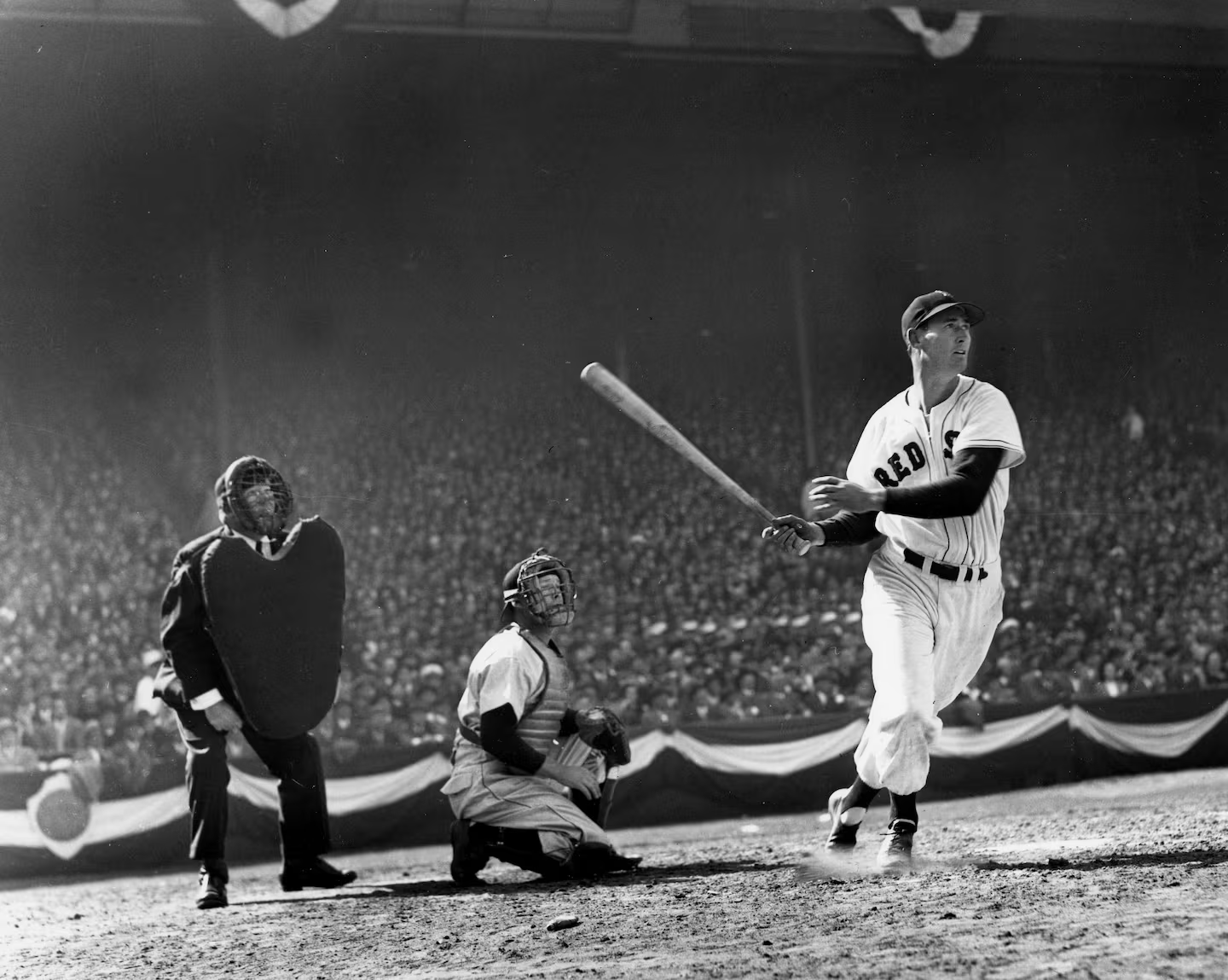
No one particularly cares about batting averages any longer. Forget about Ty Cobb’s 12 batting crowns, or the five batting titles accumulated by our own Wade Boggs. Fortunately, we have a local dispensation enabling us to forever rhapsodize about Ted Williams and his epic .406 in 1941.
But those days are gone. Just stop the next thousand self-professed baseball fans on the street and ask how many can tell you about Luis Arraez. Very few, if any, could tell you that he is a second baseman for the Giants who is playing for his fourth team in five years despite being a three-time batting champion along the way. He doesn’t walk much and he doesn’t hit for power, and when your OBP (.346) only exceeds your batting average (.314) by 32 points — as it did in 2024 when he was traded from the Marlins to the Padres during the season — you really aren’t valued.
Of course, all you have to see is the paucity of .300 hitters in 2026 to know how things have changed. That we can attribute to the part of baseball that has radically changed: pitching.
Remember the thing known as a complete game? Remember when pitchers threw 300-plus innings? (376, 327⅓, 308⅔, and 308 between 1971-74 for Mickey Lolich.) Teams got by quite well with 10-man staffs. If you wanted to win a Cy Young Award, you’d better win 20 and you’d be safer with 25.
Things were simpler then. Pitchers threw fastballs, curves, sliders, sinkers, changeups, knuckleballs, and occasional screwballs. Somewhere along the way we got a “cutter” and now we have the “sweeper.”
Really? Label me an ignorant 20th century diamond luddite, but will somebody tell me the difference between Steve Carlton’s legendary hard slider and Mariano Rivera’s legendary cutter? Both were pitches that looked like fastballs until moving horizontally at the very end.
Read more Aidan Emmerich heats up in afternoon to win 118th Massachusetts Amateur
Sweeper? What could it possibly do that no curve, slider, or changeup has never done previously?
Announcing has become more of a challenge. They have to identify a four-seam fastball, as opposed to a two-seamer and a sweeper, as opposed to a curve. How can they try to convince us that the last pitch was a sinker when it was around the batter’s neck? Wouldn’t they all like to have Tim Wakefield back? No guesswork there. He made it easy.
We are bombarded by the minute with data. How did I ever become a devoted baseball fan without knowing the launch angle, bat speed, and exit velocity of every home run hit by my boyhood idol Ted “Big Klu” Kluzewski? But somehow I persevered and got through.
Now, I do like the instant measurement of every contemporary home run. If only this data were retroactive. Just how majestic were some of the titanic home runs off the bat of the celebrated Josh Gibson? I suspect we’d all be very impressed.
That brings us to velocity. A pitcher’s has become the be-all and end-all of his craft. Warren Spahn, he of the 363 victories and 13 20-game seasons, framed pitching as living off the 2½ inches on each side of the 17-inch home plate and keeping batters off-balance. I wonder if he even threw 90 miles per hour. I’ve long wondered the same about Greg Maddux, winner of 355 games without remotely sniffing 100.
All this velocity business does have me wishing we could backdate the technology. The average fastball is way faster now. According to ESPN’s Jeff Passan, 20 years ago, the fastball average was 91-plus m.p.h. Now? It’s 94 and rising. You can bet that every game has multiple 98, 99, and 100 m.p.h. fastballs.
I would sure like to know how fast Bob Gibson and Sandy Koufax really threw. I’d love to go all the way back to the first famous flamethrower, Amos Rusie, the “Hoosier Thunderbolt” of the 1890s. Walter Johnson? Of course. And Smokey Joe Wood, whom Johnson said threw harder than anybody. The list goes on: Lefty Grove, Dizzy Dean, Bob Feller, Van Lingle Mungo, Rex Barney, Ryne Duren, Jim Maloney. We’ll never know.
All I want to say about defense is that I am proudly skeptical of so-called defensive metrics. I will stick with the good old eye test. So sue me. I profoundly believe we are in the Golden Age defensively of shortstops and center fielders. I don’t need no stinkin’ data.
The fortunate thing is that the essence, beauty, and drama of what I maintain is the greatest game ever to spring from mortal man’s mind remain intact. Baseball has the pitcher-batter, game-within-a-game like no other. There is more conversational fodder available in baseball than in any other sport. As haughty as this sounds, baseball truly is the thinking man’s game.
Read more Wellesley’s Michael Thorbjornsen, Matt Fitzpatrick atop leaderboard as fog delays Scottish Open
Oops, almost forgot. WAR? Bah! You don’t want to get me started.



Post Comment