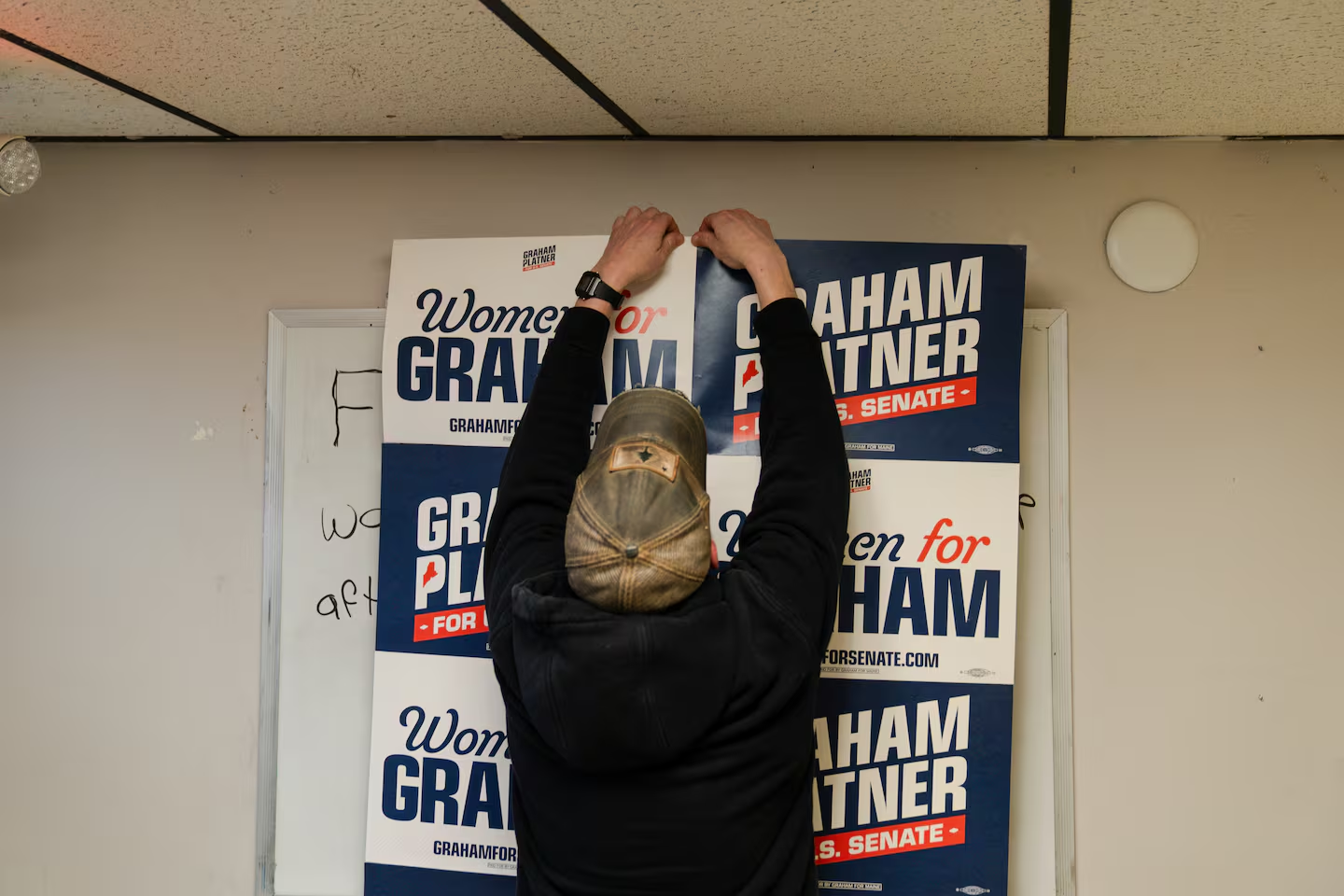
Why some women in Maine are mourning the end of Graham Platner’s campaign
BELFAST, Maine — Cory Upton-Cosulich sat in a parked car by a hiking trail in Maine this week, fuming over the implosion of Graham Platner’s Senate campaign.
Read more Boston Legacy’s Sophia Lowenberg goes out on loan to Super League club
Her anger wasn’t directed at him.
It was aimed at the powerful people far away from her working-class harbor town who, one after the next, had rescinded their endorsements of a candidate she supported in the Democratic primary last month. The feeling was familiar — watching people in Washington decide who should represent her.
She said she believed the woman who had accused Platner of rape, a claim he has denied. She believed the other allegations, too. She decided to support him anyway, because he had promised to work on her behalf, and she believed him.
“Establishment Dems are clutching their pearls because they don’t have him on a leash,” Upton-Cosulich, 40, typed into the box on Facebook asking her what was on her mind as she sat in her car. “The people of Maine want change.”
Democrats at every level of the party assumed that women who had supported Platner would be thrilled that he was being pushed out of the race. Instead, some women in this independent-minded slice of the country who powered the progressive upstart’s meteoric rise are angry and grieving.
Some of their pain stems from the loss of a candidate who put words to their frustrations with a political system that they feel makes their lives harder, not easier. Platner, they said, made them believe that a different reality was possible. His vision resonated so deeply that neighbors who had spent a decade disagreeing found common ground in someone who sounded like them.
That excitement was powerful enough for many women to push past their own feelings, after a monthslong trickle of unsavory revelations, that Platner was a morally compromised candidate. He had weathered scrutiny over a tattoo that is widely recognized as a Nazi symbol, a history of offensive online posts and a series of allegations by women he had dated that he had acted in disturbing ways.
“I supported him with trepidation,” said Kat Higgins, 64, a retired nurse, on a power walk through the coastal city of Belfast this week. “I was giving him the benefit of the doubt because of the bigger picture.”
This week, as news spread that Platner had withdrawn from the race, The New York Times spoke with more than 40 women along Maine’s coast about why they felt that he had deserved their support.
Many of them explained that, after falling in love with his movement and its possibilities, they placed just as much blame on the leaders who had elevated Platner, and their failure to find someone less fallible, as on the candidate himself.
“It’s not as simple as we need to protect women,” said Libby Davis, 34, the owner of a raw bar and event company in Portland. “As much as yes, we believe the stories of survivors and that stuff needs to be taken seriously, there is grief there, too, because he was so relatable to Mainers.”
Davis said she was glad he suspended his campaign, given the seriousness of the latest accusation.
Several women said they recognized Platner’s swaggering style from men in their lives who had hurt them.
They supported him anyway, at least until this week, because he cared about their medical bills, had ideas to make housing more affordable and seemed to be a normal guy who meant what he said and took responsibility for past mistakes. They saw him as a potential answer to a leadership void they believed existed on the left since former President Barack Obama left office.
Read more Game 92: Red Sox at Mets lineups and notes
“We were all fired up,” said Nettie Nelson, 77, who worked in a local superintendent’s office near her home in rural Clinton, Maine, before she retired. “I’m disappointed, to say the least.”
Whether Democrats can reenergize the Platner coalition in the coming sprint to replace him on the ballot is one of the questions hanging over the party. Defeating Sen. Susan Collins, the five-term Republican who voted to confirm Justice Brett Kavanaugh of the Supreme Court, became a rallying cry for Platner this year. He also liked to say that Democratic control of the Senate this year runs through Maine.
Now, for many of these women, that prospect feels dim.
As recently as late June, a slight majority of women — 52% — said they supported Platner, according to a New York Times/Portland Press Herald/Siena poll.
Some of them have not ruled out supporting Collins now that Platner is out of the race. Collins has held onto her seat despite the state’s Democratic tilt, largely because moderate and independent women were willing to split their ticket to support the longtime senator. Joan Merriam, 79, a lifelong Democrat from Rockland, Maine, was planning to cast a reluctant vote for Platner until she saw a woman on the news accuse him of rape.
The moment she heard what he allegedly did, she said she decided to “plug my nose” and vote for Collins.
“Here in Maine, we are practical people and have a sense of morals,” she said. “We’re not going to tolerate that.”
Now, Merriam, a retired teacher, said she was interested in Troy Jackson, the former president of Maine’s Senate, and in Nirav Shah, former director of Maine’s public health agency.
Upton-Cosulich, 40, is a mother, a pottery studio owner and a survivor of abuse who said she had made a point of teaching her young daughter that Collins did not represent the interests of women.
Although she believes the woman, Jenny Racicot, who said Platner had raped her, she also believes, with just as much conviction, that politicians in Washington are corrupt. Not only had many of them, including President Donald Trump, survived their own allegations of sexual assault, but they seemed to have lost sight of their main responsibility to the regular people who had elected them, Upton-Cosulich said.
How else could it be that, after years of promises, she still could not afford medical checkups? With a deductible north of $10,000, she said she had to weigh whether a mammogram was worth the $450 price tag.
She was in the kitchen of the house she cannot afford to buy when she learned that Platner had suspended his campaign.
The feeling reminded her of 2016, when she read reports that officials with the Democratic National Committee had privately derided and mocked her preferred presidential candidate, Sen. Bernie Sanders of Vermont. The revelations convinced her that the fix had been in for his primary rival, Hillary Clinton.
Her emotions this week also brought her back to the way she felt in November 2024, when she was handed a ballot featuring former Vice President Kamala Harris, a candidate she never got to choose.
Read more Boston Globe All-Scholastics: Meet the top athletes of the 2026 spring high school sports season
She had wanted 2026 to be different.
This article originally appeared in The New York Times.




Post Comment