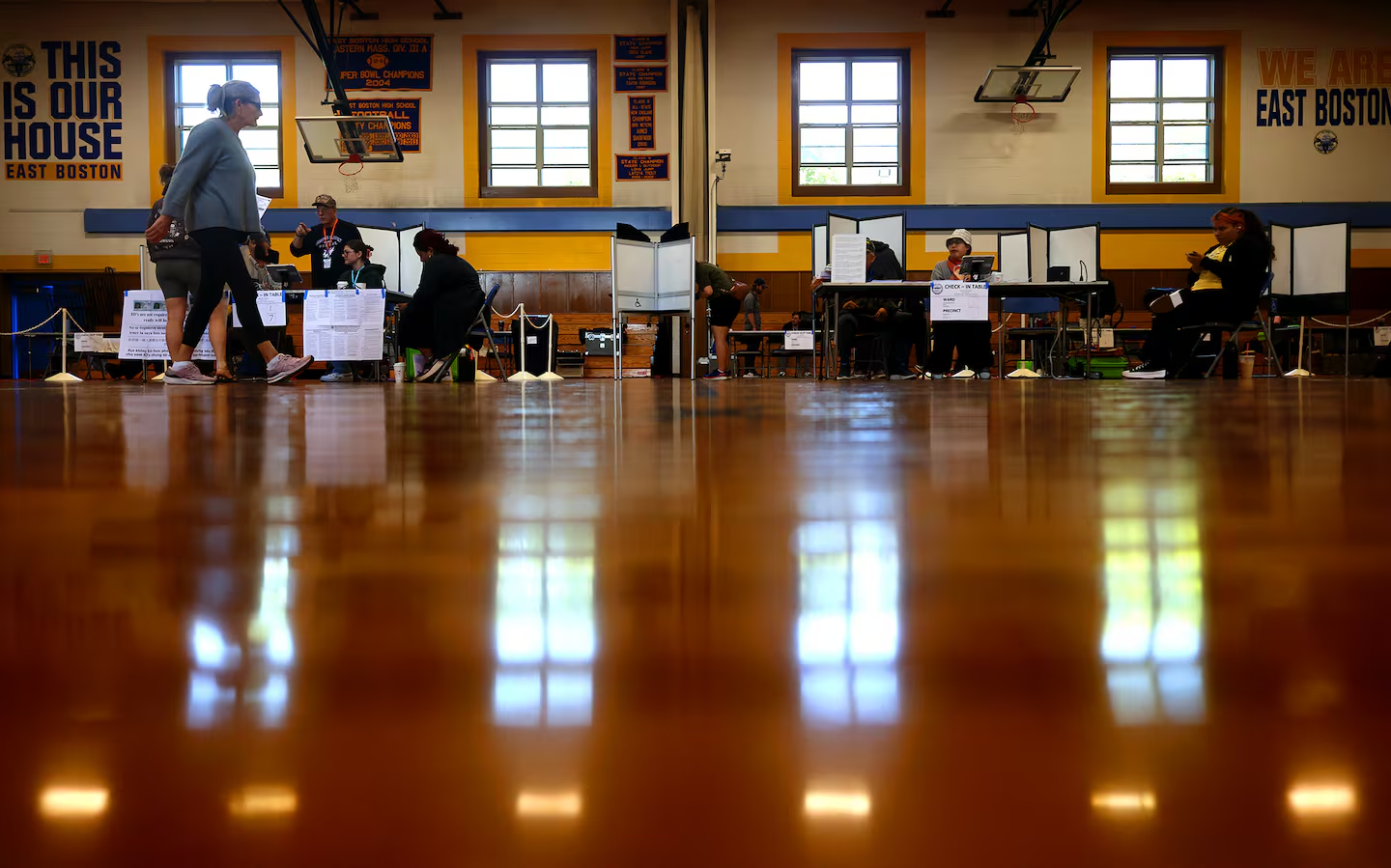
Federal election monitors deploying to Mass. and N.H. for September primaries
When voters in Boston and three other New England cities head to the polls for their state primaries in early September, federal election monitors will be on site to keep watch as ballots are cast and counted, according to the Justice Department.
Read more Eight men indicted in alleged planned drone and sniper attack on White House UFC cage-fighting show
Harmeet Dhillon, an assistant attorney general for civil rights, announced plans earlier this week to dispatch monitors to more than a dozen jurisdictions in six states, including Massachusetts and New Hampshire. A spokesperson confirmed Thursday that those locations include Boston, New Bedford, Manchester, N.H., and Nashua.
Dhillon described the move as routine, noting that prior administrations had similarly sent election monitors across the country. Federal personnel have, in fact, observed voting in several other Massachusetts cities in recent years, including during Republican and Democratic presidencies.
In her announcement on social media, Dhillon said the election monitors were being sent to cities where “there may have been some problems in the recent elections.” Without elaborating on those past problems, she said the monitors will watch for potentially illegal barriers to access while shoring up voter confidence.
“It’s also important to make sure that our voting is accurate,” she said, “so that every citizen who votes has their vote counted equally without being canceled out by somebody who shouldn’t be voting.”
The context of the move is stoking concerns, especially among Democrats, who object to the pressure campaign that the Trump administration has been waging to exert more influence and control over how states manage their elections ahead of the midterms that will determine who holds congressional power for the rest of Trump’s time in the White House.
The Justice Department has sued 30 states and Washington, D.C., to compel them to give the federal government access to their full voter registration lists, ostensibly for the purpose of purging names of ineligible people.
Eleven of those cases — including in Massachusetts, New Hampshire, , and Rhode Island — have been dismissed on the merits, as administering elections has long been the purview of state governments. None of the cases has been decided in the federal government’s favor.
With a losing track record in court, the Trump administration has sought to achieve similar ends by other means. The president has pressured Congress to pass the SAVE America Act, which would require states to share their voter rolls, though he recently acknowledged the measure likely lacks the votes needed to pass.
His administration has also threatened to withhold some federal grant funding from states if they don’t verify the citizenship of all registered voters. Dhillon sent a letter Tuesday warning top state election officials they could be criminally prosecuted if they knowingly allow noncitizens to remain on the voter rolls.
“We encourage you to contact us to discuss what steps your state should take to maintain clean voter lists as required by law,” she wrote in the letter.
Massachusetts Secretary of State William F. Galvin, a Democrat, said Dhillon’s letter was “far more adversarial” than what he’s seen in the past, which influences perceptions of her other actions.
“We’ve had a long history of having observers from the civil rights division and others come and look at various locations,” he said, “and we’ve cooperated with them and encouraged them to observe. … This has a different tone to it.”
Galvin said the letter continues a pattern in which the Justice Department has endeavored to “fulfill Trump’s fantasies.” The president and his loyalists, including Dhillon, have long claimed without evidence that widespread fraud and noncitizen voting had illegitimately caused his 2020 electoral defeat.
Robert Weiner, director of the voting rights project for the Lawyers’ Committee for Civil Rights Under Law, said the administration’s current efforts may be designed for something other than protecting election integrity.
Read more Can Trump’s arch be so tall? A panel may redefine a law to get to yes.
“I predict that the president is trying to create chaos and then use that chaos to take drastic measures in states that oppose his policies or to refuse to recognize the results of the elections in those states,” Weiner said.
Galvin said the federal election monitors will be welcome to observe voting in Massachusetts, but the state won’t tolerate interference or voter intimidation.
“That’s just not going to happen,” he said.
New Hampshire Secretary of State David Scanlan, a Republican, released a copy of Dhillon’s letter to the Globe on Thursday, but declined to comment on its contents. A spokesperson said Scanlan’s office had not received any communications from the Justice Department regarding election monitors, as of Thursday morning.
Scanlan has said illegal voting is very rare in New Hampshire, but does happen. Voter fraud by non-citizens is even rarer.
A federal judge who recently blocked New Hampshire’s proof-of-citizenship law for voter registration found that the evidence showed only eight people had been identified as non-citizens who potentially voted in New Hampshire at any point between 1998 and 2024. Only one of them, 35-year-old Naseef F. Bryan of Manchester, has been criminally charged with intentional voter fraud. Jury selection for his trial is scheduled to begin in August.
Olivia Zink, executive director of the nonpartisan nonprofit Open Democracy, which has been observing elections in New Hampshire for years, said Bryan’s pending prosecution shows the system is working. It also illustrates the strong incentives for green card holders to refrain from voting illegally, she said.
“If I were in that vulnerable position, I would not risk it by trying to cast a ballot,” she said.
Zink said she’s confident the federal monitors will see that those who run New Hampshire’s polling sites are committed to the law and doing a great job. What’s more, a federal monitor’s presence at the polls may help support the important principles of transparency and oversight, she said.
“It’s just another person to say ‘hello’ to when you go and vote,” she added.
Tom Murray, who cofounded the Government Integrity Project, a conservative grassroots group in New Hampshire, said he welcomes the election monitors and wishes the federal government would do more to shore up voter confidence. He expressed some surprise that the Justice Department isn’t sending monitors to Windham, N.H., where he has closely tracked elections administration since poorly folded ballots threw off the results of a local 2020 legislative race.
Murray, a Trump supporter, spoke highly of Dhillon, but said he agreed with Scanlan’s decision to withhold the state’s voter registration list from the federal government. Murray said he’d be “very reluctant” to support criminally prosecuting Scanlan for sticking to New Hampshire election law.
“We are a sovereign state,” he said.
Boston has had its own recent challenges with voting procedures. Galvin placed the city’s Election Department under state receivership in early 2025, citing “systemic” and “unacceptable” issues with administering the 2024 presidential election. Those issues included widespread ballot shortages, voting machine breakdowns, and a failure to answer more than a thousand phone calls from poll workers and residents who tried to report the problems.
The Boston Election Department forwarded questions to the mayor’s office, which did not immediately respond Thursday. The top election officials in New Bedford, Manchester, and Nashua did not respond to requests for comment.
The primaries will be held in Massachusetts on Sept. 1 and in New Hampshire on Sept. 8.
This report includes material from the Associated Press and prior Globe reporting.
Read more Replacing a Senate nominee is rare. Has it ever worked?


Post Comment