World Cup viewership numbers show Boston is a soccer town
This column is from Trendlines, the business newsletter that covers the forces shaping the economy in Boston and beyond. If you’d like to receive it via email on Mondays and Thursdays, sign up here.
Read more The Scots moved into his Wakefield Airbnb for the World Cup. The world watched.
The energy around the FIFA World Cup in Boston has been palpable. Local viewership metrics are backing that up.
Fans who watched United States stars Folarin Balogun and Malik Tillman score in the team’s knockout round win last week against Bosnia and Herzegovina helped Boston post the second highest viewership among local markets with a 13.1 rating, bested only by Kansas City.
The telecast was the most-watched English-language soccer telecast in US history. That is, until England beat Mexico on Sunday. Preliminary numbers showed nearly 22 million tuned into Fox for England-Mexico, and over 23 million watched Telemundo, but we’ll have to wait for additional data to see whether Boston was a top local market. (Same with the US loss to Belgium on Monday, a game that eclipsed the US team’s first round win against Bosnia and Herzegovina in viewers.)
The World Cup bump could be good news for local broadcasters, who are hoping to retain some of the viewers they brought in over the past month.
Scott Isaacs, the news director at Fox affiliate Boston 25, said in a statement that the station’s locally produced segments, specials, and exclusive coverage from Boston Stadium “have been well received and delivered significant viewership gains.”
It’s worth noting a few changes in how some of these numbers are collected. Ahead of last year’s Super Bowl, Nielsen announced it was expanding its out-of-home measurement, meaning it would count more viewers who watch live sports and programs at bars, restaurants, and other public spaces.That means this World Cup is difficult to compare to previous events.Still, there’s no doubt that the tournament has drawn a massive TV audience.
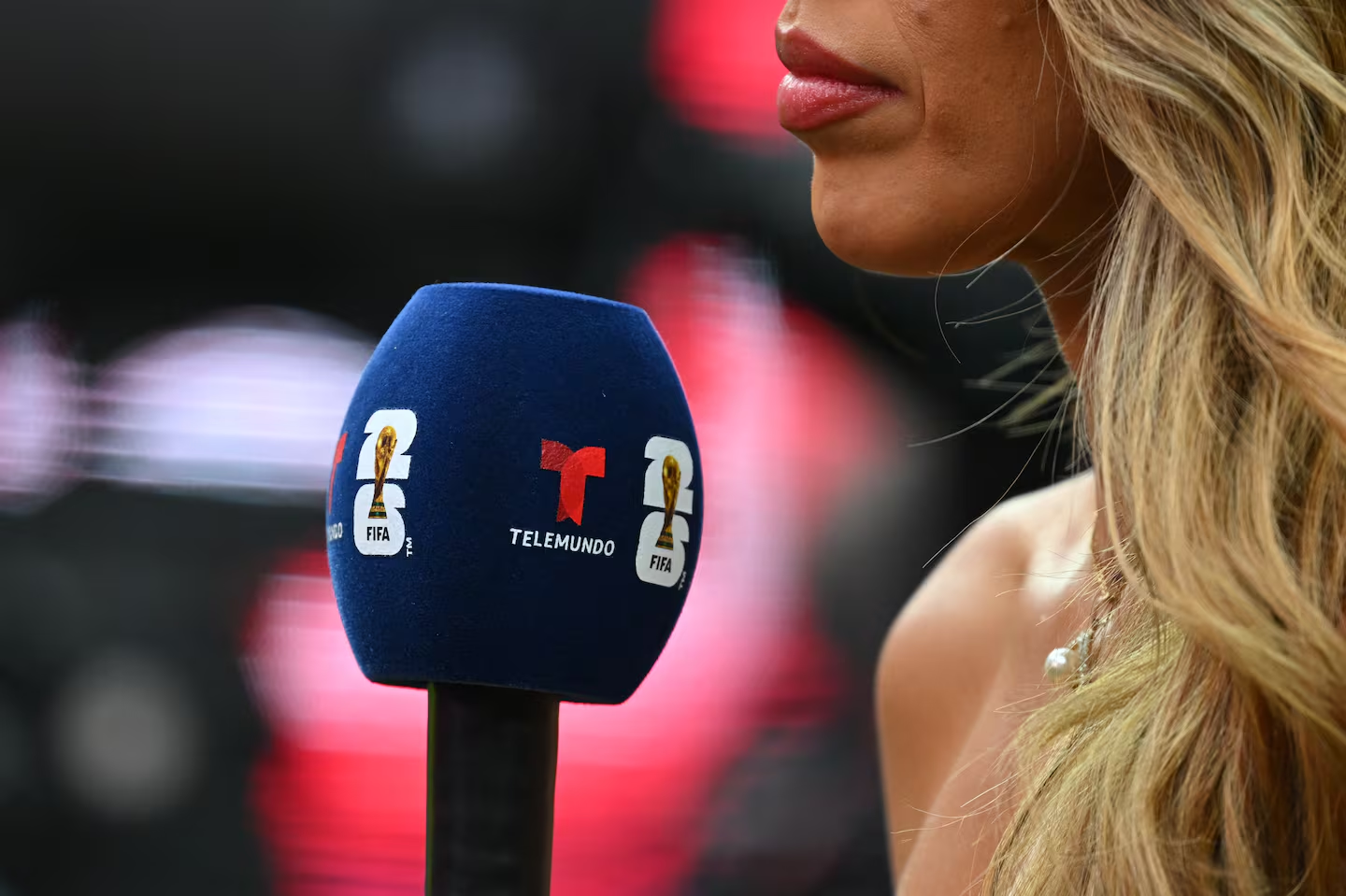
GOALLLLLLLLLLLLLL: Fox isn’t the only network breaking records. At Telemundo, fans are loving legendary broadcaster Andrés Cantor and the rest of the network’s team of commentators.
A spokesperson for NBCUniversal, which owns Telemundo, said that total viewership for the World Cup, which combines the traditional broadcast and streaming on Peacock, is up 34 percent in the Boston media market from the 2022 tournament. That translates to more than 400,000 on TV and 1.2 million unique viewers on streaming.
Clips of Telemundo broadcasters have gone viral on social media, including Cantor’s call of Lionel Messi’s game-tying goal in Argentina’s comeback win against Egypt Tuesday. Telemundo has said that it’s captured nearly half of the country’s World Cup audience, and NPR reported that 20 percent of the network’s World Cup viewership is made up of viewers who speak English as their primary language, citing Nielsen data.
“They call the game so much better,” said Cambridge resident Jared Payton, 55, who said Cantor is in the pantheon of sports broadcasters. “He matches the intensity, you want to listen to him even if you don’t understand what he’s saying.”
For some viewers, Telemundo was the better option because it presented more games over the air (other matches were available on cable channels), or it was cheaper to stream through Peacock. But there are many who actively chose Telemundo, partly because they dislike how the Americans have been calling matches.
Read more Revolution reportedly sign goalkeeper Matt Turner on another loan from Lyon
Bruce Ishikawa, 73, of Marlborough, said he thought US broadcasters overanalyzed matches, whereas the Spanish broadcasters were more energetic and called what they were seeing.
“In general, US sports announcers are wannabe coaches,” he said.
Soccer Town, USA: The jubilation of the World Cup in Boston — cemented early in the tournament when Scotland’s thirsty Tartan Army laid siege to the city — has led some to claim that Boston has always been a soccer city.
But how did it get there?
Charlie Davies, who grew up in New Hampshire and played for Boston College, the New England Revolution, andthe US Men’s National Team, said he was “a little taken aback” when he saw that Boston was a top three local market for USMNT games. But as he reflected on growing up here, he said soccer is really “ingrained” here, especially with how diverse Boston has become.
“A lot of people think of Boston in the traditional sense,” he said.. “Now it’s international and welcoming and warm, and I can’t tell you how many people have come into Boston and loved it.”
Gus Martins, a former Boston Herald sportswriter who covered the World Cup in 1994 and 1998, isn’t surprised by the massive Boston viewership for this year’s tournament.
Martins now drives a school bus in Belmont. He’s noticed a lot of kids who come onto the bus with shirts and jerseys sporting their favorite MLS, English Premier League, and international teams.
“They already know the game,” he said. “During my time, it would have been unthinkable.”
Final thought: Fox paid $485 million for rights to the tournament, per The Athletic. NBCUniversal reportedly paid $600 million for the Spanish language rights. Expect a bidding war for the next tournament.
This week, CNBC reported that FIFA is hoping to sell broadcasting rights to the 2030 games in Spain, Portugal, and Morocco to a single bidder to broadcast in both English and Spanish. The price tag could get up to $2 billion.
The success of this World Cup shows that Fox and Telemundo got the rights at a massive bargain. It also proves yet again that in an increasingly fragmented media landscape, live sports continues to be king.
Read more New attacks raise questions about what comes next in the Iran war
In other words, get used to the hydration breaks.



Post Comment