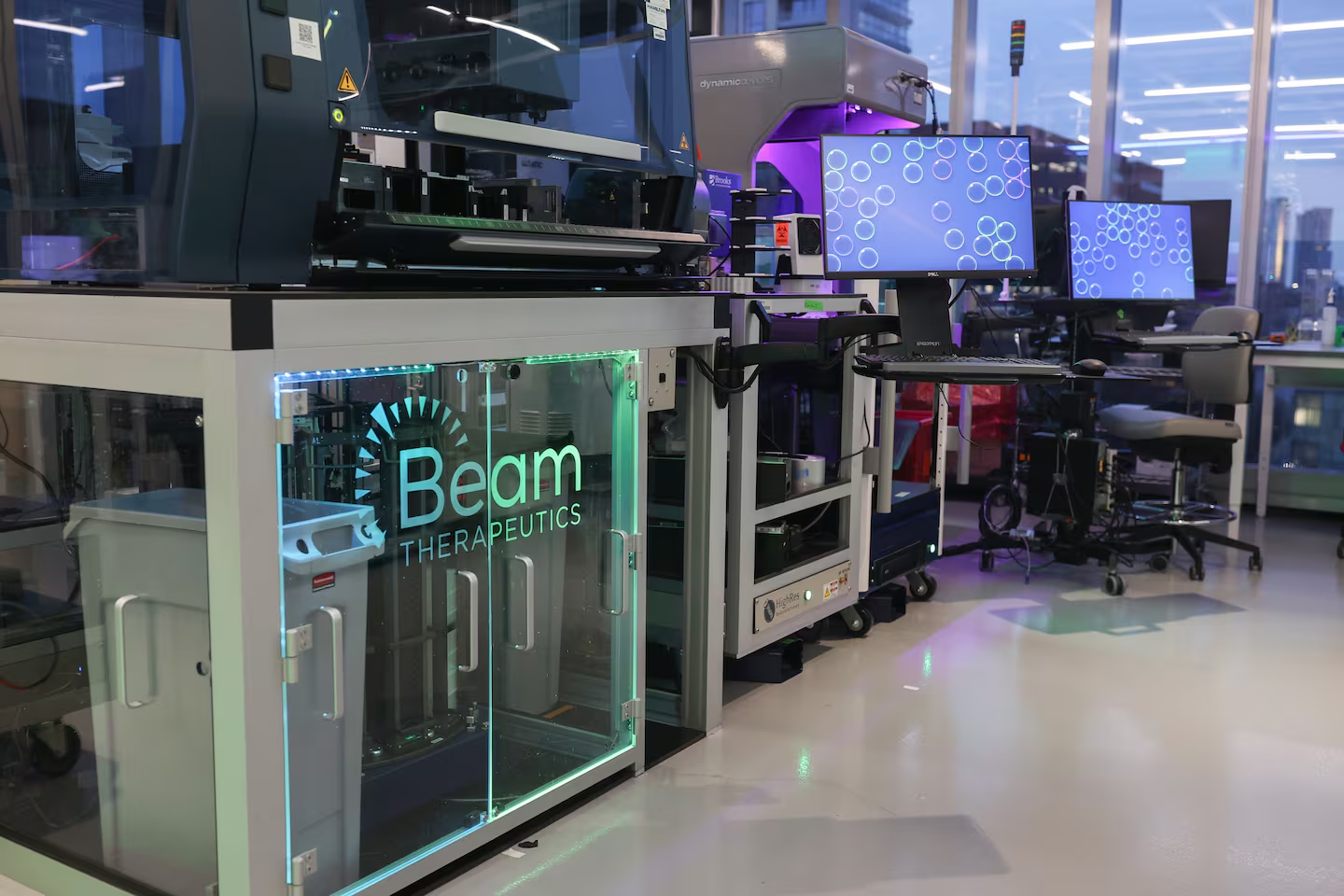
Prime Medicine claims victory in dispute over gene-editing technology with Beam Therapeutics
This story is republished from STAT, the health and medicine news site that’s a partner to the Globe. Sign up for STAT’s free Morning Rounds newsletter here.
Read more Jayson Tatum breaks silence on Jaylen Brown trade: ‘It’s tough’
Prime Medicine said Wednesday that it had won an arbitration dispute against Beam Therapeutics, resolving for now a clash that had pitted two well-backed gene-editing companies that had been spun out of the same lab against each other.
An arbitrator ruled that Prime’s work on a gene-editing drug for the rare liver disease alpha-1 antitrypsin deficiency, or AATD, did not violate a 2019 agreement designed to prevent the two Cambridge-based companies from competing against one another.
The ruling paves the way for Prime to start a clinical trial for AATD this quarter, lifting the biotech’s stock 11 percent Wednesday morning. The outcome, however, is a blow to Beam Therapeutics.
Beam’s own AATD program is in late-stage development and could be the company’s first blockbuster drug, but it has faced competition from a slew of competitors. Beam traded down roughly 2 percent.
In a statement, Beam said it “respectfully” disagrees with the ruling but indicated it believed the fight may not be over.
“As we have demonstrated with this process, we are and will continue to defend the innovative technologies, collaboration rights, and foundational patents in both base editing and prime editing that we have assembled,” the company said.
In an interview, Prime CEO Allan Reine described the dispute as being over — “We see this as binding arbitration,” he said — and added that its conclusion positioned the company for more success.
“So now we think we have the potential for two blockbusters,” he said, referring to AATD and a program entering the clinic for Wilson’s disease, a rare liver condition.
The dispute arose over a year ago, when Prime announced it had secretly been working on an AATD program.
AATD has become an increasingly hot target for CRISPR gene-editing companies, because it involves a single mutation in the liver — the easiest-to-reach organ with current gene-editing technology — and may affect around 100,000 people in the US, meaning any therapy could potentially bring in billions in revenue.
Prime’s decision was notable, however, because the company had seemingly handed over rights to work on AATD in 2019. Generally speaking, Prime and Beam were both built on cutting-edge gene-editing technology out of David Liu’s lab at the Broad Institute.
Read more Here’s your World Cup forecast for Foxborough’s final match Thursday
Beam was launched first, to commercialize base editing, a technology that allows scientists to turn certain DNA letters into certain other DNA letters. That includes the single-letter switch required to treat most AATD patients.
Prime came second, built around prime editing, a technology that allows scientists to turn any DNA letter into any other DNA letter, along with other changes. The tools overlapped.
To prevent the two from competing, Prime and Beam struck a deal. Beam gave Prime, among other things, assistance on delivery technologies required to get gene editing into the body.
And Prime gave Beam rights to use prime editing for any mutations that could already be treated with base editing. Prime would focus instead on a long list of diseases that could only be treated with prime editing.
Most of those diseases, however, were either very rare or affected hard-to-reach organs. After Covid, as the biotech market tightened and enthusiasm for gene editing waned, Prime’s stock tumbled.
It shelved many of its original programs and soon after announced work on AATD. For technical reasons, it’s possible that a prime-editing approach for AATD could be more effective.
The company argued its work did not violate the earlier agreement because its treatment made changes to patients’ DNA beyond the single-letter change strictly required to treat the disease. Beam disagreed.
The ruling now puts Prime in a better position than it has been in some time. In addition to the AATD program, the company believes it will soon be able to snare approval for a treatment for the rare condition chronic granulomatous disease — thanks to striking early data and an immense amount of Food and Drug Administration flexibility — and has its treatment for Wilson’s disease entering trials.
The fight, however, around AATD and gene editing is far from over. In addition to the dispute with Beam, at least two other companies — CRISPR Therapeutics and Tessera Therapeutics — are working on treatments Prime believes are essentially copycats of its technology.
“We’re going to very vigorously defend our intellectual property at the right time,” said Reine.
Read more Boston’s pro women’s baseball team, set to begin play in August, has a name
When was the right time?
“I’m not going to comment further than that,” he said.





Post Comment