Wanted: More corporate sponsors. Here’s why Sanofi stepped up.
In this edition: Chelsea slashes affordable housing mandate, Healey administration pulled into White Stadium fight, fans want new Celtics arena
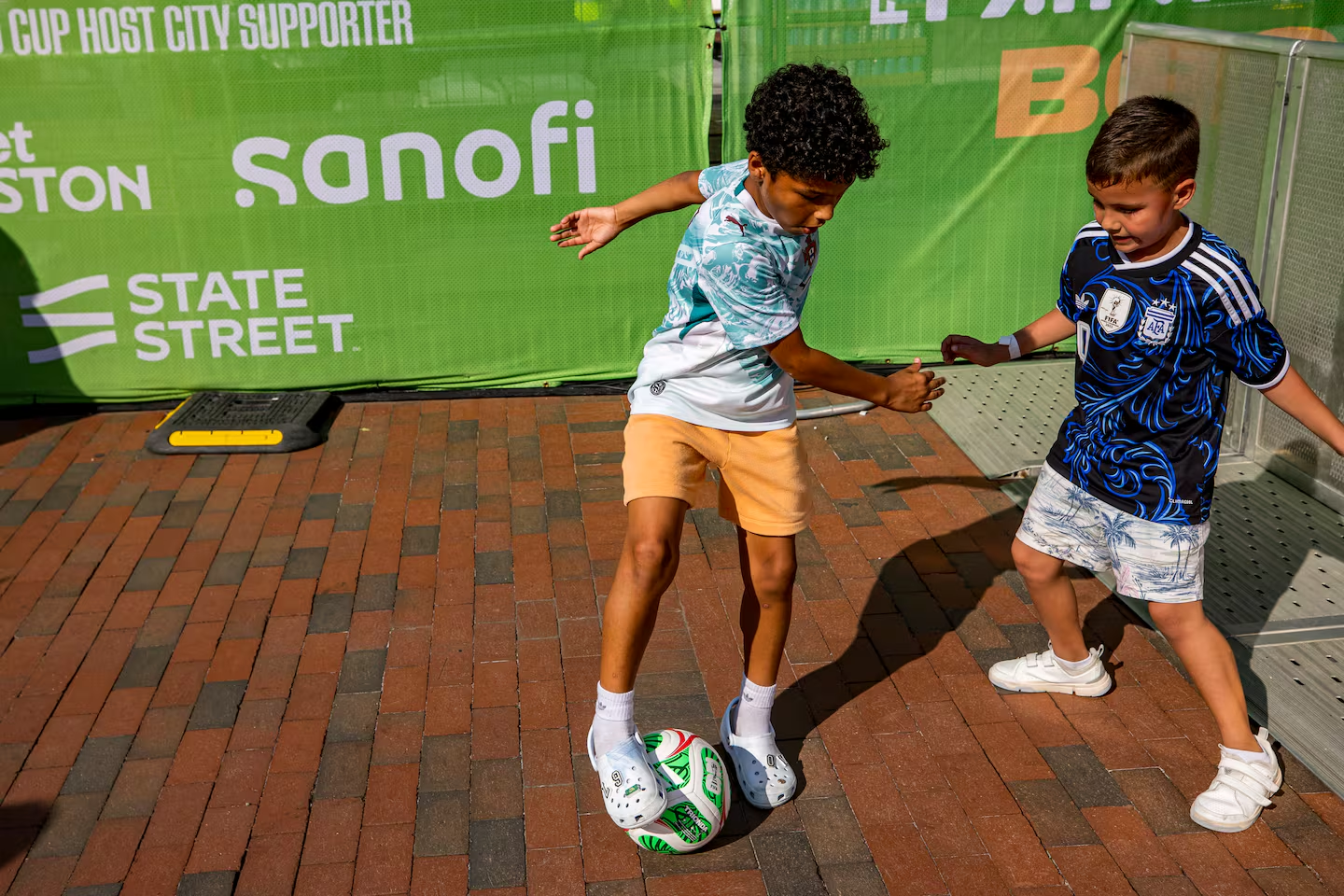
We’re back. Shirley here. Hope everyone had a great Fourth. Boston’s World Cup hosting duties come to an end this week with a final match at Foxborough. But the party continues with Sail Boston’s Tall Ships arriving this weekend. Someone has to pay for the costs of all these big summertime events. I take a look at why one company, Sanofi, decided to lean into the World Cup and America’s big birthday.
Read more Trump says Walmart cut prices at his request, but Walmart statement omits administration’s role
If someone has been sending you this newsletter, it’s time to get your own copy. Sign up at globe.com/powerplay.
Featuring: Deborah Glasser, Tanisha Sullivan, Bob Rivers, Fidel Maltez, Rebecca Tepper, Phil Eng, Dianne Wilkerson, Keith Lockhart, Marisa Sechrest, Spot, Bill Chisholm, Jaylen Brown, and more.
All we’ve heard for much of the year is how corporate sponsors have to be coaxed, even coerced, to pony up support for big local events, like hosting FIFA’s World Cup or celebrating the nation’s semiquincentennial.
Because, what’s really in it for them? It’s a fair question.
Then there’s Sanofi. The French pharmaceutical giant, which has about 4,800 employees in Massachusetts, stepped up to be major sponsors of both Boston Soccer 26 and MA250, the initiative behind a year-long celebration anchored by the July 4 Boston Pops Fireworks Spectacular.
“We weren’t going to let the semiquincentennial pass,” said Deborah Glasser, Sanofi’s US Country Lead based in Cambridge, where the company operates its North American research-and-development hub. “And then the World Cup coming is a once-in-a-generation moment. There’s no way that we weren’t going to show up.”
Sanofi is too discreet to say just how much it’s spending, but the scale suggests a commitment of several million dollars, which these days is notable. Of course, it probably helps that France is a favorite to take home the Cup.
Glasser experienced firsthand the emotional draw of a big global sporting event in 2024 when the Summer Olympics came to Sanofi’s hometown of Paris. The company was an official Olympic partner and flew in high-performing employees from around the world to volunteer. Glasser was among them.
“We’re two years out from the Olympics, and people within the company still talk about that experience,” she said.
With seven World Cup games scheduled at Gillette, Glasser wanted to replicate that experience for her 13,000 US employees. One program helped close to 600 Boston-area Sanofi workers volunteer at World Cup events like the FIFA Fan Festival at City Hall Plaza.
Another initiative brought in about 500 high performers from around the country for a three-day program in Cambridge to reflect on the next 250 years of scientific breakthroughs — and then they attend a World Cup game on the company dime. The final cohort arrives Wednesday ahead of the last game at Foxborough.
Beyond its employees, the World Cup and MA250 were chances to build community, said Tanisha Sullivan, Sanofi’s head of external engagement. The company helped underwrite not just the Fan Fest but also watch parties in Cambridge, Brockton, and the Seaport’s Lawn on D, plus the installation of mini-pitches in Cambridge and Framingham.
Read more Brigham and Women’s Hospital nurses walk out, beginning largest nurses strike in state history
Sullivan, who is also a leader at the NAACP, wanted Sanofi’s sponsorship dollars to flow to local small businesses. Some 65 vendors, including event planners like RoseMark Productions and Endless Flair, custom T-shirt maker Sterling Printing, and furniture rental firm Dez Collective, many run by women and entrepreneurs of color — got a chance for the first time to work with Sanofi, forming relationships with a $100 billion multinational company they hope to build on.
“That was really important to us,” said Sullivan.
Ultimately, organizing programs related to the World Cup and MA250 was about showing that Sanofi in particular and the life sciences industry in general can be bigger civic players.
“I hope that we can raise our profile not for the sake of raising our profile, but I hope that we can be a better corporate citizen,” said Glasser. “We are one of the largest industries in Boston, and I think our industry should be doing more within our community.”
Perhaps that’s starting to change. Looking at the roster of MA250 sponsors — recruited by Eastern Bank’s Bob Rivers, who chaired the MA250 Executive Committee — Takeda Pharmaceuticals, Vertex Pharmaceuticals, and Biogen also stepped up, joining corporate stalwarts Bank of America, Eastern Bank, Fidelity Investments, State Street, among others.
For consumer-facing businesses, it makes sense to have your brand out there. But life sciences companies don’t need to become household names in the same way. Sanofi makes vaccines and drugs to treat rare diseases and chronic conditions like multiple sclerosis.
Let’s hope this year’s events mark the beginning of a new chapter in corporate citizenship.
JON’S TAKE
What’s your take? Share in the comments here.
HEARD AROUND TOWN
CHELSEA SCALES BACK AFFORDABLE HOUSING
After months of debate, the Chelsea City Council voted unanimously in late June to scale back its inclusionary zoning regulations. Effective immediately, the city no longer requires housing developments to set aside 15 percent of its units as affordable. Now small buildings — under 10 units — have no requirement, while only developments with 50 or more units must be 10 percent affordable. The new policy also allows more units to be built for moderate incomes rather than low incomes, and slashes the fee developers can pay instead of building a unit to $275,000 from $400,000. “It was a really, really hard conversation for our community … many said we were selling out our community and favoring developers,” said City Manager Fidel Maltez, who pushed for relaxing requirements. “Our inclusionary zoning ordinance was too strict … so strict that it was preventing development.”
WHITE STADIUM FIGHT
Governor Maura Healey’s administration has largely stayed out of the fight over the rebuilding of White Stadium in Franklin Park. Maybe not anymore. Last week, top Healey aides – including environmental secretary Rebecca Tepper and transportation boss Phil Eng – met with stadium opponents at the State House to discuss their transportation concerns, according to former state senator Dianne Wilkerson. She said in a social-media post that her group, the Franklin Park Defenders, made the case that no new state permits should be issued for the project. She added: “Yeah, they took it seriously!” (The project is being pursued by the Wu administration and soccer team Boston Legacy FC.) While they wait to see if Healey’s people intercede, the opponents also await word from the Supreme Judicial Court; the court is expected to rule soon on the project’s fate.
THE DRONES MUST GO ON
Not only did “Spot,” Boston Dynamics’s robotic dog, make its debut with Keith Lockhart and the Boston Pops Fireworks Spectacular Saturday night, but so did 1,300 drones for a revolutionary-theme formation synchronized to a live performance of the “1812 Overture.” The drone show – the warm-up act to the fireworks – swarmed the sky for about 10 minutes featuring different animations from the Boston Tea Party to Paul Revere’s midnight ride. Nova Sky Stories, based out of Boulder, Co., put on the show under the direction of executive producer Marisa Sechrest, an Acton native who grew up going to the Esplanade on the Fourth of July. “Producing this sky story carried deep personal meaning,” she said. Nova Sky shows have also been popular entertainment at massive sporting events from the Olympics to this summer’s FIFA World Cup. “It’s a new form of storytelling,” Sechrest said, “with the sky as our canvas.”
YOUR TURN
Last week our colleague Catherine Carlock explored how the Celtics have been scouting potential locations for a new arena. We asked Power Play readers if the team should stay put at their longtime home at TD Garden, which is owned by the Jacobs family and where the Bruins play, or whether lead owner Bill Chisholm should build a new venue. Fans were loud and clear: 64 percent think the C’s deserve their own space. Our poll was conducted before the shocking Jaylen Brown trade to the 76ers in what appeared to be a money-saving move (or not). If asked today, we have to think fans would choose their beloved NBA All-Star over paying for new digs.
THANKS FOR READING POWER PLAY.
This newsletter was edited by Tim Logan and Greg Huang, and produced by Curt Woodward.
Have a question for the team? Email us at [email protected].
Delivered Tuesday and Friday.


Post Comment