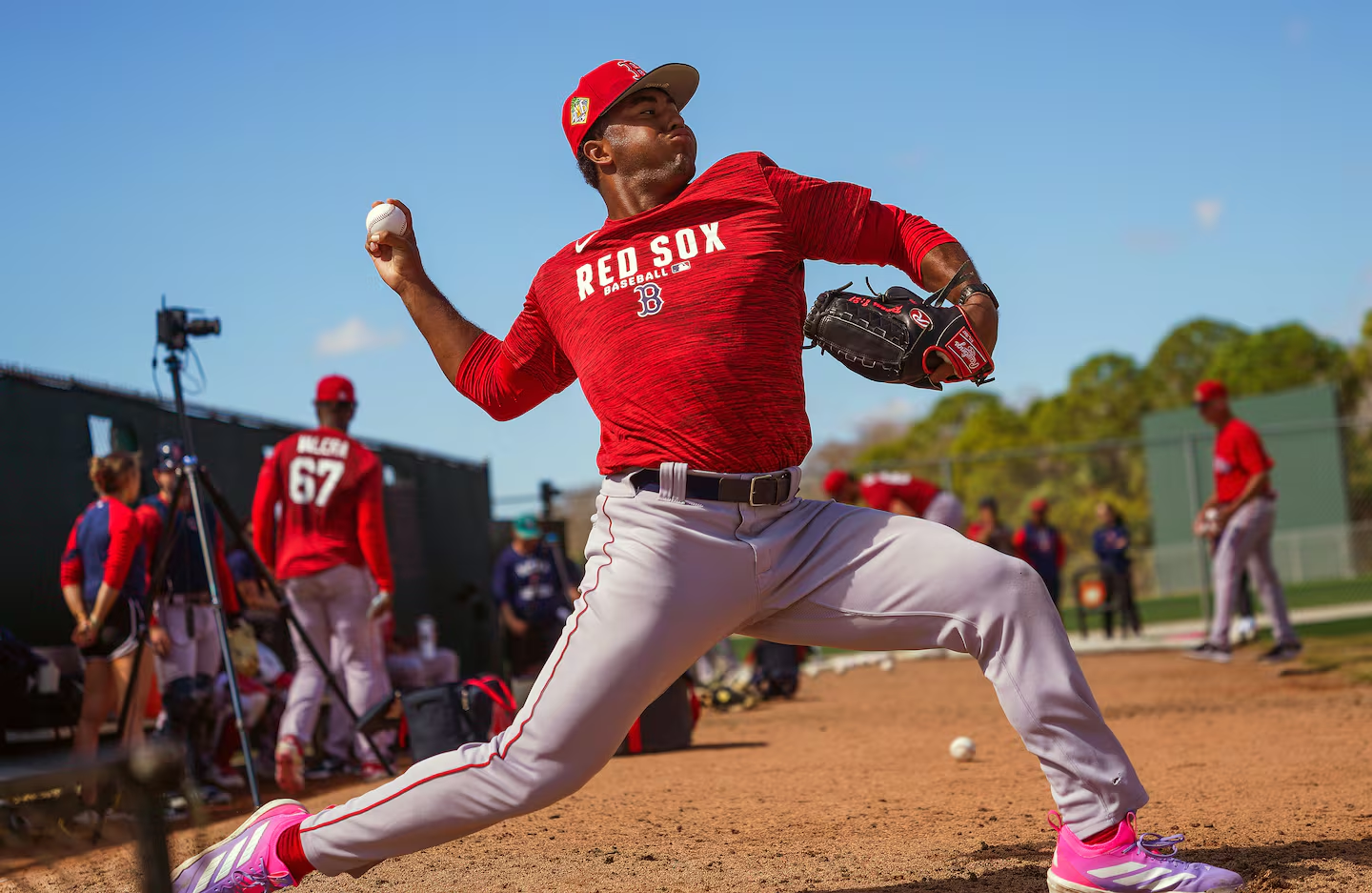
With the No. 20 pick in the first round of the MLB Draft, the Red Sox will select … who can say?
There was a time, not so long ago, when Red Sox drafts seemed like distant theoretical exercises.
Read more Is 80 too old for the Senate? Here’s what 80-year-olds (and almost 80-year-olds) think.
Top college talents often took at least three years to marinate in the minor leagues, while top high schoolers typically developed over four years or more before reaching the big leagues. There were prominent exceptions to that pattern (including Mookie Betts, Jackie Bradley Jr., and Andrew Benintendi), but those were seen mostly as outliers.
But in recent years, expectations have been reshaped around the industry — including with the Red Sox. The team’s roster features a heavy dose of recent draftees who flew through the minors, including Roman Anthony (2022 draftee out of high school, 2025 debut), Connelly Early (2023 draftee out of college, 2025 debut), and Payton Tolle (2024 college draftee, 2025 debut).
Against that backdrop, the challenge facing Jake Bruml is straightforward: Keep the pipeline flowing.
Bruml, who was promoted to director of amateur scouting this offseason after six years working alongside predecessors Devin Pearson and Paul Toboni (both of whom left the Sox for the Nationals last October), will be overseeing his first draft for the Red Sox this weekend.
The Sox picked in the top half of the first round with Pearson overseeing the draft from 2023-25, and jumped when standout college players who ranked among the top 10 picks on their board (catcher Kyle Teel in 2023, outfielder Braden Montgomery in 2024, and righthander Kyson Witherspoon in 2025) fell to them with their first pick. This year, the Sox will have to wait until the No. 20 pick.
What’s different about a draft where the Sox have to wait out the first 19 picks before their first selection?
“It remains actually quite similar. We’re crossing our fingers that someone from the top part of the board falls. Obviously the likelihood of that at pick 20 is less than when we were picking at 15 or 12,” said Bruml. “When we picked 15th last year, we had 15 scenarios that we planned for, so that way, when we’re drafting, there’s not too much maneuvering. We know exactly how we’re going to want to approach it. [This year], we’re going to plan for 20 different scenarios, so as [picks] go off in live time, we can just cross the next one off so we have a very clear picture.”
That said, when the Sox last picked in the second half of the first round under Toboni, they made strategy-driven selections, picking players who most expected to go later in the draft, signing them to bonuses below their MLB slot recommendations, then employing the unused money from their pool on prominent prospects who remained on the board.
In 2020, the Sox shocked the industry by taking Nick Yorke at No. 17, then selected slugging high schooler Blaze Jordan in the third round and signed him to an over-slot deal. In 2022, the team took projected second-rounder Mikey Romero at No. 24, then used some of his bonus pool money to draft Anthony and sign him to an over-slot bonus.
This year’s draft — for which the first four rounds will take place on Saturday, followed by the remaining 16 rounds on Sunday — might lend itself to more surprises.
There’s a cluster of standout prospects at the top — like UCLA shortstop Roch Cholowsky, Georgia Tech catcher Vahn Lackey, high school shortstops Grady Emerson and Jacob Lombard, UC Santa Barbara righthander Jackson Flora — a next tier of roughly a half dozen players, and then a draft class that is widely viewed as one of the deeper ones in recent years.
Read more Trump covets Greenland for its location. Here’s why.
“When you really get to 15 through even the 50-60 range, it gets really flat, because of the equal dispersion of talent in what seems like each of the four major demographics: college pitching, college hitting, high school pitching, high school hitting,” said Bruml. “There is some kind of flavor from each bucket, where teams are going to find someone that I think they’re really excited about coming from all four demographics.”
So who might the Sox pick in the first round? Bruml has no idea which of the 20 scenarios for which he’s preparing will unfold, and likewise wouldn’t disclose his preference order even if he did.
Mock drafts are all over the place with the Red Sox’ pick, identifying high school hitters (Trevor Condon of Etowah High in Woodstock, Ga., Bo Lawrance of Greenville, S.C, Taj Marchard of James Island, S.C.), college hitters (Derek Curiel of LSU, Zion Rose of Louisville), college pitchers (Hunter Dietz of Arkansas, Cameron Flukey of Coastal Carolina, Taylor Rabe of Ole Miss), and even a two-way high school prospect (lefthanded pitcher and outfielder Jared Grindlinger of Huntington Beach, Calif.).
The spread of names and talent pools associated with the Sox suggests the team’s top targets at No. 20 remain shrouded in plenty of mystery — not uncommon for a team picking that deep in the draft, given the immense variables of player availability, how each team lines up its draft board, and how teams approach draft strategy.
With the selection of Tolle in the second round in 2024 and Witherspoon in the first round in 2025, the Sox can no longer be accused of anti-pitcher bias in their selections. Nor will they draft for a farm system need, instead taking a player whom they feel represents the best selection.
That’s led the team to swim in a number of different player pools. At the top of their last four drafts, they’ve taken a high school infielder (Romero), college catcher (Teel), college outfielder (Montgomery), and college pitcher (Witherspoon).
One demographic notably missing from that group: High school pitchers. The Sox haven’t drafted and signed a high school pitcher since 2021, when they selected Elmer Rodríguez (now the No. 2 prospect in the Yankees system) out of Puerto Rico in the fourth round. When drafting pitchers, particularly at the top of the draft, the Sox crave pitch-tracking and biomechanical data that can inform development plans of those arms — information that is typically available for college pitchers, but limited for high schoolers.
“There’s just so much less information [about high school pitchers] because of the lack of data and tracking units at high school facilities,” said Bruml. “The range of outcomes is so much wider for high school pitchers. … You can just have a lot more comfort with a college player when you have him throwing in the SEC or ACC, and throwing thousands of pitches year over year and have a sense of who they are as a player.”
Even with plenty of available information about the players who the Sox have lined up on their draft board, the team still can only guess about how the draft will unfold. All the same, the depth of talent in a number of positions has Bruml and the rest of the team’s amateur scouting team eager for what awaits.
“It’s tough to read the tea leaves,” said Bruml. “It’s really uncertain, in a good way. I think everyone’s excited.
MLB Draft
When: Saturday (Rounds 1-4) and Sunday (Rounds 5-20)
Where the Red Sox pick: They have 19 picks, beginning with the No. 20 selection. The team gave up its second- and fourth-round picks for signing free agent Ranger Suarez, then gained the No. 67 pick from the Brewers in the Caleb Durbin/Kyle Harrison deal.
Read more Five questions facing the US men’s national team after painful World Cup exit in the round of 16



Post Comment