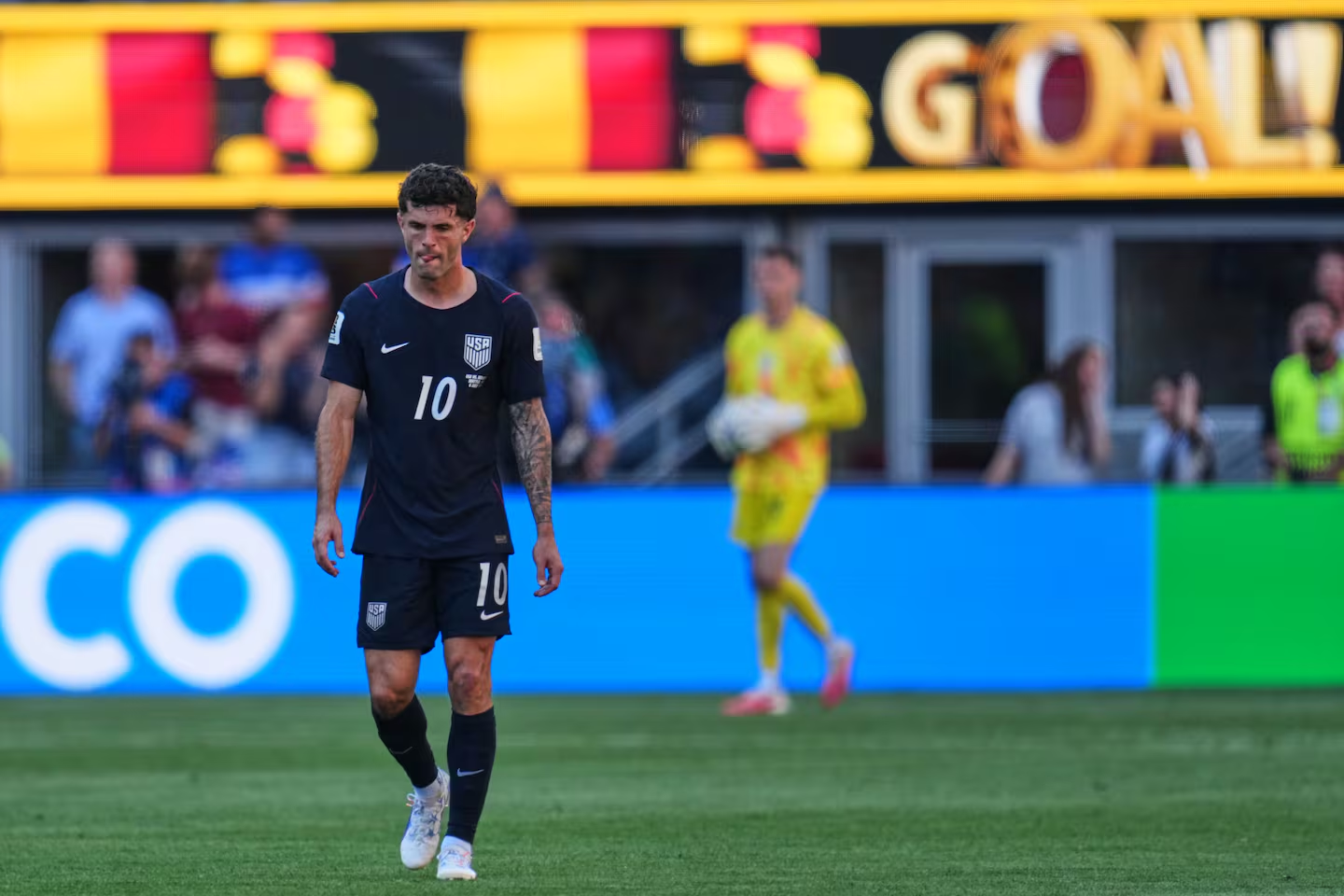
Five questions facing the US men’s national team after painful World Cup exit in the round of 16
The US men’s national team’s exciting run at a home World Cup came to a grinding halt on Monday, with the Americans suffering a 4-1 defeat to Belgium in the round of 16 Monday.
Read more Town of Foxborough fires back at Kraft Group over licensing fees lawsuit, asks court for dismissal
After defeat in Seattle that verged on embarrassing at times, where do the US men go from here?
Here are five questions facing the US men’s national team after the World Cup:
1. Will Mauricio Pochettino stick around?
In the Argentine, the US men had a coach with real pedigree who had coached at the highest levels of European soccer.
The 18 months that preceded this tournament weren’t perfect for Pochettino, who took over the job in October of 2024, but up until Monday, he got the best out of the Americans at this World Cup.
Pochettino became the first US men’s national team coach to win three World Cup games. Some of the performances — particularly a dominant showing against Paraguay — were some of the best the national team had produced in a long time, turning doubters into believers.
So, now what? Pochettino’s contract expires this summer, and while there have been talks of an extension, nothing has been confirmed yet.
“Right now, it’s about resting a little bit, to think, have conversations with the federation to see what the decision is,” Pochettino said Monday night. “I’m so happy. We’ve built a very good relationship, now is not a moment to talk about [my future].”
It was a fourth straight exit in the round of 16 for the Americans (not including the tournament they missed in 2018), but it was a run that showed more promise than any since 2002.
“One year ago, we were in a mess,” Pochettino said. “Today, at this World Cup, we improved a lot. But sometimes you improve little by little, it’s not linear. I’m so proud.”
Pochettino, who had a very strong stint in England with Tottenham Hotspur and won France’s League 1 with Paris Saint-Germain, may be getting calls from top European clubs again this summer. US Soccer would do well to keep him around for another World Cup cycle.
2. Where does Christian Pulisic go from here?
The American’s star has struggled to deliver on his promise as this country’s great hope, but this tournament was the closest we’ve seen to that potential.
Pulisic was sensational at times, especially in that opening win over Paraguay. But his impact waned after a calf issue forced him off at halftime in the opener, and he really struggled in the defeat to Belgium before again being substituted due to injury.
The 27-year-old Pulisic isn’t a star young talent anymore. He’ll be 31 at the next World Cup, nearly 15 years into his pro career. He has just one goal in eight World Cup appearances, and exited another tournament with his head in his hands Monday.
The Pennsylvania native is far from finished, but it’s natural to wonder if his best soccer will be behind him by 2030.
3. Will any young stars emerge?
The next World Cup cycle will likely be the last centered around this particular US core, as Pulisic, Tyler Adams, Weston McKennie, and others will be on the wrong side of 30.
The Americans will need an injection of talent. You’d expect to see Real Salt Lake teenager Zavier Gozo in the mix, as well as Red Bull New York youngsters Julian Hall (18) and Adri Mehmeti (17). Cavan Sullivan, a 16-year-old with the Philadelphia Union, is set to join Manchester City when he turns 18 and has long been pegged as a potential star for the national team.
The Americans will also be hoping to call up 19-year-old defender Noahkai Banks, who has yet to make a decision between representing the United States or Germany at the senior level.
4. Can a top keeper be found?
The Americans have talent up front, in midfield, and at the back, but they just can’t seem to produce an elite goalkeeper.
Matt Freese has been steady under Pochettino, but the Harvard product’s monumental blunder against Belgium sunk the Americans and will live long in the memory.
A generation ago, the United States had multiple goalkeepers playing in Europe’s top leagues in Brad Friedel, Kasey Keller, and Tim Howard. Since Howard left the fold nearly a decade ago, the American goalkeeping room has been a revolving door of uninspiring players that struggle to stick anywhere outside MLS.
This World Cup has shown us how a special keeper can propel a team at a tournament. Not since Howard’s memorable run in 2014 have the Americans had anything special between the posts.
Whether it’s one of the established goalkeepers — Freese will only be 31 in 2030, relatively young in keeper terms — or a new face like Diego Kochen, a 20-year-old product of Barcelona’s famed academy, a safe pair of hands will be needed.
5. Can the defense find its missing piece?
You could argue that three-quarters of the US back line is in great shape. Right back Alex Freeman was excellent at times, as was Antonee Robinson. Center back Chris Richards, who plays in England at Crystal Palace, is the kind of defender you can build around.
But it says a lot about the rest of Pochettino’s options at the back that he opted for 38-year-old Tim Ream. There was plenty of blame to go around for the loss to Belgium, but Ream was caught ball-watching terribly for Belgium’s first goal, was bullied in the air on the second, and flubbed a chance to clear the disastrous third after Freese’s error in possession.
Freeman will be 25 in 2030, Richards will be 30, and Robinson 32. They will all expect to be firmly in the mix at the next World Cup, but they’ll need another reliable defender to avoid an exit like this one.
Read more Coco Gauff rallies to beat Jessica Pegula to reach semifinals; Jannik Sinner to face Novak Djokovic



Post Comment