‘This is Game of Thrones right now:’ Platner isn’t out yet, but Maine Democrats are moving on
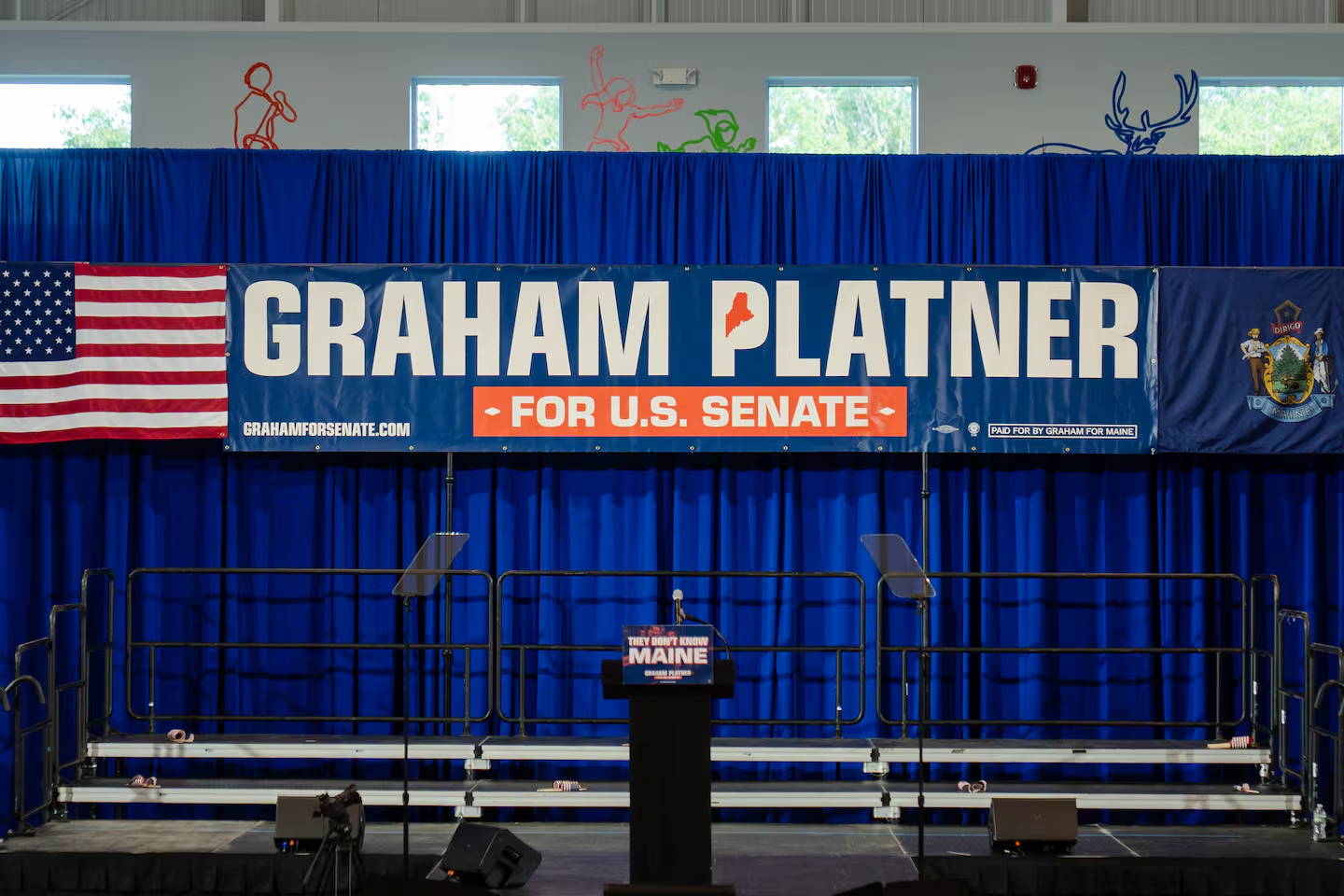
Graham Platner hasn’t yet announced whether he’ll continue his US Senate campaign in Maine following a bombshell rape allegation that landed Monday.
Read more Trump looks to rewrite history at the Smithsonian
Maine Democrats, however, are rapidly moving forward without him.
Under Maine law, Platnercan be replaced as the Democratic nominee if he withdraws before July 13 — which seems increasingly inevitable as his support collapses across the party.
The party would then have until July 27 to select a replacement. But there is no obvious existing procedure for this situation — leaving Democratic officials scrambling to devise a process to replace Platner that is fair, open, and can be concluded in time.
Meanwhile, at least a half-dozen possible contenders waiting in the wings are competing for position and letting news media know they are receiving supportive calls.
Progressive and moderate factions both in and outside Maine are escalating online battles that have become nasty, demanding the other side be blocked from influencing who succeeds Platner as nominee.
For voters, activists, and even potential candidates, it’s a heady mix, and one without precedent in living political memory in the state. Nirav Shah, former chief of the Maine Centers for Disease Control and Prevention who placed second in this year’s gubernatorial primary, is one of the leading Democrats to register interest in a Senate campaign.
In an interview with the Globe, Shah said the top priority among Democrats must be establishing a process that produces a candidate ready for the immense challenge and scrutiny that comes with a nationally-watched Senate race.
“This is Game of Thrones right now, and everyone’s going to be jockeying,” Shah said. “I want to make sure that what comes out is… that the nominee is ready for action.”
The chaos is turning Maine, on paper Democrats’ best shot to flip a Senate seat in 2026, into an ominous mark on their map. Even before Politico reported Monday on Jenny Racicot’s claims that Platner raped her in 2021, the candidate was on tenuous footing, his campaign already beset by scandals and damaging revelations about his past. (Platner has denied any nonconsensual activity.)
In recent weeks, several polls showed Platner running neck-and-neck with Collins, despite an abysmal overall political environment for Republicans. It’s possible Democrats wind up with a stronger challenger to Collins when the dust settles — if it ever does, given the intraparty warfare that broke out following the Politico story.
Democrats who share Platner’s left-wing populist vision are insisting his successor be someone with the same vision, arguing that would reflect the will of Democratic voters who overwhelmingly backed Platner in the June 9 primary. In fact, Platner himself is reportedly pushing to secure an aligned candidate to take his place before withdrawing.
That could be Troy Jackson, the former president of the Maine Senate, who placed third in the Democratic gubernatorial primary. He campaigned closely with Platner and shares many supporters with him, including labor unions and Vermont Senator Bernie Sanders.
But Democrats closer to the center, primarily outside Maine, are furious with Platner and his progressive allies from Maine and beyond, arguing they are responsible for the debacle.
Left-wing groups aligned with Sanders have already endorsed Jackson.When Representative Ro Khanna of California, formerly a staunch defender of Platner who appeared with him only weeks ago, praised Jackson as a possible successor, backlash was swift. “You’ve done enough damage in Maine,” responded Jim Kessler, of the center-left think tank Third Way, on X. “We cannot nominate a Democrat covered in the stench of Platner or his accomplices.”
The list of possible contenders is growing along with the prospects for factional warfare. In addition to Jackson, there are two other runners-up from the gubernatorial primary seen as viable candidates: Shah and Secretary of State Shenna Bellows.
Shah, still well liked for leading Maine’s response to the COVID pandemic, said he began receiving a huge volume of encouraging calls and texts almost immediately after Politico’s story went live. He said he has not yet decided whether to run, but nonethelesssketched out an argument showing how he could appeal to Platner supporters as well as independents and Republicans.
But he said Democrats can’t lose sight of the ultimate goal amid the factional disputes around a Platner replacement.
Read more The 4 most pressing questions about the Maine Senate contest right now
“All of this must be angled around one question: Who can defeat Senator Collins?” Shah said. “If that happens to be a natural successor to Graham politically, then great. But ultimately what’s going to matter is who can defeat her.”
Jackson also took steps toward a run. His allies began circulating a video touting his credentials as a progressive and fifth-generation logger from northern Maine. And on Tuesday, he filed paperwork with the Federal Election Commission to create a Senate exploratory committee.
In a statement released Tuesday night, Jackson confirmed he was considering a bid and spoke directly to Platner supporters who are “hurting” amid the disturbing news about his conduct.
“Together, we can bring our shared progressive vision to life,” said Jackson. “And we can unseat Susan Collins once and for all.”
Bellows, meanwhile, previously faced Collins, in 2014, and lost decisively. But since then, she has built a reputation as an aggressive counter to President Trump in her role as Secretary of State; she drew national headlines, and intense GOP backlash, for moving to disqualify Trump from the 2024 ballot. On Tuesday evening, Bellows confirmed she was interested in entering the race and called herself “uniquely fit to unite Mainers and defeat Susan Collins in just over 100 days,” according to the Midcoast Villager.
Bellows and Jackson hail from the left wing of the party, and both were endorsed for governor by Platner, who urged voters to select them in Maine’s ranked-choice primary along with Hannah Pingree, who ultimately won. (Platner did not recommend a vote for Shah.) While Shah has embraced policy positions like Medicare For All, progressive activists and groups did not line up behind his candidacy.
Another possible contender is Dan Kleban, co-founder of Maine Beer Company, who briefly ran for Senate before dropping out when Governor Janet Mills entered the race. Kleban is well-connected in Democratic circles; he has received calls encouraging him to run, according to a source close to him.
Former congressional staffer Jordan Wood, who briefly ran for Senate before running in Maine’s 2nd Congressional District and placing third, announced that he was interested, as well.
The intentions of two political heavyweights remain unclear. Mills, who bowed out of the race in April after failing to compete with Platner, has not commented on recent developments. She also has not endorsed Platner. But Mills campaigned with the backing of Senate Minority Leader Chuck Schumer and the Washington party establishment, who are deeply unpopular among the base.
Representative Jared Golden, who is retiring, has consistently overperformed in the Republican-leaning 2nd District. In a statement, Golden said Racicot’s account spoke for itself, but did not express interest in a run — nor explicitly closed the door on one.
How Maine Democrats might sort through all these potential candidates remains unclear. State law stipulates only that the state party committee makes the final decision as to how to replace a candidate. The party has considerable latitude to craft a process to arrive at that decision.
A number of proposals are currently the subject of chatter among Maine Democrats, including one to stage another convention amongprevious delegates to the spring state convention and another to hold a statewide caucus among county activists, said one local party chair who asked not to be named to share details of internal discussions.
Shah is already pushing for additional benchmarks for an abbreviated process, calling for candidates to commit to a televised debate as well as public town halls.
“We are 24 hours in, and in uncharted waters,” Shah said, adding he wants to give state Democrats “grace to figure out what works.”
“We called for a process that is open, transparent, and as robust as possible,” he said. “That’s critical, because if the process is anything but, if it is a handing of the torch, then the eventual nominee will not have generated enough trust and buy-in from the base, let alone the broader party, to be able to prosecute the case against Senator Collins.”
Read more Trump passports debut, delighting some and dismaying others
James Pindell of the Globe staff contributed reporting.


Post Comment