With abortion meds in legal ‘no man’s land’ until Monday, Mass. leaders urge people to continue to seek care
The abortion pill, which accounts for half of abortions nationwide, is widely available in Massachusetts for now. It’s also, as one attorney active in the abortion debate put it, in “no man’s land.”
But come 5 p.m. Monday, the US Supreme Court, which temporarily restored broader access to the abortion medication mifepristone, may decide whether to stay the course or permanently ban distribution of the widely used pill through the mail with a telehealth prescription, instead of through an in-person visit to a doctor.
That’s when a temporary stay on a lower court’s ruling limiting access to the pill expires. With that looming deadline, the uncertainty over how a conservative Supreme Court may rule is especially acute in Massachusetts, which has become a national hub for abortion care that relies heavily on mailing the medication to patients.
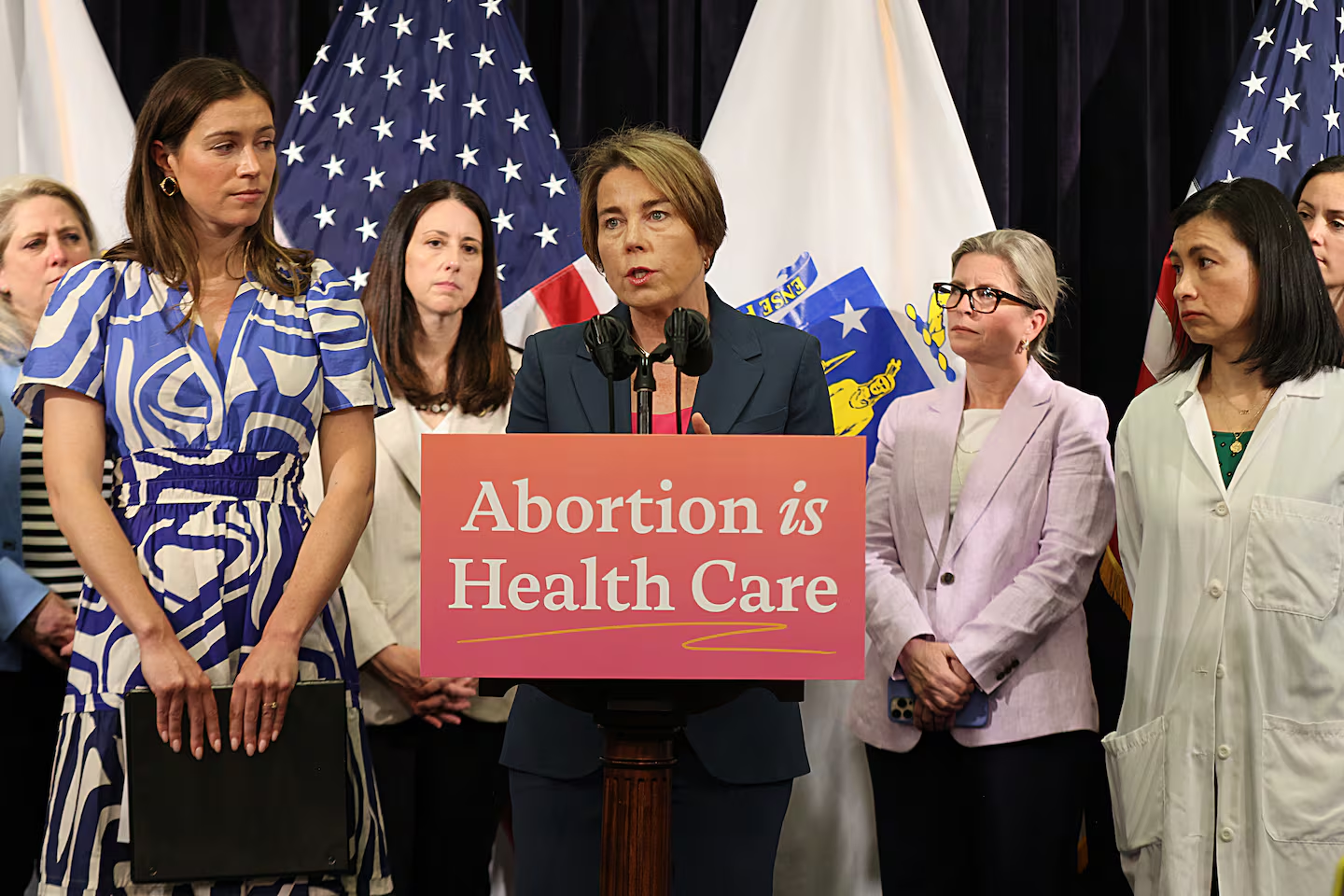
On Friday, Governor Maura Healey, backed by medical providers and activists, encouraged people to consider stocking up on abortion medicines just in case.
“We don’t know what the Supreme Court is going to do,” said Healey. “But I can tell you, whatever the Supreme Court does and however they rule, I’m going to make sure as governor that we are doing everything we can to ensure that women . . . have access to the care they need.”
The Supreme Court’s stoppage temporarily put on hold a federal appeals court ruling that would sharply restrict access to the abortion pill. That lower court ruled that mailing the medication violated federal law, siding with Louisiana officials who challenged a federal regulation that allowed people to receive a prescription through a telehealth appointment and receive it in the mail.
The Supreme Court’s order is set to last at least through Monday as justices consider emergency appeals from drug manufacturers.
Louisiana officials and other abortion opponents argue that mailing the drug enables abortions in states where the procedure is banned. Providers and local public health experts, meanwhile, say remote access is critical, especially for patients in rural areas or states with few clinics.
Since the Supreme Court’s 2022 decision overturning Roe v. Wade, Massachusetts has emerged as a major national provider of abortion care, with state data showing terminations using medication have more than doubled, and most patients receiving care are from other states.
Telehealth abortions accounted for 30,900 cases in 2024, or about 62 percent — a steep climb from 5,745 cases in 2023, the first time the state began documenting telehealth appointments.
Medication abortions, typically involving the drug mifepristone, represented more than 60 percent of all procedures, with surgical methods a smaller share, according to state data.
Massachusetts also took the unusual step of creating a stockpile of 15,000 doses of mifepristone.
“I‘m glad I stockpiled those for a reason, because I wanted to make sure . . . that there was no risk to women here that they would lose access to abortion medication,” Healey said Friday. “Abortion will continue to be safe, legal, and accessible. We’ll never back down on that.”
Healey emphasized that mifepristone is safe, noting that it’s “safer than ibuprofen, acetaminophen, and penicillin.”
“And by the way, it’s safer than Viagra, which is also approved for telehealth and mail delivery,” she said, referencing the common erectile dysfunction medication.
Taylor St. Germain, interim president of Reproductive Equity Now, said the “legal whiplash” and confusion about what happens next is “intentional.”
“Confusion is the strategy, and this chaos is by design,” she said. “Patients, unfortunately, are being the ones to face the consequences.”
St. Germain said last year alone, Massachusetts providers mailed more than 50,000 medication abortion pills nationwide. She noted the medication is also available by “advanced provision,” meaning even people who aren’t pregnant can get access to the pills.
“It’s never a bad idea to have medication abortion in your medicine cabinet,” she said.
Massachusetts has long led the way in supporting abortions, including investing money in providers and communication organizations, and passing one of the country’s most expansive laws that shield providers from prosecution by other states.
The laws here, among other things, restrict state agencies from sharing information with out-of-state investigations, require insurance companies in Massachusetts to limit access to patient electronic medical records, and require hospitals to provide emergency abortions if medically necessary.
At the time the laws were passed, lawmakers said the purpose was to protect against emerging threats to abortions.
Last year, a divided Supreme Court allowed states to cut off Medicaid money to Planned Parenthood. Louisiana charged a New York doctor under its total abortion ban with allegedly providing abortion pills via telehealth to a Louisiana teenager, and the same doctor was fined by a judge in Texas for mailing abortion pills to a patient there.
Medical professionals and advocates said Friday they fear the latest appeals court ruling is part of a trend that they see no sign of stopping.
As of this week, about one in three states has a near-total abortion ban.
Carol Rose, executive director of the ACLU of Massachusetts, said her team has been “scenario planning” for possible legal challenges since the 2022 Dobbs decision that overturned Roe v. Wade.
Her organization is watching in case the Supreme Court decides the current case through its emergency or shadow docket, which is when the court issues orders and summary decisions without a full briefing or hearing oral arguments.
“When women and their families need to find a way forward that’s best for their families, they’ll find a way forward,” Rose said. “If you try to make [abortions] illegal, all it’s going to do is to drive it underground, and you’re going to have more people dying.”
Read more Is the GOP nomination for governor already sewn up? History says, not so fast.
But until Monday, “it’s procedurally, kind of in a ‘no man’s land.’”
Sarah Rahal of the Globe staff contributed to this report.


Post Comment