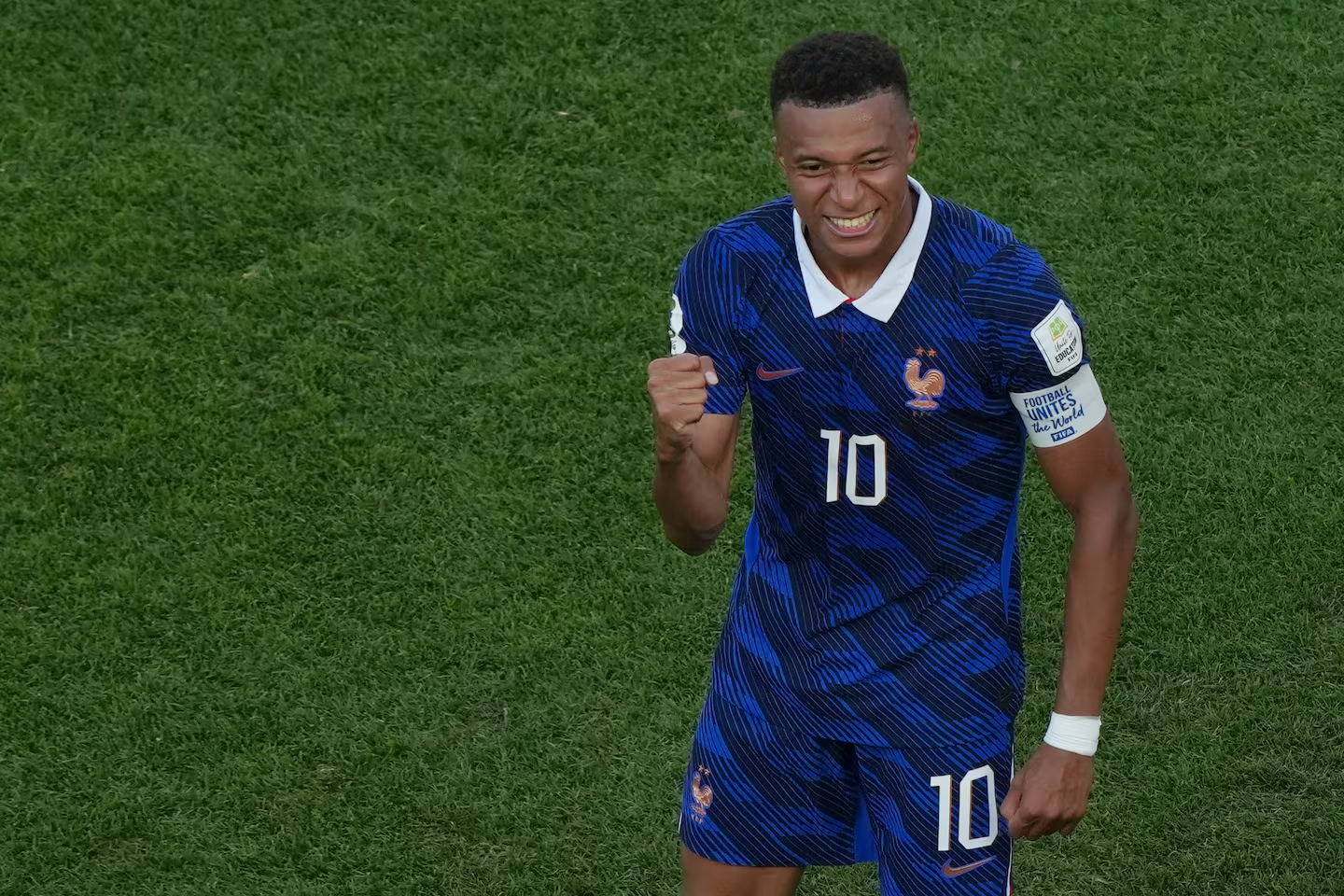
France’s mark on this World Cup extends far beyond its borders
They entered the World Cup as favorites, and, however the French fare, they will have had a strong influence on the event.
Read more Some thoughts on the Jaylen Brown trade, and how the Celtics move forward without him
Start with the fact 99 players (54 from the Greater Paris area) on World Cup rosters were born in France, including six on the Moroccan squad they will be facing in Foxborough on ThursdayFriday. Rivals such as Belgian defender Thomas Meunier have said France could enter as many as three teams capable of winning the World Cup. An exaggeration, maybe, but not much – an 11-man group of French players that didn’t make the 26-man cut would be ranked in value ($43.4 million per player) ahead of Argentina, Brazil, and Portugal.
So, how did Les Bleus get to the point where they are expected to capture a third World Cup title, considering they didn’t qualify the 1994 event in the US?
You have to go back to 1972, when the FFF established INF, Centres de Formation, following a history of disappointments, according to Lindsay Sarah Krasnoff, author of “The Making of Les Bleus: Sport in France, 1958-2010.”
“While we think of France winning in football, it wasn’t always like this,” said Krasnoff, an New York University professor who grew up in Carlisle. “A series of [failures] led to a crisis, made bare in the 1960s, and forced the French to reconceive how they approach sport.”
A third-place finish in the 1958 World Cup was followed by failure to qualify in 1962, ′70, and ’74.
“It was part of a kind of football crisis,” Krasnoff said. “Failure to qualify for the world’s premier tournament also did not present a terribly good image of France internationally. Also, there was a wider youth crisis of the ‘70s, a lack of French Olympians doing well at major competitions. That’s why they created INF, first located at Vichy, with the idea to train some of the country’s top footballing talents. In 1988, it moved to Clairefontaine, which, today is shorthand for French excellence.”
Former national team coach Georges Boulogne is credited with conceiving L’ Institut National du Football (INF), according to Clairefontaine administrator Franck Bentolila. From there, the government backed the program as a way to both improve Les Bleus, and also promote French culture and the sporting values of FIFA’s founding fathers — who happened to be French.
Everything seemed to be functioning, as France won the European Championship and Olympics in 1984. But, French clubs still crashed out of the Champions Cup — another French invention — and France failed to qualify for the 1990 and ’94 World Cups.
A change was made, as Bordeaux president Claude Bez, and others, pushed to revise a 1901 statute, allowing clubs to operate as for-profit enterprises. In 1993, Olympique Marseille won the Champions League and, now, Paris Saint-Germain is a two-time defending Champions League winner.
By 1998, when France won the World Cup as host nation, French clubs’ academy programs were functioning, and have now surpassed the reach of Clairefontaine.
“If you can get a wide base of the pyramid, it will trickle up, so you get the best of the best at the apex,” Krasnoff said. “They’ve had to tinker with the system over time and to refocus certain things, in terms of training and funneling youth into system. The last major overhaul was in the 1990s, a result of not qualifying in 1990 and ‘94, and they’ve seemingly found the recipe for success.
Read more US support for Israel slips as Democrats grow more critical, poll finds
“A lot is based not only on detecting as many players as possible, but also having a coaching methodology that seeks to train players who are creative, and have a high footballing IQ. And you see that with players this summer. Creativity comes from the academies, and also the streets — football is much more a fabric of everyday life, especially in certain parts of the country or certain social demographics. It comes with playing with friends, and constant play.”
Unlike the US pay-to-play model, France’s system encourages youth involvement via free access to facilities. Then, there are the pickup games played by Thierry Henry, and others, in the banlieues. And, a recent development, includes improvised “street academies” producing 12-year-olds who “play like [Kylian] Mbappé,” according to Bentolila.
“What sets it apart is it is constantly evolving to maintain relevancy,” Krasnoff said. “The kind of players France is producing now are different than those coming out of the system 20-30 years ago.”
Les Bleus 1998 edition, dubbed “Black-Blanc-Beur” reflected the multi-ethnicity of France, and countered right wing rhetoric of the National Front. But the national team faltered, losing to Italy in the 2006 World Cup final, and the development program was criticized for having “too many Arabs and Blacks,” in what was dubbed “L’affaire des quotas.”
“Post-colonial multi-culturism was very much the ideal,” Krasnoff said. “Looking back, with time, it didn’t really fully happen. There were cleavages within France society, cultural and racial, that still exist. What it did do, though, was [increase] awareness, and I think there started to be greater embrace of that.”
Symbolizing change were the Opening Ceremonies of the Paris Olympics, featuring Franco-Malian singer Aya Nakamura performing in front of the Republican Guard, Krasnoff said.
“Since the 1930s, the national team has reflected the French population,” Krasnoff said. “Like the US, France has been an immigrant destination for centuries. The first Black player was Raoul Diagne, and who had the most problem with him was his father, Blaise, the first Black deputy in the National Assembly. He was not happy that his son was playing for France, and also that he was a professional footballer. His father wanted him to go into one of the professions.
“In France, class matters, more than skin color, and you see that in sports. [Olympics founder] Pierre de Coubertin long held to the ideal of amateurism, and to play for money, professionalism, was something negative. Football was the first sport to go professional, in the ‘30s, and has long been stigmatized by political elites. But if you look it at from the ‘30s, the national team reflected France’s diverse immigration history. The 1958 team had players of Polish, Spanish, and Eastern and Central European descent. The 1980s, Michel Platini, Italian, and family heritages from Spain and the French Caribbean. It’s always been a reflection of the larger French population.”
Along with seeking skillful players, the system emphasizes education and family, according to Stéphane Nado, who helped develop players such as current Aston Villa midfielder Boubacar Kamara.
“They are well-educated players, in a much broader sense,” Krasnoff said. “Not necessarily in a scholastic sense, but in a larger, human, sense. Particularly around temperament and adaptability, so they can adapt to any kind of system or scenario.”
Flexibility was demonstrated in France’s 1-0 win over Paraguay, Krasnoff said.
“It was how they reacted to what some called the dark arts,” Krasnoff said. “They are trained to push beyond frustration, and not let frustration provoke them into action that could have had negative results.”
Read more Mikel Merino’s late goal sends Spain to quarterfinals and ends Cristiano Ronaldo’s World Cup career



Post Comment