Michigan Democrats face a stark choice between a progressive and a moderate
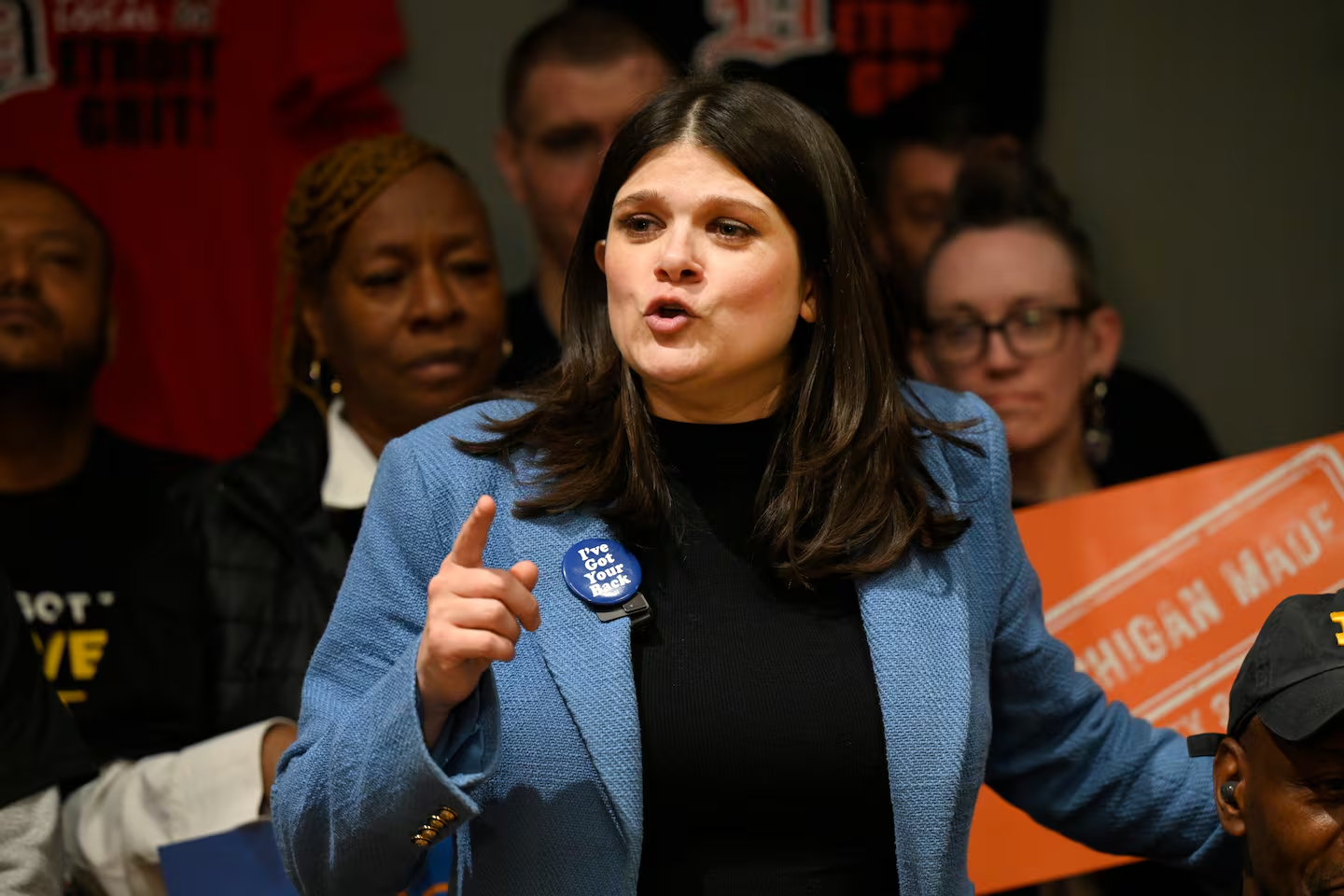
Democrats in Michigan entered this week with a sudden clarity about the ideological stakes of the party’s consequential primary race for Senate, in which a candidate’s departure created a bitter one-on-one fight between an ardent progressive and a moderate backed by Washington leaders.
The Sunday exit of Mallory McMorrow, a state senator who struggled to find a middle ground in the contest, left Abdul El-Sayed, a progressive former public health official, facing off against Rep. Haley Stevens, a four-term moderate.
Perhaps no other Democratic primary in the country this year will have as clear a contrast between the direction voters could choose.
El-Sayed, who has endorsements from Sen. Bernie Sanders, I-Vt., and Rep. Alexandria Ocasio-Cortez, D-N.Y., is a fierce critic of Israel who has called for “Medicare for All” and a raft of other progressive priorities.
Stevens, a supporter of Israel whose political brand centers on her effectiveness as a legislator, is backed by Senate Minority Leader Chuck Schumer and millions of dollars in super PAC spending, a large chunk of which is from pro-Israel groups.
El-Sayed has led in polls of the race, even as Stevens’ supporters hope her wide advantage in advertising, funded in part by groups tied to the American Israel Public Affairs Committee, will help her overcome her rival.
The two candidates are set to meet in their first one-on-one debate on Tuesday night in Grand Rapids, Michigan.
Stevens, who ousted a Republican in 2018 and won a divisive Democratic primary against a fellow member of Congress in 2022, wasted little time on Monday in arguing that her ability to win the general election was of paramount importance in the Senate primary.
“No one wants Abdul to win more than the Republicans, and that’s because they think that they can beat him in November,” she said during a morning interview on MS NOW’s “Morning Joe.” “What they’ve never done is beat me. That’s the reality.”
El-Sayed framed the new two-way race not as a question of who was more likely to win in November, but of what the Democratic Party stood for at a moment when its voters are demanding a fight against President Donald Trump.
Read more Medicaid funding is resuming for Planned Parenthood after being cut off for most of a year
“Are we willing to allow AIPAC, big corporations, Chuck Schumer, to show up and rig our democracy, to choose who our Democratic nominee is going to be?” he said in a video posted on social media. “This is all in an effort to cherry-pick from Washington, D.C., or New York who gets to be the Democratic nominee for Senate.”
By the time she suspended her campaign, McMorrow’s support in public polling had dwindled. The middle path she envisioned between El-Sayed’s unrelenting progressivism and Stevens’ establishment moderation was not in the end wide enough to remain viable.
What happens with McMorrow’s supporters will be critical to the success of both remaining candidates. The McMorrow campaign’s internal polling found that her supporters’ second choice was split evenly between Stevens and El-Sayed, according to a person who viewed the data.
The Senate Democratic campaign arm, which is tacitly supporting Stevens, has its own internal polling data that suggests Stevens gains more support than El-Sayed does in a two-way race without McMorrow, according to a person who has seen the committee’s polls.
“I don’t think they fit neatly into a bucket,” said Lonnie Scott, a McMorrow supporter and former executive director of Progress Michigan, a progressive organization in the state. “There are plenty like me that are policy-wise far more aligned with Abdul but also concerned that he’s never been through the negative campaigning and doesn’t have elected experience.”
Scott said he had already cast his ballot for McMorrow.
Stevens on Monday pointed to new endorsements from Dana Nessel, Michigan’s two-term attorney general, and EMILY’s List, the Democratic fundraising group that backs women running for office who support abortion rights. Nessel, a Democrat, had not endorsed McMorrow, but she did appear with her at campaign events as recently as late last month.
“Haley is wicked smart, has won multiple highly competitive races and she connects with people on a level so sincere and genuine that everyone who meets her feels truly seen and heard,” Nessel wrote on social media.
Most of the high-profile Democrats who had endorsed McMorrow, including Sens. Elizabeth Warren, D-Mass., and Chris Murphy, D-Conn., have not weighed in on the race since she announced she would suspend her campaign.
This article originally appeared in The New York Times.


Post Comment