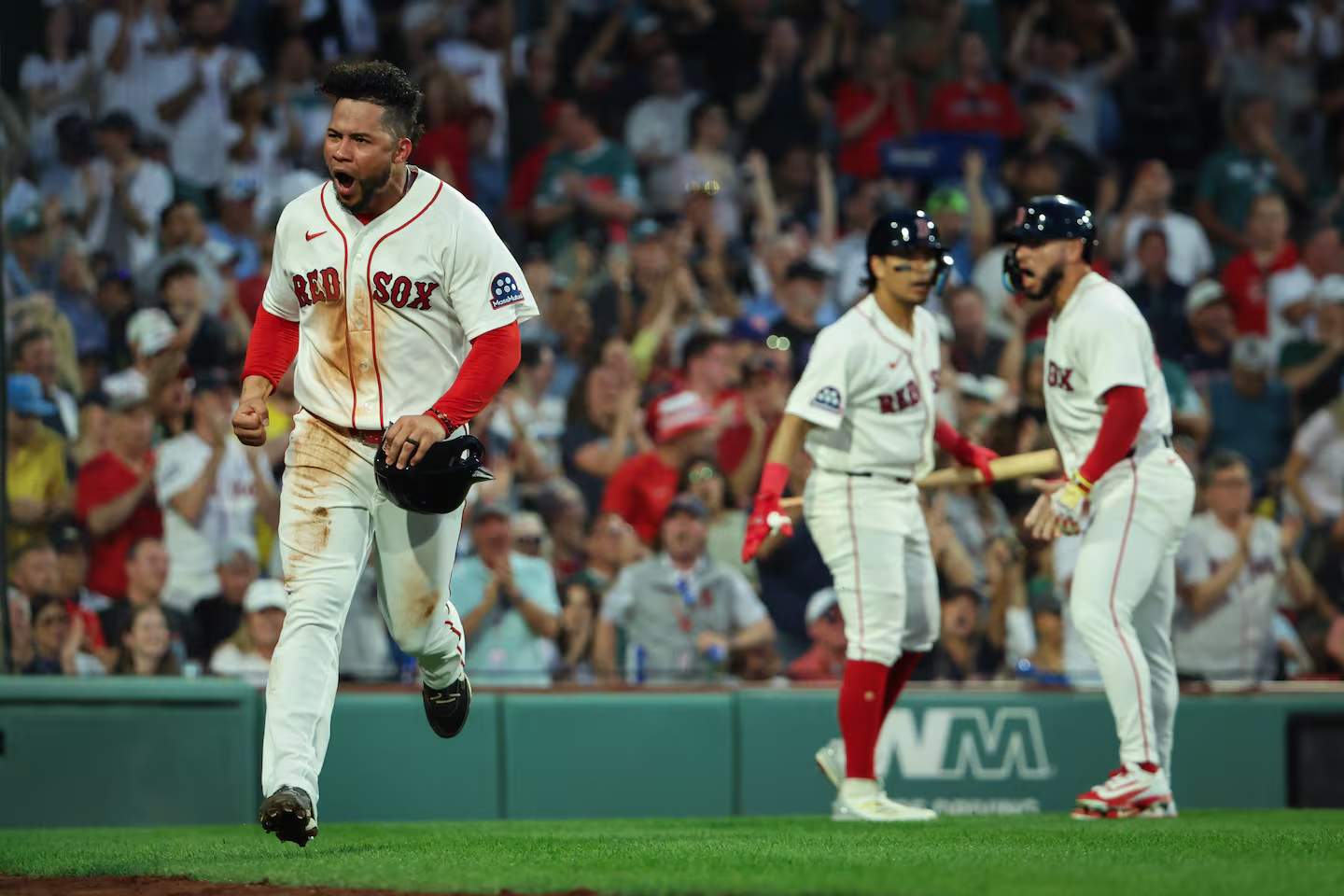
The flawed, fumbling Red Sox have outscored their opponents for the season. Does that suggest better days ahead?
What a confounding path the Red Sox have forged through 88 games of the 2026 season.
Read more Mitch McConnell is ‘continuing his recovery,’ but details are scarce after a lengthy hospital stay
As impressive as the team’s recent 8-2 burst has been, their 40-48 record and last-place standing — not to mention a seismic managerial and coaching staff shakeup in April — speak to a season that has veered painfully and profoundly from expectations.
And yet, there are plenty of reminders of the team’s talent. Ranger Suarez and Aroldis Chapman got selected for the All-Star Game, while Sonny Gray had a compelling case. Both Willson Contreras and Ceddanne Rafaela rank among the top dozen AL position players in wins above replacement as calculated by FanGraphs, making the Sox one of two AL teams with multiple players in that elite grouping.
Perhaps most notably, the Red Sox have scored five more runs than they’ve allowed this year. They’re one of just six American League teams with a positive run differential.
Typically, run differential correlates well to record. Teams that score more runs than they allow generally are good; teams that get outscored generally are not.
The pattern is far from perfect, but holds well enough that those two basic stats — runs scored and runs allowed — are used widely to calculate expected wins and losses. The Sox, based on run differential, have an expected record of 45-43, a mark that would be good enough to hold the third wild-card spot. Instead, they have the fourth-worst record in a weak American League.
“Does [the run differential] add to the frustration of the win-loss column?” pitching coach Andrew Bailey wondered rhetorically. “Maybe confusion is the right word. We all look at the standings. We all look at run differential. It’s nice to see a green number there. It doesn’t change what our record is.
“The name of the game is to let in less runs than the other team, and we’ve been able to do that slightly positively this year. Obviously, that’s the goal: To prevent runs and score runs. I think that it is sign of a successful team at that metric, right? Now, winning games is a different story.”
The gap between the team’s expected record and actual record is a function of how it’s performed in close games. In games decided by one or two runs, the Sox are 14-26 — a .350 winning percentage that is the third worst in baseball this year. Meanwhile, they’ve won enough lopsided games (26-22) to elevate their expected record, but not their actual one.
“That [disparity] tells you that the game’s not won or lost on paper,” agreed shortstop Trevor Story. “Numbers can give you a kind of a pulse of what’s going on, but it’s about the winning details, I think. We didn’t do a good job of that, I feel like, the first couple months.”
Still, it’s worth asking — particularly with the Sox amidst their best stretch — whether teams that significantly underperform their predicted records to this stage of the season typically go on second-half runs.
Read more Prosecutors argue the man accused of killing Charlie Kirk should stand trial
A look at precedents is … not terribly promising for the Sox (or, for that matter, the Tigers, who have a 46-44 expected record but are 40-50 thanks to the worst performance in one- and two-run games in MLB this year).
From the introduction of the 162-game schedule in 1961 through last season, there were 26 teams in non-strike-shortened years that, through 88 games, had a positive run differential and a winning percentage below .475. Their performance over the rest of the season?
None made the playoffs — a reminder of the difficulty teams face in digging out of deep holes.
As a group, those teams had a .455 winning percentage through 88 games, and a .461 mark the rest of their seasons.
Ten of the 26 teams (39 percent) posted winning percentages of .500 or better over the rest of the season. Just three reached .554 — the mark that the Sox would need to finish 81-81.
None of the 26 teams performed at a .581 or better mark down the stretch — the winning percentage the Sox would need to get to 83 wins, the fewest number of wins that resulted in a playoff berth in a full season over the last 20 years.
The most hopeful precedents were from 2023, when the Cubs and Padres surged back into contention in a weak NL wild-card field. But both ultimately fell short, with the Cubs finishing at 83-79, one game behind Arizona, and the Padres at 82-80.
This year’s unimpressive AL landscape offers the Sox some grounds for hope. The last AL wild-card spot is currently held by the Rangers (45-45), whom the Sox trail by just four games. While they remain close to the back of the league-wide traffic jams, the license plates in front of them remain visible.
“That’s kind of what it comes down to,” said Story. “The AL not being so potent has kept us in it.”
Still, to overcome the deficit, the team will need not only considerable improvement, but also its actual performance to start matching — or exceeding — expectations.
Read more FIFA red card reprieve for US is the latest example of the new world order




Post Comment