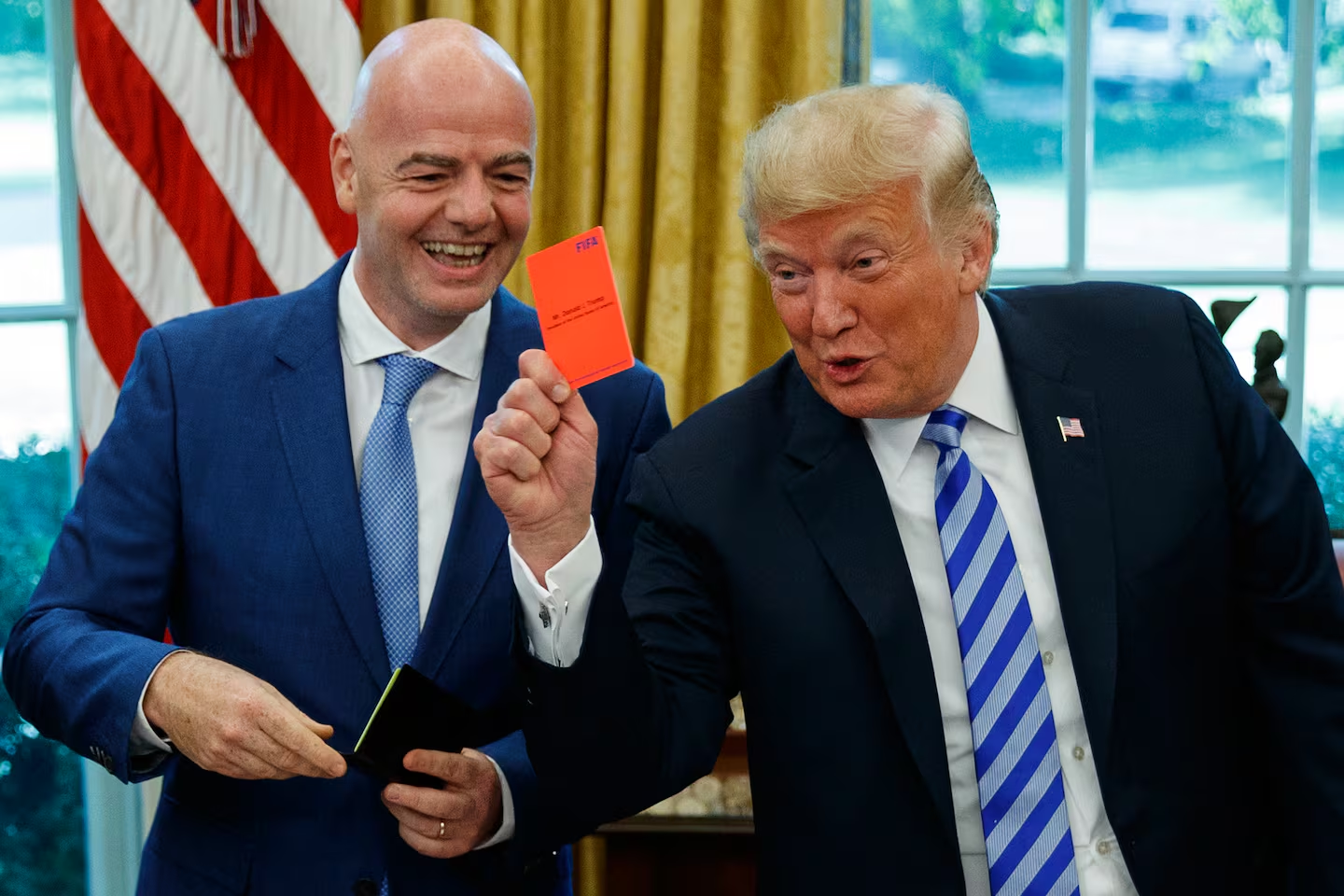
FIFA red card reprieve for US is the latest example of the new world order
See if you recognize the following scenario:
The president of the United States celebrates an action on the global stage. Europeans express dismay and condemn it as a brazen move because it didn’t follow the established rules or maintain the status quo.
Read more ‘The Five Star Weekend’ is a love letter to female friendship with a starry cast
The rest of the world shrugs its collective shoulders.
Was it about:
A.) The most recent Iran war
B.) Trump’s tariffs
C.) FIFA’s decision to suspend a red-card punishment for a star US player
The answer: D) all of the above.
In each case, established international rules proved negotiable when a major power was involved.
While much has been made (perhaps falsely) of the decision to suspend the red card and allow US striker Folarin Balogun to play as some precedent-setting moment, the truth is the precedent happened earlier in this tournament. But it’s also very much in line with the new world order partially ushered in by President Trump.
But first, what happened earlier in the tournament?
During Portugal’s final World Cup qualifying game in November, Cristiano Ronaldo, one of the biggest figures in the history of soccer, was given a red card and a three-game ban for violent conduct.
Ronaldo sat out one meaningless World Cup warm-up match against Armenia, and then FIFA, the global soccer organization, decided he shouldn’t have to sit out the first two matches of the World Cup because… well… you can fill in the blanks.
The new “Ronaldo rule” created a pathway for the United States to at least ask the question of whether something could be done after its top goal scorer in this tournament was sent off with a red card in the last match, which would have also made him ineligible to play Monday night against Belgium.
FIFA originally said there was no appeals process during the tournament. Then, on Sunday, FIFA somehow found yet another way to appease the United States, one of the tournament’s hosts. Trump confirmed to reporters on Monday that he called the head of FIFA after the last US match to inquire whether there was any way to appeal what he viewed as a controversial red card, though he said he didn’t explicitly ask for anything.
Yet the news that FIFA agreed to suspend Balogun’s one-game ban struck many as similar to FIFA making up a peace prize and awarding it to Trump.
The European soccer federation, UEFA, to which Belgium belongs, issued a strongly worded statement of outrage defending Belgium. While it acknowledged FIFA can do what it wants, UEFA demanded “fair play and transparent competition.”
FIFA agreed to hear an appeal from Belgiumbut officially dismissed it on Monday, hours before the match.
Read more Trump + FIFA = Corruption squared
The World Cup doesn’t occur in a vacuum. One of the reasons the quadrennial competition is so interesting is because it is a global event shaped by the geopolitics of the moment. It’s always been this way. (For example, politics is the reason Israel qualifies through Europe rather than Asia.)
And in this moment, the world is reminded that global institutions and the rules-based international system are giving way to a world in which great powers increasingly write their own rules.
Look no further than how FIFA has been bending to the world’s biggest players for a while: the United States and China.
The ways FIFA has embraced the United States go far beyond this tournament and the suspension of Balogun’s ban. There is so much money to be made if soccer truly takes off in the world’s richest nation that the discussion is already about how quickly the US could host another World Cup.
As for China, there are many lucrative reasons the tournament expanded the number of nations that could participate this year. And there are reasons it will likely expand further – which the cynics say this is only to help China to qualify.
None of this should be surprising. FIFA is behaving much like other global institutions increasingly do. The biggest powers have more leverage than everyone else, whether because of their economic might, political influence, or simply the revenue they generate. The rules still exist, but they are becoming more flexible for those with the greatest clout.
All the while, the “middle powers” and Europe can do little more than complain about rules and fairness. UK Prime Minister Keir Starmer reportedly intervened with FIFA last week and got it to reconsider the start time for England’s game against Mexico in Mexico City. FIFA wanted to move up kickoff to avoid storms, but England was worried that doing so wouldn’t give its players enough time to adjust to the altitude.
It’s unclear which world leader will call FIFA next or what will happen. But the broader lesson extends well beyond soccer. If it seems as though there are rules for everyone except the United States and the world’s biggest players, that’s because the institutions built to enforce those rules increasingly accommodate power instead.
Welcome to the way the world works in 2026.


Post Comment