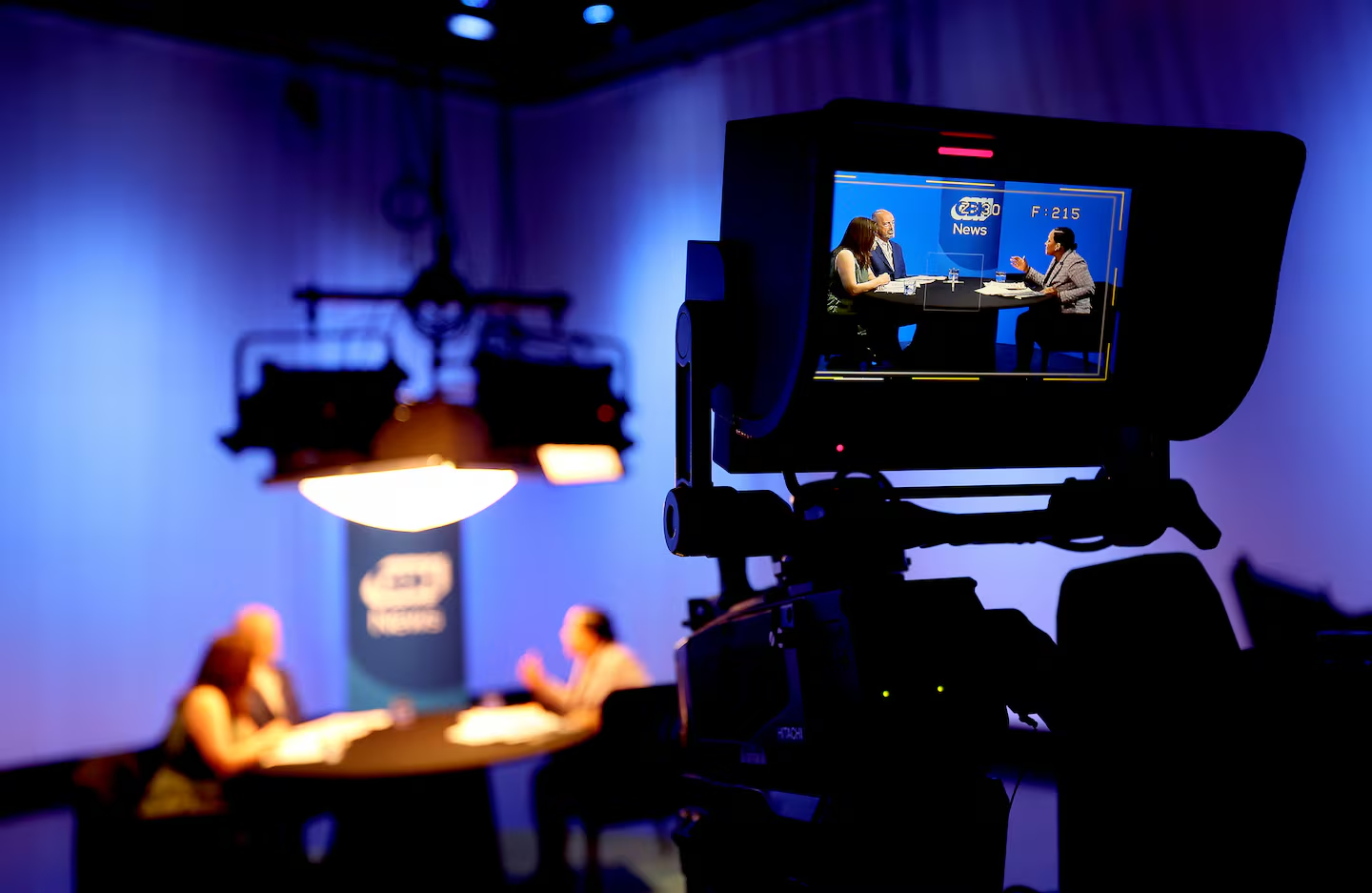
After years of cuts, GBH touts growth in donors and launches statewide show
For the past few years, the news out of GBH’s Brighton studios has been bleak. Layoffs, suspended shows, and the loss of federal funding have concerned staff and supporters about the viability of the Boston public media giant.
Read more MLB made right call on fight between Cade Cavalli and Willson Contreras, and other Red Sox thoughts
But a string of recent updates shows that the organization has, at least for now, stabilized itself.
Although the public funding cuts have cost the NPR and PBS station an estimated $20 million per year, chief executive Susan Goldberg said in an interview last week, the station has brought on more than 57,000 new paying members since the start of last year. During the last fiscal year, which ended June 30, GBH raised $10 million more than it normally does. A year prior, it generated just over $50 million in revenue from member donations.
The organization has also launched a new statewide radio show following its merger with New England Public Media of Western Massachusetts and received new funding from Beacon Hill.
“As much as I dreaded where we were a year ago, right before defunding, what I think we’ve seen is that we are innovating our way through a crisis,” Goldberg said. “Our staff has just done a really good job in tackling the situation and taken a lot of lemons and made a lot of lemonade.”
As one of the largest public media organizations in the country, GBH had a cushion that some smaller stations lacked. But its resilience following the loss of federal funding will be a relief in other corners of the industry because of GBH’s outsized role in public media.
“The success of GBH as a national content producer really is critical to the system overall,” said Marc Hand, chief executive of Public Media Venture Group, a consortium of 32 stations that includes GBH.
Leaders across public media feared the worst when President Trump signed a law rescinding federal funding for public media a year ago. Stations in rural areas that benefited most from public funding were most vulnerable, and leaders worried those problems could cascade because of how reliant stations are on their peers for funding.
Donors, however, have stepped up with funding to keep stations small and large afloat.
GBH‘s fund-raising gains, which give the organization a total of 250,000 members, aren’t enough to make up the $20 million of lost revenue on their own, said Goldberg, who added those losses could expand if the recent surges in fund-raising don’t hold up. But she added that the organization is experimenting with new revenue streams to help fill the rest of the gap.
One such gambit is advertising sales on YouTube. While that’s hardly a new revenue stream for media outlets, Federal Communications Commission guidelines have restricted NPR and PBS stations from airing ads during broadcasts. But those rules don’t apply to digital.
That does come with some risk to the trust that noncommercial stations have built up with audiences, Hand said. He added that one way to responsibly tap into digital revenue is to exert some control over the types of companies that can advertise in its content.
And so far at GBH, “people don’t seem to mind the advertising” on YouTube because they’re used to seeing ads on the platform, Goldberg said.
GBH is still trying to keep expenses in check: It’s looking to bring on staff for some roles, but it’s not making a big hiring push. It gave 3 percent raises to staff, following similar raises in the previous two years, a spokesperson said.
WBUR, Boston’s other NPR news station, has also seen a jump in donors. Its membership has increased nearly 19 percent from a year ago and the station met its $1.1 million spring fund-raising goal in just four and a half days, a WBUR spokesperson told the Globe. Additionally, the station held its second annual WBUR Festival, which sold 2,500 tickets — nearly half of which were sold to people who were not previously in the station’s database.
“We’ve been blown away by the outpouring of support and WBUR is on a roll,” WBUR chief executive Margaret Low said in a statement. “We’re staying true to our principles, adapting our business to support the high-quality journalism that we produce, and expanding the audiences who count on us.”
WBUR is one of the most prominent NPR news stations in the country,with national shows such as “Here & Now” and “On Point.” But as both a PBS and NPR station, GBH is a larger organization and has more ties to broader public media networks.
In the wake of the public funding cuts, GBH has also found other government revenue — though this income is much closer to home.
Last month, Governor Maura Healey signed into law a supplemental budget that included funding for some educational programs from revenue generated by the Commonwealth’s “millionaire’s tax.” The Legislature appropriated $500,000 of the $1.35 billion surtax revenue for “educational public media resources” at GBH, which Axios first reported in early June.
The funding will go toward children’s educational programming — GBH is a significant producer of children’s shows such as “Work It Out Wombats” and “Molly of Denali” — that was previously funded by Ready to Learn grants, one of the federal programs canceled by the Trump administration.
“We at GBH had never received state funding before,” Goldberg said. “That boost from the state really helped us.”
Beyond funding, GBH is also expanding its programming. After launching radio program “The Curiosity Desk” earlier this year, the organization will begin airing the statewide radio show “In Common” on July 4 in partnership with two of its other owned stations, New England Public Media and CAI, the latter of which covers Cape Cod, Martha’s Vineyard, Nantucket, and the South Coast.
The show, hosted by Jeremy Siegel, will “take listeners on a sonic road trip across the state” in the format of a one-hour program, according to the announcement, which builds on efforts to expand coverage across Massachusetts.
“There are a lot of these corners of the Commonwealth that we only go to — and we, I say broadly speaking, the media — whenever there’s a big breaking news story,” said Dan Lothian, editor in chief and general manager of local news at GBH. “As we look to where we want to be with the statewide effort, I think we’re just touching on the tip of the iceberg here.”
The show’s launch also follows a May announcement that GBH was fully merging with New England Public Media. GBH has owned NEPM since 2019, but the two entities have operated with independent boards and filed separate taxes. The merger is expected to go through this month, Goldberg said Monday.
Earlier this year, Goldberg floated the idea of merging with WBUR, a prospect that WBUR chief executive Margaret Low firmly shut down. While Goldberg wants to focus on the merger with NEPM and other recent efforts, she noted that there are other merger efforts across the country in states including Texas and Colorado.
“I want to get our own house in order, and then we’ll see where we are,” Goldberg said.
Read more Belgian federation to challenge FIFA’s decision to let Folarin Balogun play in World Cup match



Post Comment