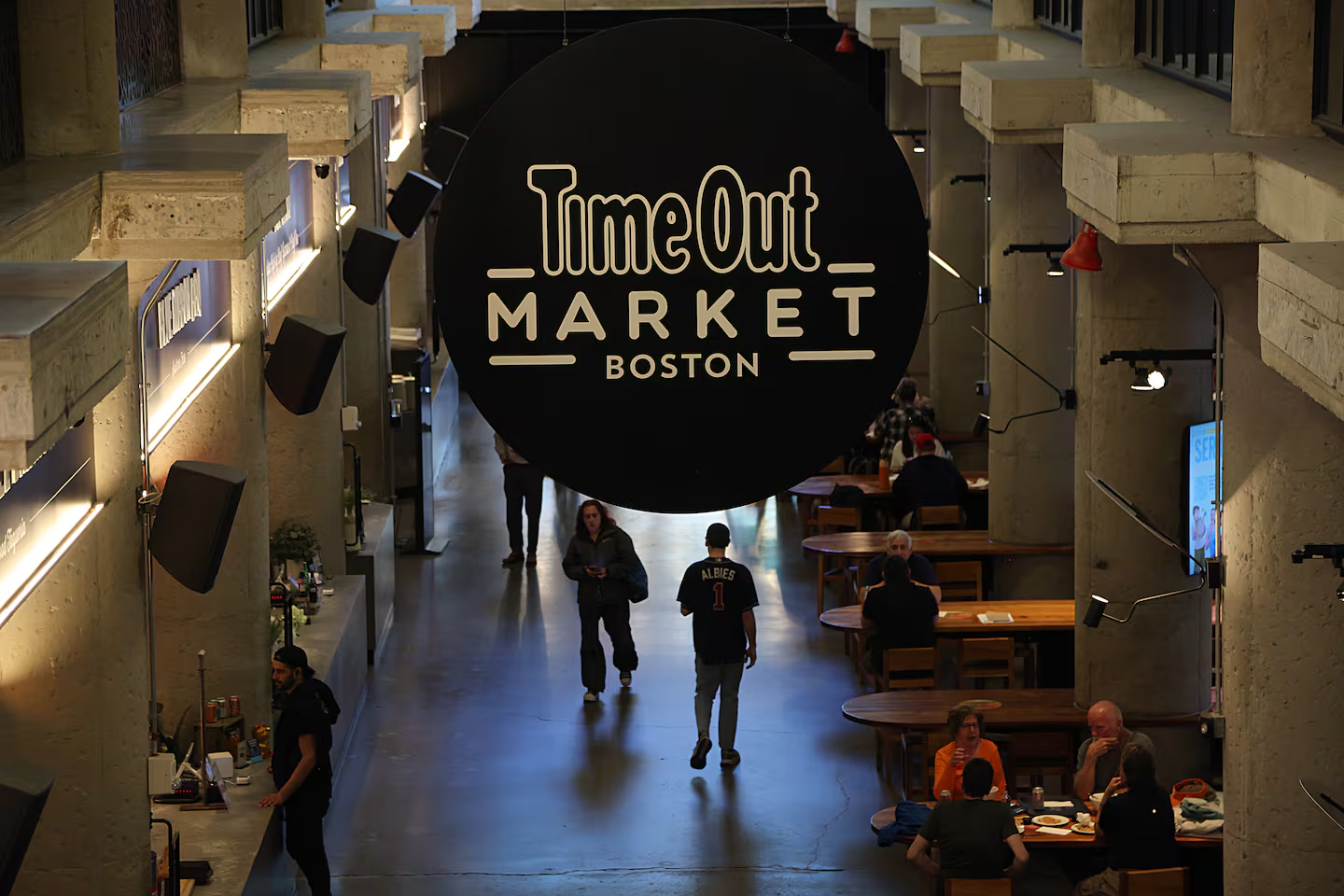
‘Come back and try it again.’ That could be Time Out Market’s new motto.
Ask Steve Samuels what surprises him about going from real estate developer to restaurateur, and he doesn’t hesitate: “Everything.”
Samuels — best known for bringing offices, apartments, and retail to the Fenway — stepped in to rescue the neighborhood’s Time Out Market in late January. The food hall was on the verge of closing until he took over the lease (with a not-so-subtle nudge from me).
Turns out what vendors want most from a new operator issomeone who cares aboutmore than just the bottom line. In Samuels, they now have someone focused on keeping the neighborhood vibrant and finding a way for the food hall to play a big role in that.
“The motivation is very different,” said Pajo Bruich, president of Umami Riot Experience, the restaurant group for Tim and Nancy Cushman’s concepts that include the food hall’s Gogo Ya and Ms. Clucks Deluxe Chicken & Dumplings. “The way that they’re approaching this is very much … tell us what needs to be done differently.”
After operating Time Out for a few months, Samuels doesn’t pretend to know all the answers. On a recent walkthrough, Samuels seemed more at ease talking about the building the food hall occupies — the old Sears, Roebuck & Co. warehouse he bought in 2011 to redevelop. He brought in Time Out as a tenant in 2019 before selling the complex, long known as Landmark Center, two years later to Alexandria Real Estate Equities for $1.52 billion.
But Samuels is someone who knows what he doesn’t know. Which explains why he recruited hospitality guru Matthias Kiehm early on to help turn around Time Out Market. It marks Kiehm’s return to the food hall; the consultant helped open Time Out locations in the US but since then, all – except the ones in Boston and New York – have shuttered.
“So now Miami’s gone, Chicago’s gone,” acknowledged Kiehm, “and Boston, we will bring back to life.”
Time Out wasn’t always struggling. It originallyopened with fanfare as Boston’s first true food hall, but six months later the pandemic hit, upending communal dining. Even as restaurants reopened and filled up again, Time Out didn’t have the same buzz as other food halls opened across the city.
And as the years went by, vendors sensed that parent company Time Out Group, which also publishes city nightlife guides, struggled with its food hall business. Vendors told the Globe that revenue at the Boston market fell 20 percent last year, and that management lacked vision.
Now it’s up to Samuels to figure that out as he manages the food hall through a licensing agreement with Time Out. After Kiehm met with all 14 restaurants and two bars, he implemented a slew of changes, many of them subtle but key to the food hall’s long-term survival.
Chief among them: freshening up menus, lowering prices, upgrading the payment system, and adding food delivery via platforms like Uber Eats and Grubhub. Perhaps more noticeable is the programming: music classes for kids, thrift shop pop-ups, live music, mahjong, and World Cup watch parties.
“The idea is for everybody to remember how much fun and festive this was in the very beginning,” said Samuels. “Come back and try it again because it’s better now.”
Read more Trump rings Wall Street’s opening bells as he ties his presidency to stock market gains
I was one of those people who came in 2019 after it opened. The food was good, but the prices felt high: $16 for a burger, even if it was from Chef Tony Maws of Craigie on Main. (He left the market a year later during the pandemic.)
When the novelty wore off, I didn’t return until recently — first to meet up with Samuels and his team on a weekday afternoon, and then again with my family for dinner on a Saturday night.
The day I caught up with Samuels, the food hall was hopping before a Sox game, but quieted after fans left. On the weekend, girl band Les Femmes played Madonna and other cover songs, making for a lively atmosphere, even though the place was only half full. I was impressed by the diverse crowd: couples, college kids, a girls’ night out group, and families ranging from kids in strollers to teenagers like mine.
You go to a food hall because there’s something for everyone, and it’s reasonably priced. Time Out satisfies different food cravings from Asian to Mexican, and now prices are in line with other fast-casual options, from a $15 beef bowl at Blue Ribbon BBQ to a $16 chicken parm pasta from POE-Lenta.
Kiehm has been meticulous with changes and has a keen sense of what patrons want, having helped the Edgerleys develop the popular Back Bay social club The ‘Quin House.
These days Kiehm thinks customers want high quality at a good value. He’s tasted all 150 menu items at the food hall and pushed for lower prices, even on beer, wine, and cocktails. Next up: lunch specials.
“There are two ways of doing things in order to generate more revenue,” said Kiehm. “Some people raise prices and think the revenue goes up. Some people drop prices and think the revenue goes up. I like the latter.”
Samuels said the food hall isn’t making money yet, and ultimately, Time Out’s success depends on attracting as many customers as possible: residents, office workers, families, tourists, Sox fans, and more.
“It’s too soon to say where it ends up,” said Ian Calhoun, who runs Cusser’s Roast Beef & Seafood in the market, an offshoot of his Back Bay restaurant Mooncusser Fish House.“But the difference between having an operator who’s just looking for the last few cents and an operator who sees Time Out as part of the neighborhood is a huge difference.”
But Samuels can’t do this alone. For all those who wanted Time Out Market to be saved, now’s the time to show up and be part of its second chance.
Read more Could downtown Boston’s McCormack courthouse become housing?




Post Comment