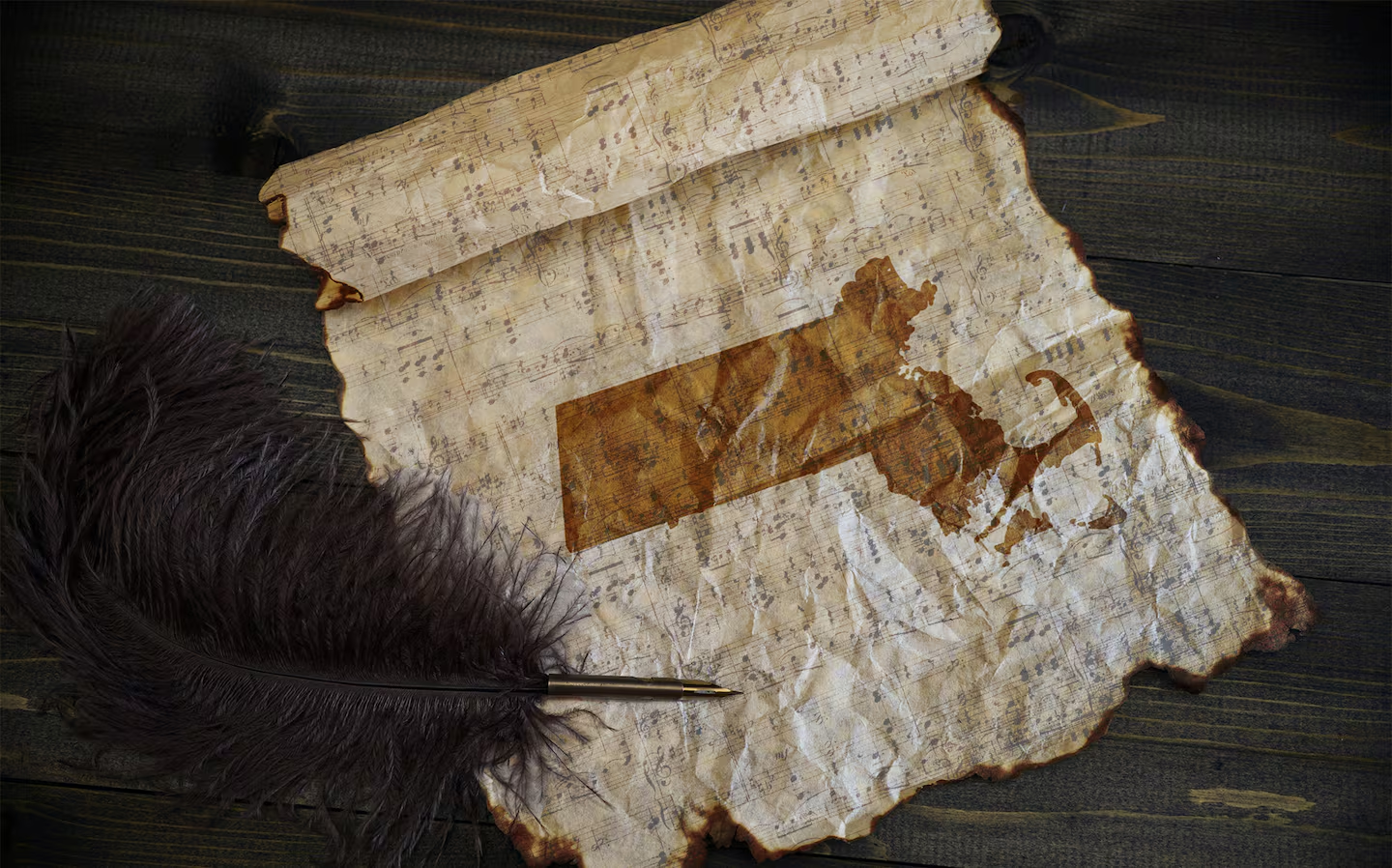
Early New England had its own robust musical style. Then a Boston composer helped suppress it.
Mississippi and Chicago can lay claim to the blues and New Orleans has jazz. Memphis is famous for soul, while Nashville is synonymous with country. What about Massachusetts?
Read more ‘Widow’s Bay,’ ‘Half Man,’ and more of the best TV of the year so far
Known historically for Puritans —and more recently for sports fans with big feelings — Massachusetts and New England had a robust regional musical style long before the Remains, Aerosmith, or the Del Fuegos arrived. That is, until a Boston composer and music educator helped suppress it in the 1800s.
“There was a very real regional music in the 18th and early 19th centuries that was organic,” said Tim Eriksen, an Amherst musician and ethnomusicologist who fronts the folk-punk band Cordelia’s Dad. “It was deliberately stamped out in favor of European models in the 19th century, because regional music was deemed too unruly, countrified, and not up to snuff.”
New England in the 1700s was dotted with singing schools that gave rise to a choral harmony style that eventually spread to other parts of the country, especially the South, and evolved into what’s known as sacred harp, or shape note singing (sometimes also called Fa-Sol-La). Comprising four-part harmony for communal singing, shape notes are literally that: triangles or squares, for example, incorporated into musical notation to help singers identify the pitch.
Though the music often had devotional lyrics, the style wasn’t strictly religious.
“It kind of straddles the line,” said Eriksen, who in April released a new album with Peter Irvine, “Absence and her sister.” “Even the stuff that was sacred music, it was taking place largely in a kind of community setting.”
In fact, what Eriksen calls “proto-shape note” hymns sometimes had a subversive streak. New England choral music initially reflected French-Canadian and Irish songs circulating through the region in the 1700s, said Sam Amidon, a singer, songwriter, and guitarist from Brattleboro, Vt., who grew up immersed in another folk tradition, contra dance.
The folk hymns also drew on secular material from more disreputable quarters.
“There are actually melodies borrowed from murder ballads and pirate songs and drinking songs, which would have been totally unacceptable for these people to sing,” said Amidon, who released the album “Salt River” in 2025. “So, they took the melody and they put Christian words on, and I’m sure the words were very beautiful and meaningful to them, but it’s also the case [that] they were sneakily finding a way to sing some of these salacious melodies that would have been forbidden.”
That style of choral singing took root throughout New England among people of all backgrounds.
“Whether their ancestry was European or African or Native[American], people that were engaged with composition at that time were really working in this style,” said Eriksen, who has taught at Dartmouth and Amherst colleges, contributed to the Oscar-winning soundtrack for the 2003 film “Cold Mountain,” and holds shape note singing workshops across North America and Europe.
Music was often a side pursuit for early New England composersin the late 18th and early 19th centuries, including Boston tanner William Billings and Vermont tavern-keeper Jeremiah Ingalls,who were largely self-taught. In Connecticut, a formerly enslaved man named Sawney Freeman in 1801 published a book of music he had written, which included four-part harmony in compositions that landed somewhere between what would become shape note music and viola da gamba concert music, Eriksen said.
In Western Massachusetts,Cummington hired an instructor in the early 1800s to teach children to sing; the teacher, Royal Joy, was a 12-year-old boy who later became a doctor and abolitionist.
“Without having had any musical training, they wrote three- and four-part harmony,” Amidon said. “That’s a very gutsy thing to do, write in three-part harmony without having gone to a European classical music school.”
Read more A tradwife wakes up in 1855. What could go wrong?
By the 1820s, though, New England choral music was viewed with disdain by music aficionados with a more Eurocentric perspective. They had strong opinions about the correct, “scientific” way to compose musical progressions and harmony, which contrasted with the rougher, untrained sound of the music that had proliferated around New England.
Lowell Mason was prominent among the skeptics. Perhaps best remembered for the melody he added to the nursery rhyme “Mary Had a Little Lamb,” Mason was a banker and choir director who grew up in Medfield before moving to Georgia in his early adulthood. In 1827 he returned to Boston, where he was a pioneer in teaching music in public schools, worked as music director for three different churches, and served as president of the Handel and Haydn Society orchestra, which published a hymnal that Mason had produced — a collection that soon supplanted other musical texts used in churches and singing schools in the Northeast.
“He often is the villain in the story of American music, because he was so active in trying to get rid of this very vibrant regional tradition, while also still working very much within that tradition,” Eriksen said.
The movement to eradicate New England choral music didn’t fully erase it. For one thing, the songs were easy to find: Northampton was a hub of music publishing in the 1790s, Eriksen said, and composers would come to Western Massachusetts from all over the Northeast so their manuscriptscould be set in movable music type, rather than being engraved by hand for reproduction.
Also, musical taste isn’t a spigot that can simply be shut off.
“People don’t always stop loving things just because you tell them to,” said Allison Blake Steel, a songwriter and artist who began singing “weird Yankee folk hymns” in the late 1990s while attending Smith College.
Those songs have endured because “They are unbelievably awesome,” said Steel, who carves slate gravestones and once worked as a costumed re-enactor at Old Sturbridge Village.
“They are big enough to grapple with the deepest questions of life and death and meaning, complex enough to reflect the world as it is, and simple enough to be sung by regular people without fancy skills,” Steel added. “They don’t speak to everyone, but they spoke to people 200 years ago, and they speak to me.”
In the 1800s, young people who loved the folk hymns they learned at a formative age were the ones who kept them alive as they got older, prompting a revival of the style later that century.
“They pushed back against the pushback, and they developed a tradition called ‘Old Folks Concerts’ that were also very much a regional tradition and lasted for about 100 years or so, into the 1950s,” said Eriksen, who researched the pushback for his 2015 doctorate in ethnomusicology from Wesleyan University in Connecticut.
Later, New England choral music influenced the modernist composer Charles Ives in the early 1900s. Shape note singing was also a key element of Bread & Puppet, the countercultural theater troupe that began in New York City in the early 1960s before moving to Vermont — where Amidon’s parents became members in the ’70s.
More recently, Steel wrote and contributed five new shape note songs to “The Sacred Harp,” an 1844 hymnal revised and republished in 2025 for the first time in 34 years. (Eriksen and several other composers from Western Massachusetts are also represented.)
“The music always survives in one way or another,” Amidon said. “But it is true that because we tend to tell simple stories about things, New England hasn’t had as clear a story to tell as maybe the South or Texas, or Chicago around blues, or New Orleans. I think that’s kind of the beauty of it, in a way. It’s just very much a place of multiplicity, of different people doing different things.”
Read more 22 bucket list activities in Greater Boston, for visitors (and locals, too)




Post Comment