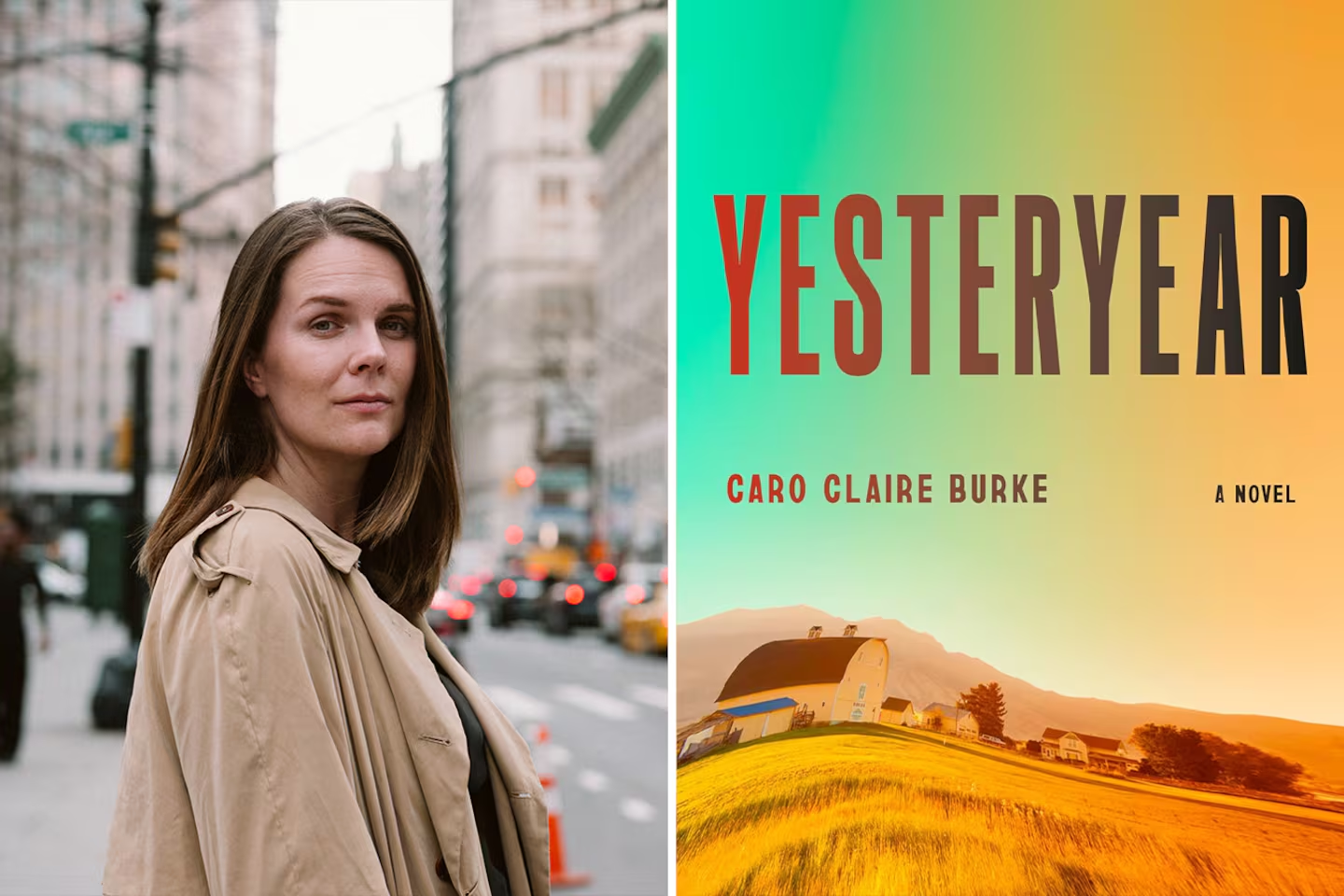
A tradwife wakes up in 1855. What could go wrong?
In winter 2024, author Caro Claire Burke found herself drawn to the rising trend of tradwife content.
Read more 22 bucket list activities in Greater Boston, for visitors (and locals, too)
“I just became very interested in the discourse around tradwives and the state of modern feminism,” says Burke. The videos of glamorous stay-at-homestead moms quickly led to the idea for “Yesteryear,” her new novel, out Tuesday.
For those not yet familiar with the genre: Imagine perky videos that marry the visual language of agrarian propaganda posters from Nazi Germany or Stalin-era Russia updated with American-style sex appeal and voracious capitalism. Or, more simply, Playboy magazine meets The Farmer’s Almanac. Large families and conservative Christianity predominate, but if Burke’s book teaches us anything, it’s that the real holy trinity at the center is made up of subscriptions, algorithms, and monetization.
The resulting novel, Burke’s first, is unusually ambitious for a debut novel, and also uncannily astute about the complicated, contradictory times in which we live. According to Burke, the book tumbled out of her when she found the lead character’s voice, which she uses to narrate an interwoven pair of timelines that both feature the woman caught in a trap of her own making.
As the book opens, Natalie Heller Mills is a “tradwife” influencer at the peak of her success.A young married mother of five, belly big with the sixth, she oversees a social media enterprise that churns out content about homeschooled children, homemade baked goods, free range eggs, and all the fruits of the homestead life. Never mind the farmhands and nannies who do most of the work behind the scenes, Natalie (assisted by her producer) presents her family and their Yesteryear Ranch as an avatar of American individualism and herself as “a flawless Christian woman. The manic pixie American dream girl of this nation’s deepest, darkest fantasies.”
But something happens to Natalie. She goes to sleep one night and awakens in an unfamiliar bed with children and a husband she can’t quite recognize. In the barn, she spots the notches on the wall measuring the children’s heights as they grow. The most recent year says 1855.
What follows is one of the year’s most relentlessly fast-paced and satisfying novels, a sharp and witty social satire that also works as a taut thriller and a vexing work of speculation.
We learn that Natalie has escaped a suffocating childhood to attend Harvard University, where she briefly samples the world’s secular wares before returning to the evangelical faith in which she was raised. When she meets Caleb, the youngest son of a prominent Conservative politician, she begins to map a journey that will take them to Yesteryear Ranch.
Burke grew up in Dartmouth, in a very different family and community than her protagonist.
”I had a great childhood,” she says. “My parents, from a very young age, gave me probably an inappropriate level of belief in what I could do.”
Still, early aspirations to a legal career fizzled, and a decade of odd jobs followed: “It’s been a long journey.”
After Burke, who cohosts the pop culture and politics podcast “Diabolical Lies,” first encountered tradwives on TikTok, which she downloaded (“on a whim”). Shesoonbegan seeing video after video of “these beautiful kitchens with the beehive ovens and these really happy women. I thought it was intoxicating,”she says.
Even now, she adds, after writing a novel about how false and dangerous the tradwife fantasy can be, “I still kind of can’t look away.”
Burke began recording and posting Instagram videos analyzing tradwife content through the lens of feminism. “It felt like there was kind of endless opportunity for conversation with it,” she says. “I just all seems so beautiful to me. And I’m very secular. My husband and I have a very progressive marriage. Why do I find this appealing?”
Read more At the MFA, the past and present converge in a fractious moment
Her curiosity led her to “lurk in Reddit threads” and seek out women who had left fundamentalist communities. “These women want to talk about what they went through and the weird contradictions. I couldn’t get enough of their stories, and it was striking to me how similar their experiences were of womanhood. Seeing women say again and again, ‘this is how I was told to act.’ You really start to see how powerful the programming is.”
“I think these communities really encourage women to roll out on an assembly line in terms of how they look and behave and what they value,” Burke says. But looking behind the cookie-cutter image led her to Natalie.
“Natalie is so acidic and ambitious,” Burke says. “She’s always thinking. So I kind of just closed my eyes and stayed very claustrophobically in her voice. I think that’s what ended up shaping the novel.”
“Fiction is very subconscious,” she continues. “You can try to do something all you want and it just ends up being something else.” After trying to write an opening chapter that would make Natalie likeable, Burke says she learned something. “By the end of the day, I just thought, well, that’s not what she is. And that was when I became excited.”
As the novel progresses, we learn that Natalie’s husband, Caleb, has also fallen prey to trendy internet coercion, dabbling in the so-called manosphere. Burke’s affection for Caleb (“he’s so bumbling!”) betrays the compassion with which she writes most of the book’s characters.
“He certainly isn’t perfect, but he really starts out as someone who could have ended up in a very different world,” she says. “And I think that there are so many economic and cultural factors that are influencing people to feel really aimless and lost.”
Some of those factors are explored in “Inside the Manosphere,” the documentary by Louis Theroux that looks at the boys and men who cling to a set of cultlike beliefs, all hinging on misogyny, to make sense of the world. It’s a natural fit for Natalie and Caleb: As a recent paper in Psychology of Women Quarterly argued, men who are attracted to the idea of tradwives also express misogynistic attitudes.
“They hate women,” Burke says.
And yet, she goes on, she wanted to explore the humanity of even unsavory characters with toxic belief systems. “I’m really not interested in moralizing,” she says. “I think a lot of contemporary fiction is very morally focused. And I just — maybe it was just finding Natalie’s voice. And as soon as I knew how terrible she was, I also just loved her.”
Despite the compassion she feels for Natalie, Burke’s aware she might face backlash for satirizing tradwives.
“I’ve been on social media for a while, so I kind of know the rules of the game,” she says. “I don’t worry or even think about anyone reading it, let alone tradwife influencers. Those women theoretically have a lot on their hands. If you have 10 kids and five cows, I think you have bigger fish to fry than reading my novel.”
There is a film deal already; with some details still under wraps, Burke will only say that “the team is very passionate about it, and we have a script that is currently in rewrites.” Another twist: Burke is pregnant with her first child. “It’s been a crazy year!”
Would she ever share the kind of content that helps Natalie and her fellow influencers amass an audience?
“God, no,” she laughs. “You couldn’t waterboard that out of me!”
On April 8 at 6 p.m., Caro Claire Burke will discuss “Yesteryear” in conversation with author J. Courtney Sullivan at the Brattle Theatre for the Harvard Book Store. Tickets are available at harvard.com/event/caro-claire-burke
Read more Filtering America’s 250th anniversary through the best picture nominees of its bicentennial year




Post Comment