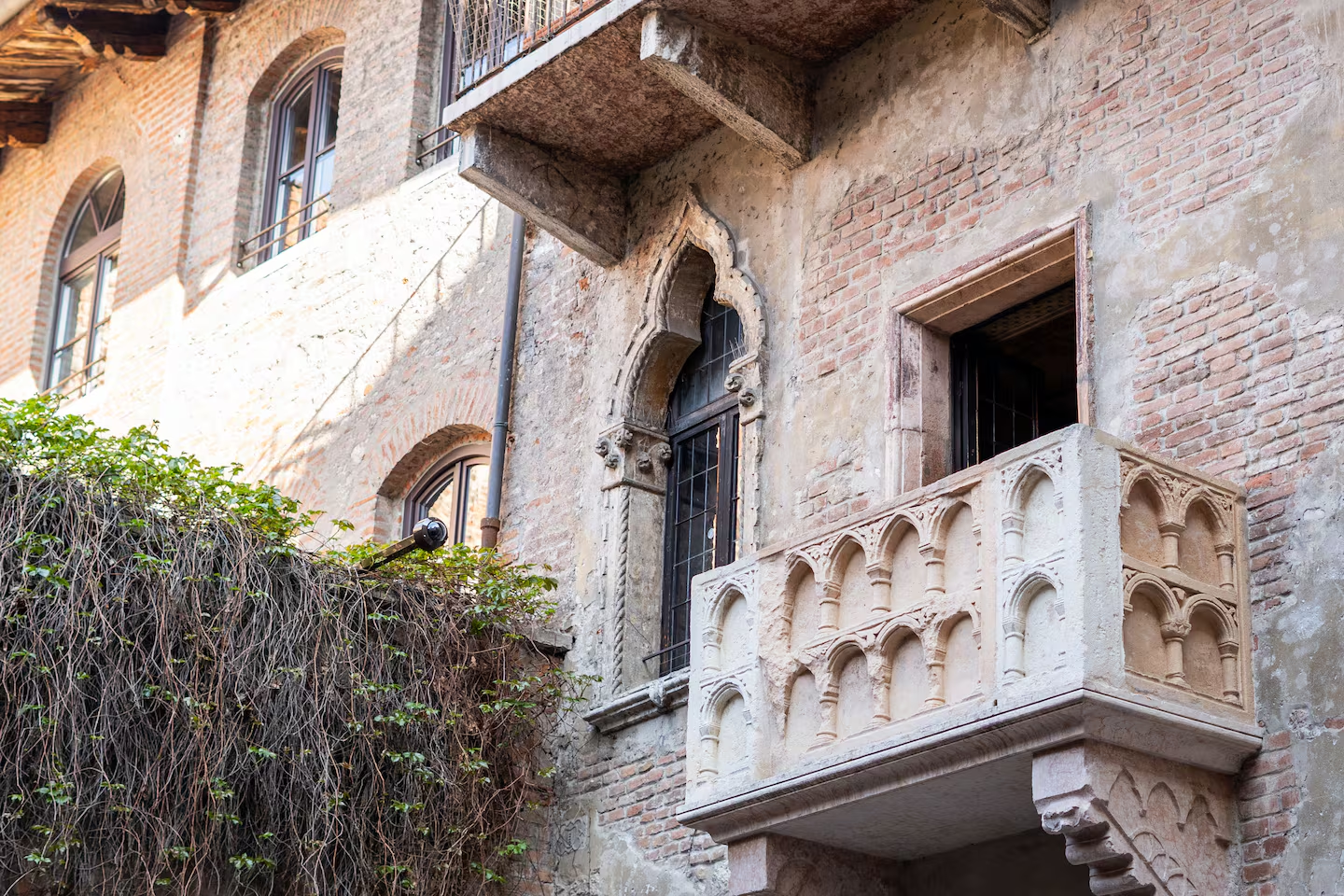
How the Juliet House shattered my fantasies
VERONA, Italy — They say you should never meet your heroes. Well, in my experience, the same goes for your bucket list travel destination.
Read more Azzedine Ounahi scores twice to help Morocco beat Canada in the World Cup round of 16
The moment we stepped off the train into Verona, we faced an uphill battle.
My two friends and I only had six hours in this so-called “city of love.” While I would’ve liked to spend more time here, we had already planned a bold itinerary for our Italy trip, stopping in three cities over the course of seven days.
As we booked our trains in the months prior, the three of us — Lizzy, my current roommate, whom I met two years ago; Katie, a longtime childhood friend; and I — decided we would take a detour to Verona, spending half a day there on our travel day from Venice to Florence.
For as long as I can remember, I’ve wanted to visit Verona, more so than any other part of Italy.
That’s because at the impressionable age of 9, I watched “Letters to Juliet” at my local movie theater, and I rewatch it now at least once a year. Starring Amanda Seyfried, the movie follows the story of Sophie, who discovers an old letter in the walls of Casa di Giulietta (the Juliet House) and ultimately goes on a journey to help a woman find an estranged lover. It was a real tradition for people to write to “Juliet” for love advice and stick their letters on the courtyard walls of the house, and Club di Giulietta (the Juliet Club) would reply to the letters. (However, the house itself was created in the early 1900s as a mere tourist attraction inspired by William Shakespeare’s famed star-crossed lovers.)
The movie has an air of warmth and spirit that planted a seed for two passions that I hold now: one for adventure and one for writing. For much of my childhood, I wanted to feel that sense of magic in person.
The first thing we had to do upon arrival was find a place to store our luggage. I found such a place on Google Maps that was an eight-minute walk away. Perfect.
We arrived at the address and found absolutely zero signage for it. Plus, every business nearby had its roll-down gates closed. Less than perfect.
This would soon become a pattern. We headed to the next spot, which led us to a tech convenience store.
Then, after stopping by two more luggage places and failing to find any open lockers, we nearly passed out from heat, dehydration, and hunger. We were in desperation mode.
Bracing ourselves for what we hoped would be our last attempt at luggage freedom, we rolled our suitcases over a half-mile of cobblestone, under the burning sun, bobbing through tourists and strollers like it was a sport, until we were greeted by a kind woman outside her luggage business. Finally.
After offloading, we immediately stopped by a grocery store for water and something to hold us over. We sat on the skinny concrete curb outside the store, in complete silence as we ate a bowl of fruit and prepared ourselves to, well, have fun.
We slowly walked around the center of town to regain our strength, strolling through the park and past the Arena di Verona (which is actually older than the Colosseum in Rome). Gradually, we made our way to the Juliet House, the main reason for this whole day trip.
The courtyard entrance that Google Maps took us to was blocked off by a black curtain. The security guards told us to go around the corner to the front instead.
We rounded the corner to see a massive line in front of the entrance, filled with people baking in the sun and showing their phone screens to the staff members. And that’s when it hit me — the house and courtyard are now ticketed. Separately.
For a long time, the courtyard was free to enter. But because of the rise in tourism, there is now an admission fee, implemented as of April 1. (We went on April 6.) Over the last few years, it seemed that Verona had been facing major overtourism problems, seeing up to a thousand simultaneous visitors to the house and courtyard at one point.
We already killed two hours between the luggage fiasco and refueling ourselves, so I didn’t think it was worth it to go before we left for our train. But Katie, recalling memories of watching the movie with me on my basement couch, insisted we see the wall of letters. She quickly booked the earliest time slot for entry to the courtyard: 5 p.m. Our train was at 6:15 p.m.
It was now 3 p.m. Having a couple of hours to kill before we went back, we decided to stop for a sit-down meal. We were so hungry that it wouldn’t have even mattered if the food was any good.
We tried renting bikes to get to a cafe nearby, but the app didn’t accept my credit card or Katie’s phone number. Lizzy, who managed to book a bike, decided to meet us there. (Her two-minute bike ride would later cost her about $53 because the docking station didn’t register that the bike was ever returned. It was.)
At the cafe, we sat outside on the patio right along a low stone wall. As I looked to the right, I was met with a breathtaking view of the Piazzale Castel San Pietro, reflecting the afternoon sun, sitting high on the hilltop across the river.
All of our travel hiccups had somehow led us to the most beautiful lookout in the city. And just like that, the three of us had a newfound sense of joy.
We talked about everything — family, childhood, career, love, friendships. We voiced it all, from the hardships of the jobs we moved for to the relationship lessons we wish we didn’t have to learn the hard way. We dove into parts of our lives that we hadn’t thought about in a long time. We were each other’s sounding boards and shoulders to lean on.
Over some cappuccinos and pizza, it felt like all our troubles slipped away. Being alongside two of the most important people in my life made this Italian waterfront feel like a familiar place.
As the clock ticked closer to our time slot, we paid our bill and walked back to the Juliet House. It was 4:45 p.m., and we were the first in line for the 5 p.m. ticket wave.
We ripped out lined pages from Lizzy’s journal for our love letters and used each other’s backs as a flat surface. We wrote down what we had just unraveled at the cafe: Lizzy’s new relationship, Katie’s desire for a new connection, and my own uncertainties about dating after ending my first long-term relationship.
We finally made our way into the lobby, a white room lined with red carpet and velvet ropes — nothing like I’d imagined it would be. The walls were lined with digital movie posters of every Romeo and Juliet-related film I could name, including the 1996 version with Leonardo DiCaprio and Claire Danes and the 1961 film “West Side Story.”
My fantasy was starting to fade.
We were led into the theatre area, with again, more movie promotional materials. At the other side of the theater was the entrance to the courtyard — yes, the courtyard.
I was instantly met with a wall of people queuing from one side to the other, waiting to take photos with the famous bronze statue of Juliet herself. I watched the wide grins on tourists’ faces behind their cameras as they captured loved ones touching Juliet’s shiny right breast. A gesture of good luck in love, apparently. We didn’t bother.
We stepped into the gift shop next door, and it felt like any Dollar Tree in February, filled with reds, pinks, and heart-shaped decor. The keychains and mugs in that room could’ve been in a CVS aisle with “Be Mine” candies and Russell Stover chocolates, and I wouldn’t have blinked an eye. For a place that was supposed to be the birthplace — the holy grail — of love stories, this fell far from the mark.
There was also one major piece of this puzzle missing: the wall of letters. I asked the man behind the gift shop counter where it was, and he looked at me with a strange expression.
“We don’t do that anymore,” he said. He told me that they are now collected in a mailbox inside the Juliet House, which was more of a museum, holding more medieval-era decor and offering access to the famed balcony. But this was sectioned off by a separate ticket.
Determined to have our letters sent — to have some semblance of the Verona experience I had dreamed of — I crossed to the other side of the courtyard and asked a man in a black suit at the entrance if he could mail the letters for us. I handed him our three folded pieces of paper and watched as he put them behind a desk.
Who knew if they would find their way to the Juliet Club. But at that point, it didn’t matter.
I already knew that I was a sucker for nostalgia and a romantic experience. I mean, this house had no real historic significance to Shakespeare. Maybe the house itself (that we didn’t get tickets for) felt more authentic. But the rest of it was gimmicky and tacky.
Even the replica “Cheers” bar in Boston felt more real than this. And at least that one is free to walk into. If I wanted to see movie posters, I would go to an AMC. And if I wanted to buy heart trinkets, I’d go to Walgreens.
But then I looked over at my friends giggling over some of the gift shop items in the corner.
I thought about our lunch along the water. I thought about us sharing stories and our inner monologues, even the ones that didn’t make sense. I thought about us laughing hysterically at the hard things in our lives. I thought about those letters that we wrote on each other’s backs. We even read them aloud to each other before heading into the courtyard. And in the end, we weren’t really writing to some organization that might reply. We were writing to each other. They are my Juliet.
Shortly after, we rushed to the train station and headed to Florence. As the train sped down the countryside, I looked over and saw they were asleep. Good, I thought. Because I knew that we’d be doing this all again tomorrow, likely facing a new set of challenges. But even if everything took a wrong turn, I knew that they would be by my side.
Read more Haverhill’s shoe legacy steps into spotlight with new exhibit
So “city of love” may have been misleading, but maybe it wasn’t that far off.
Kelly Chan can be reached at [email protected].





Post Comment