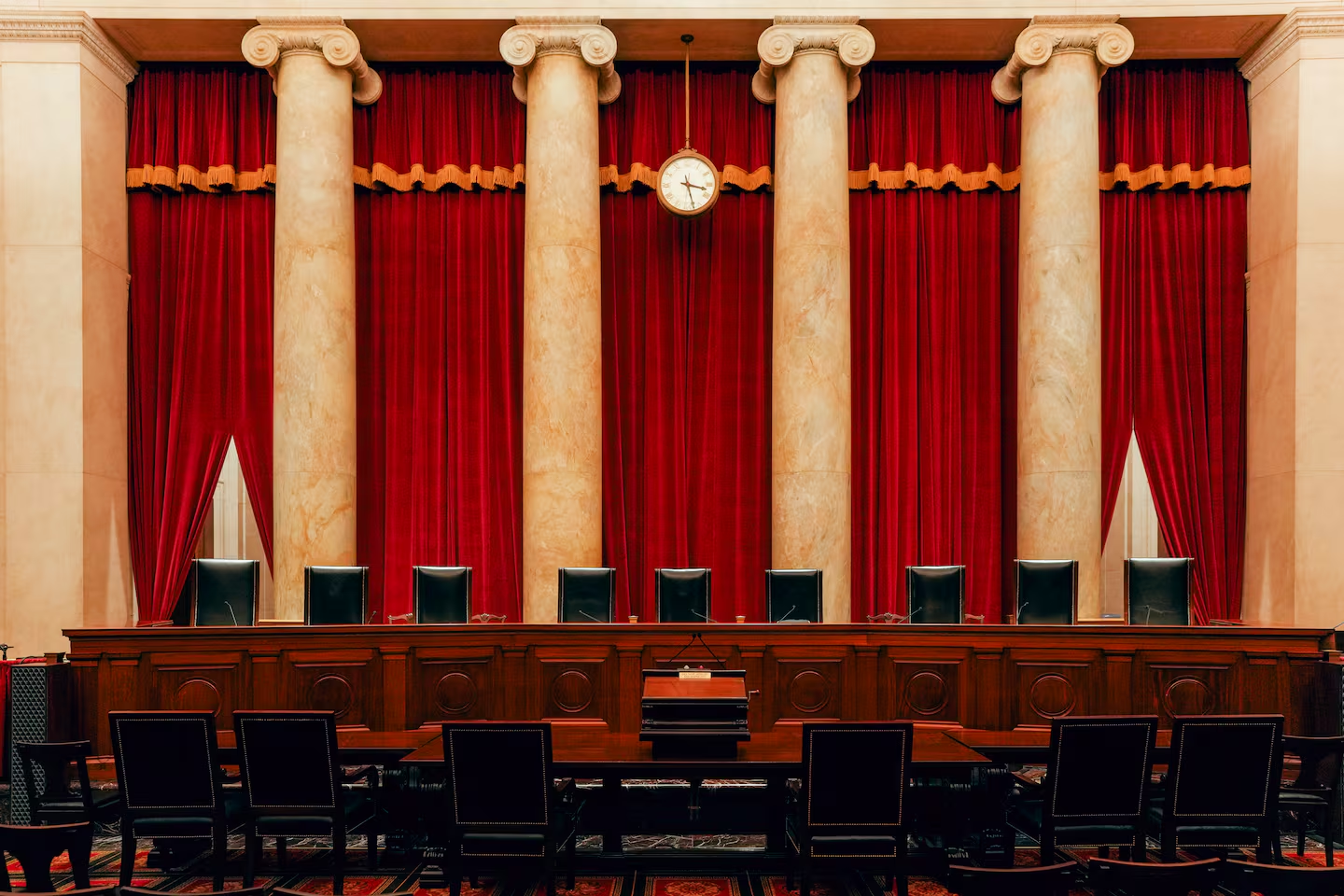
The birthright decision was surprisingly close, some legal scholars say
On the final day of its term, the Supreme Court issued a majority opinion with a clear message: Birthright citizenship is a right guaranteed by the 14th Amendment of the Constitution.
Read more Birthright citizenship ruling brings relief to N.H. plaintiffs, ACLU attorney says
That decision on Tuesday, striking down President Donald Trump’s executive order limiting birthright citizenship, reaffirmed decades of legal thought and practice. But some civil rights advocates, lawyers and legal scholars were surprised that four justices — Clarence Thomas, Brett Kavanaugh, Samuel Alito and Neil Gorsuch — said they did not see birthright citizenship as a constitutional right for certain groups.
(Kavanaugh agreed with the majority’s decision to strike down Trump’s executive order, but based his reasoning on a federal statute rather than on the 14th Amendment.)
In the end, birthright citizenship as a constitutional right survived by one vote — the latest sign of how far the conservative legal movement has shifted on the issue.
“This should have been a 9-0 decision,” said Bethany Li, executive director of the Asian American Legal Defense and Education Fund, which filed an amicus brief against the president’s order.
For more than a century, there was broad consensus among most legal scholars and the courts that the 14th Amendment extended citizenship not just to the children of formerly enslaved people, but also to nearly all babies born within the United States. It was only when Trump began running for office, in 2015, that a once-fringe academic theory — that the 14th Amendment was only about slavery, and did not cover the children of temporary visitors — started to gain political and legal traction.
The momentum culminated in Trump’s executive order on his first day back in office last year to end birthright citizenship for the children of immigrants in the country illegally and some temporary foreign residents.
“A year and a half ago, people said there was no support for this view, that it was ahistorical and atextual,” said Ilan Wurman, a law professor at the University of Minnesota who filed an amicus brief in support of Trump’s executive order. “So to get four votes for the Trump administration’s position here is quite a coup.”
To be sure, the ruling was ultimately a win for proponents of birthright citizenship.
Chief Justice John Roberts wrote his majority opinion based on the 14th Amendment, reflecting a desire, some legal scholars said, to definitively put to rest the debate around birthright citizenship. The 14th Amendment states: “All persons born or naturalized in the United States, and subject to the jurisdiction thereof, are citizens of the United States and of the State wherein they reside.”
“I think this issue has been settled for another 100 years,” said John Yoo, a law professor at the University of California, Berkeley, who was a top Justice Department lawyer during the George W. Bush administration.
Roberts’ opinion, Yoo said, “is very confident and declaratory about the meaning of the 14th Amendment.” It was a sign, he said, that affirming the principle of birthright citizenship for almost everyone was “never in doubt.”
Still, Yoo and other scholars said, there is also no question that what was once thought of as an unorthodox legal theory had become more popular among conservative legal scholars, driven partly by new research on the history of the 14th Amendment.
To understand the degree to which a narrow reading of the 14th Amendment’s citizenship clause was once considered a fringe idea, consider one of the last times birthright citizenship was seriously challenged, said Amanda L. Tyler, a constitutional law scholar at UC Berkeley. Tyler wrote an amicus brief supporting birthright citizenship as a right guaranteed by the Constitution.
Read more Despite some losses for Trump, Supreme Court delivers enduring conservative wins
In 1942, a group known as the Native Sons of the Golden West brought a lawsuit arguing that people of Japanese ancestry born in the United States were “enemy aliens” and therefore ineligible for citizenship and the right to vote.
It was just after Japan’s attack on Pearl Harbor. The U.S. government was in the midst of sending 100,000 American citizens and other residents of Japanese ancestry to concentration camps. It had declared Japanese Americans as “enemy aliens” and therefore ineligible to serve in the U.S. military.
Even in that moment of heightened anti-Japanese sentiment, the 9th U.S. Circuit Court of Appeals cut off oral arguments in the case, asserting that the question of birthright citizenship was not up for debate.
The Supreme Court declined to hear an appeal.
“There was no appetite for revisiting these questions, much less to give credence to the arguments that were an assault on birthright citizenship,” Tyler said. “And yet today, the Supreme Court barely affirms those same precedents by one vote.”
Since the Supreme Court decides cases by majority vote, rulings by 6-3 or even 5-4 ultimately have the same effect as unanimous ones. But 9-0 rulings are seen as carrying more weight, which is why, for instance, Chief Justice Earl Warren worked so hard in 1954 to unite the court in Brown v. Board of Education, the school desegregation case.
Michael D. Ramsey, a University of San Diego law professor and former clerk to Justice Antonin Scalia, said he was especially surprised that there was not more support from some of the more “textualist and originalist-oriented” justices for Roberts’ argument, which he saw as strongly rooted in the original understandings of the text.
The dissenting opinions appeared “more interested in exploring the intent of the people who adopted the 14th Amendment” rather than the text and history, Ramsey said.
“It confirms that it’s a really serious substantive division not just among legal scholars but among justices that are coming out of the conservative legal movement,” he added.
William Baude, a constitutional law scholar at the University of Chicago, said that while the majority’s argument was broadly persuasive, the case also involved highly complex questions around issues like the meaning of “jurisdiction,” as reflected in the differing opinions among the dissenting justices.
Whether the emergence of these alternative constitutional interpretations will also affect public opinion remains to be seen. A majority of Americans — about 55% — said they oppose ending birthright citizenship, according to a Reuters/Ipsos poll taken last week.
“The question is, in the long run, will the arguments of the dissenters be persuasive? Will other people keep pushing this issue?” Baude asked.
“We don’t know what will happen,” he added. “The Supreme Court doesn’t have the power to end debate.”
Read more Retrofitted Qatari jet takes flight as Air Force One for Trump’s trip to North Dakota
This article originally appeared in The New York Times.


Post Comment