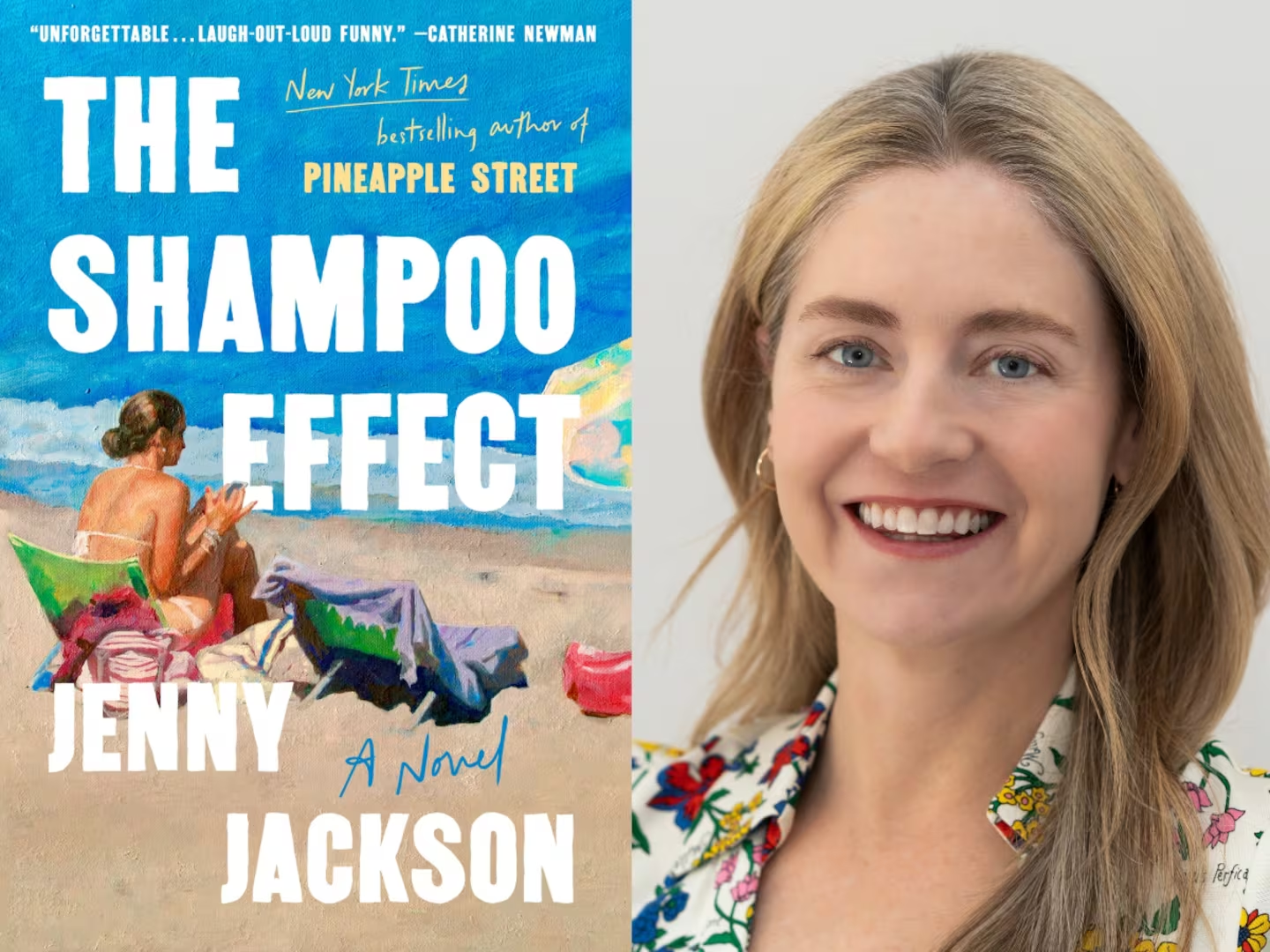
Jenny Jackson’s ‘The Shampoo Effect’ may be the most Ipswich book ever
Author Jenny Jackson’s second novel — “The Shampoo Effect,” out June 30 — could double as a love letter to Massachusetts’ coastline.
Read more Comedian Bill Maher is set to receive Mark Twain Prize at Kennedy Center
The story takes place in a fictional seaside village, but the very real North and South Shores provide atmospheric color: fried clams at Woodman’s of Essex, hot toddies made with honey from Russell Orchards, wedge salads at the 1640 Hart House. On a tour of the Crane Estate — where Jackson worked summers as a cater waiter as a teen — protagonist Caroline Lash connects with a Crocs-wearing conservationist, Van, who works for the Trustees of Reservations. In his impassioned pursuit for cleaner shores and protected wildlife, Caroline falls for him, only to learn his former childhood sweetheart/recent-enough ex, Bailey, is pregnant with their child — and it’s all anyone can talk about.
While Jackson’s 2023 debut, “Pineapple Street,” inhabited the charmed, brownstone-lined “Fruit Streets” of Brooklyn Heights, where the author resides with her family, her new novel is an homage to her hometown of Ipswich. In “Shampoo,” nepo baby Caroline is the recipient of a writing fellowship and trades her life in New York publishing for Greenhead, Mass., which shares the name of Essex County’s ravenous, beach-plaguing flies — an insect Jackson aptly deems “the pit in the cherry.” The narrative switches between Caroline and the perspectives of Bailey and other members of her and Van’s lifelong friend group. But Caroline’s role as an awkward newcomer anchors the plot.
The novel was, in part, inspired by two local legends: former Pats QB Tom Brady — and his mid-aughts breakup with Longmeadow native Bridget Moynahan, whose pregnancy shared headlines with his budding relationship with supermodel Gisele Bündchen — and novelist and fellow Ipswich-ian, John Updike, who famously examined the throes of erotic restlessness in his own backyard in 1968’s “Couples.” (In it, Updike renamed his ‘Not Ipswich’ town Tarbox, which happens to be the name of Caroline’s Updike-esque benefactor’s own Great American Novel.)
Jackson, whose day job is as the vice president and editorial director of fiction at Alfred A. Knopf, says she sent Updike’s son, Michael Updike, an advanced reader copy and letter explaining her intent to channel his father’s legacy. She didn’t want to “Bad Art Friend” the late writer’s Ipswich years, but Michael happily approved and provided additional family lore. (“We’re now email buddies,” Jackson adds.)
On July 16, the Williams College alumna returns home for a reading of what the hosting Ipswich Public Library has deemed “the most Ipswich book ever known to man.” Before then, Jackson hopped on a video call with the Globe.
Q. “Pineapple Street” was written during the COVID-19 pandemic, and you’ve said it came from a place of missing socializing and parties. Was there a similar type of longing that you channeled here, as well?
A. One of the things that people with young children wrestle with is that your time is not your own, and your friends are no longer the primary relationship of your life. You get married, but when you have children, you don’t get to choose who you spend your Saturdays with. A lot of my relationships at this point in life take place mostly on text message. So, this is a little bit of a wish fulfillment, of what would it be like if I got to still be with my best friends every day.
Q. Privilege is a recurring theme in your novels — “Pineapple Street” was about generational wealth and marriage, but “The Shampoo Effect” does something different, almost New England. What did you want to explore in this novel?
A. I walked to “Pineapple Street,” not [with my] knives sharpened, but I was ready to make fun of those characters. With “The Shampoo Effect,” it’s not as satirical. I love these characters and all of their foibles.
Van has a kind of privilege that he isn’t really aware of, but that has made him culturally different than someone like Bailey, who is not from a hyper-educated, old money family. Bailey makes decisions that are not as high class as Van. And Van, without realizing it, passes a lot of judgment on her for her consumerism or what she eats, what she drinks, how she keeps her house. There are all these micro-differences in the different kinds of privilege that they have that make them clash with each other.
Read more ‘Finally, I want people to see it.’ Maine exhibition showcases a homegrown artist’s body of work.
Q. As an editor, has your relationship with your writers shifted at all? Do you see them as peers? Go to them for advice?
A. I have a lot of church and state rules that I try to keep. I would never give a new writer a draft of my book to read because I get paid to edit their books. They don’t get paid to look at mine. Part of my job as an editor is to be their strongest champion, so when I’m working on their books, I want them to forget that I’m a writer. I want them to feel like their book is the only thing, because they deserve to have that feeling.
But I’m able to have much more informed conversations with [fellow authors] about the emotional texture of publication; like, talking to them about how to deal with bad reviews, when to respond and not respond to sort of online chatter.
Q. In a similar vein, several of the well-known titles you’ve worked on — ‘Yesteryear,’ ‘Crazy Rich Asians,’ ‘Tomorrow and Tomorrow and Tomorrow’ — explore the ‘insider-outsider’ dynamic, and it appears in your own work, as well. What do you think draws you to this idea?
A. It’s really funny that that has clearly arisen as my main interest. That’s less me thinking, that’s something I should write about; it’s truly how I view the world. I just have this deep interest in cultural groups from an anthropological perspective — whether that cultural group is a new summer camp or a workplace or a family or a group of friends.
The outsider coming in is the absolute best fresh-eyed lens to explore a place. It’s sort of like when you walk into someone else’s house and it smells like lemons here, and the person who lives there has no idea it does. You get that clarity about a group if you’re entering through a newcomer’s eyes.
Q. The shampoo effect, as a concept,was something I had to look up on Urban Dictionary — so, how would you describe it to readers before they pick up the book?
A. It’s a hangover phenomenon. It’s like the hair of the dog. But, for me, it’s about how some things never really leave your system, or you’ve become so immersed in something, that if you’ve always loved someone and situations change, you’re still going to have that love for them. It’s about the way that these long-term relationships are really just never going to fully wash out.
Interview was edited and condensed.
Jenny Jackson for Ipswich Public Library with Tidal Pages Bookshop. Ipswich Community House, Living Faith Church, 31 North Main St., Ipswich. Registration required. Additional events July 13 at OceanCliff Hotel in Newport, R.I., and Sept. 17 at Beacon Hill Books.
Read more ‘Avatar: Fire and Ash,’ plus more new movies and TV shows to watch this weekend





Post Comment