To mark America’s 250th, Congress is burying a time capsule. Here’s what New England contributed.
It’s July 4, 2276. American representatives unearth a 50-inch box from the underbelly of the Capitol and peer inside, hoping for historical tidbits or words of wisdom from the leaders of 250 years before.
Read more Meet 3 members of Albania’s ‘Flamingo Revolution’ trying to torpedo Kushner-linked development
The contents may be a mystery to these imagined future Americans. But not for us — inside, they will find embellished pieces of metal and granite, commemorative images from 1776, even a map of Vermont’s cheeses. And many, many letters.
Beyond the spectacle of a White House UFC fight and a 16-day state fair, state delegations in the 119th Congress are capturing the nation’s semiquincentennial legacy the more traditional way: in a time capsule. Actually, in two time capsules.
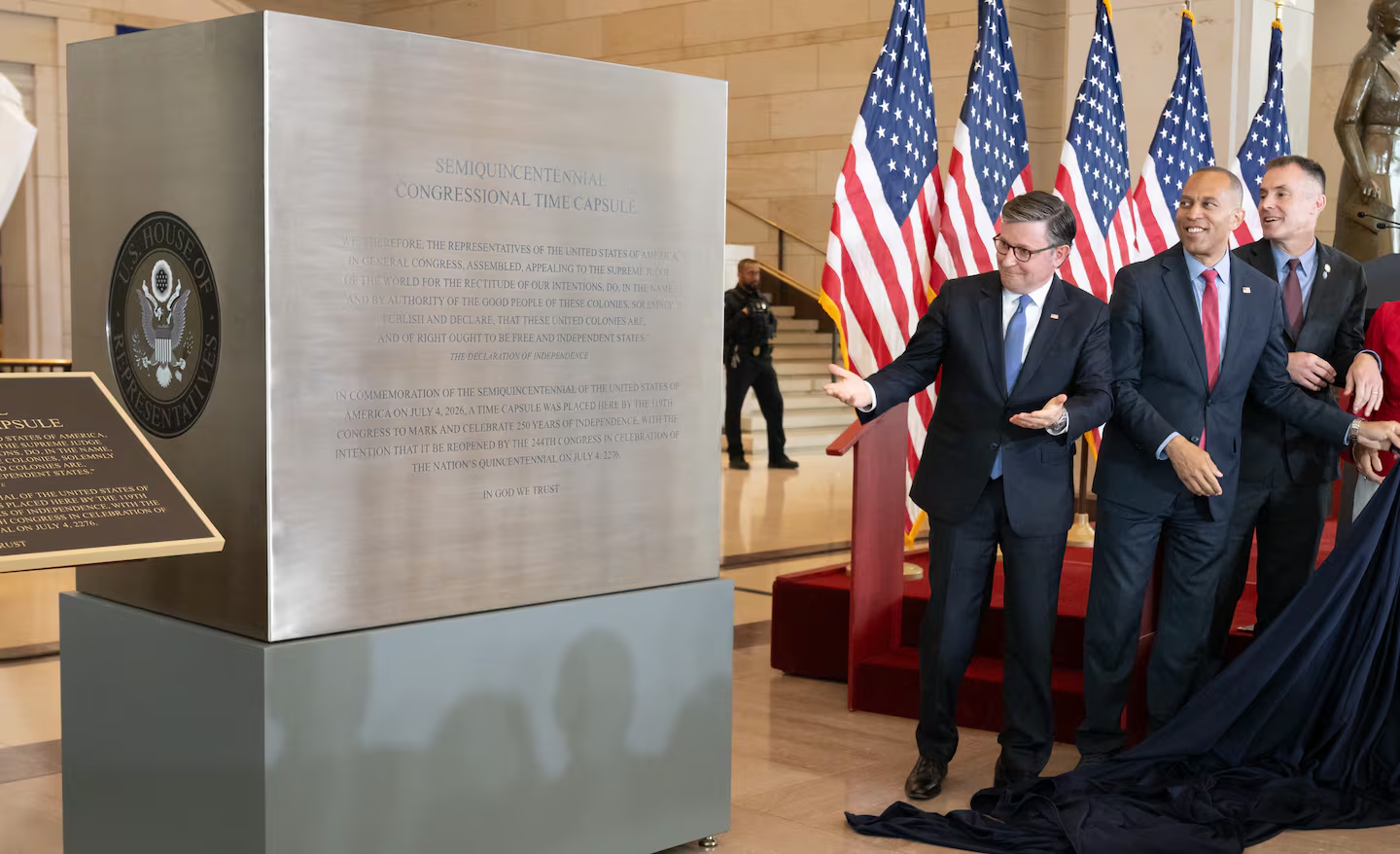
The first, a 50-inch by 32-inch by 48-inch capsule, will be buried in the Capitol Visitor Center, according to the Semiquincentennial Congressional Time Capsule Act passed in February. Contents include joint submissions from Senate leadership, House leadership, and delegations from each state and territory.
The fortified metal container, engraved with a passage from the Declaration of Independence and a dedication from Congress, was unveiled on June 24 at a ceremony in Emancipation Hall.
“It is fitting that those who are stewards of this chapter of history can now, in some small way, become a part of that history, safely stored away in this time capsule for generations to come,” said Architect of the Capitol Thomas E. Austin, whose office is responsible for the capsule.
As the Statue of Freedom loomed overhead, the architect joined House Speaker Mike Johnson of Louisiana, Minority Leader Hakeem Jeffries of New York, and a bipartisan group of lawmakers in giving remarks.
Senator Jeanne Shaheen, a Democrat from New Hampshire, held up the piece of granite her state is contributing, symbolic of the granite from New Hampshire quarries used to construct parts of the Library of Congress and the Washington Monument.
“Like every generation, they were trying to leave something behind for those who followed,” she said. “The institutions they built continue to serve New Hampshire and the country today.”
The second capsule, named “America’s Time Capsule,” has been years in the making. It’s a principal initiative of America250, a nonpartisan commission made up of bipartisan members, established by law in 2016. (America250 is separate from Freedom 250, a public-private partnership created by President Trump in 2025 to sponsor events such as the ongoing “Great American State Fair.”)
The contents of the 900-pound steel “America’s Time Capsule” have already been made public and include contributions from states and territories, the America250 commission, and its partner organizations. An orange iPhone 17 Pro Max, a gold medal from the 2026 Cortina Winter Olympics, a Claude AI prediction of California in 250 years, and a pocket Constitution signed by 11 past and current Supreme Court justices are some items on the list of memorabilia. It will be buried on July 4 at Independence National Historical Park in Philadelphia, Pa.
Time capsules have been a consistent feature in American independence celebrations, dating back to the “Centennial Safe.” In 1876, New York publisher Mrs. Charles F. Diehm sealed photographs, autographs, and a list of 80,000 government employees in an iron safe with glass doors, according to National Archives records. President Gerald Ford unveiled the contents in the Capitol on July 1, 1976 — the bicentennial.
The bicentennial commission buried its own National Bicentennial Time Capsule that year, and states and territories created individual collections. The Bicentennial Times, the commission’s newspaper, wrote that local time capsules were collecting “everything from ears of corn to automobiles in everything from empty fire extinguishers to waxed wooden boxes.” (It remains to be seen how those items will hold up on the tricentennial in 2076.)
New England, as the country’s oldest region, holds a special place in the history of time capsules. As documented by a letter from Smithsonian Institution Secretary Lonnie G. Bunch III for the America250 effort, the first known American time capsule was buried by Paul Revere and Samuel Adams in the Massachusetts State House in 1795.
“Though I cannot know precisely what the two men were thinking … I imagine they felt that their lives were worth remembering,” Bunch wrote.
New England states drew on that legacy for their contributions to the 250th anniversary capsules. Here’s what we know about their offerings.
Massachusetts
Congressional capsule:
- Clad half-dollar coin from the Naismith Memorial Basketball Hall of Fame in Springfield, Mass.
- Letter signed by the Massachusetts delegation
“Whether through education, health care, or sports, Massachusetts leads the way,” Congressman Richard Neal said in a press release. “What better way to commemorate that than by celebrating the origins of one of the world’s most popular sports, when James Naismith first tossed a ball into a peach basket at Springfield College in 1891?”
America250 capsule:
- Archival print depicting the Boston Massacre
- Letters from John Hancock, John Adams, and Benjamin Franklin
- Medallion honoring Evacuation Day, the end of the siege on Boston in March 1776
- Letters from Governor Maura Healey, Lieutenant Governor Kim Driscoll, and the Massachusetts250 commission
New Hampshire
Congressional capsule:
- Original 1819 piece of granite from the New Hampshire State House, embellished with the state’s seal
America250 capsule:
- Picture of the flag emblem for the Second New Hampshire Regiment of the Continental Army
- Brochure of celebratory events by the New Hampshire Historical Society with a timeline of revolutionary history
- Schedule of events poster for July 4, 2026
Rhode Island
Congressional capsule:
- Ornament depicting the 1776 , a break from England by the then-Colony that predated the Declaration of Independence by two months
America250 capsule:
- Ornament of six soldiers in the First Rhode Island Regiment, created last year by the Rhode Island Secretary of State
- Coin honoring the Rhode Island 250 commission’s honor flight initiative to bring veterans to Arlington National Cemetery and Washington, D.C.
- Letter from the Rhode Island 250 commission
Maine
Congressional capsule:
- Copy of classic children’s book “Blueberries for Sal”
- Letters by Senators Angus King and Susan Collins, Congresswoman Chellie Pingree, and Congressman Jared Golden
- Challenge coin from Senator Collins
- Three photos of the Maine delegation
Congresswoman Pingree paid tribute to “Blueberries for Sal” in her letter, calling Mainers “as resilient as wild blueberries.”
“We adapt to harsh, unforgiving environments and grow back collectively because, not in spite of, disruption,” she wrote.
Read more US lags other countries on social media restrictions for kids as reform push grows
America250 capsule:
- Whale bone from a North Atlantic right whale, a critically endangered species found in New England
- Woven bookmark from the Wabanaki Native American nations
- Postcards displaying maps of Maine
- Poem entitled “This Home We Carry,” by Maine’s poet laureate Julia Bouwsma, written and recited for Governor Janet Mills’s second inauguration
- Letter from Governor Mills
Vermont
Congressional capsule:
- Maps of local cheese and maple creemees (a soft-serve ice cream unique to Vermont)
- Artistic piece called “Freedom and Unity: A Graphic Guide to Civics and Democracy in Vermont” by the Center for Cartoon Studies
- Newsletters from Senators Bernie Sanders and Peter Welch and Representative Becca Balint
America250 capsule:
- Ornament of Mount Independence, a key Revolutionary War defensive point
- Ornament honoring the battle of Hubbardton in 1777, the only battle fought entirely on Vermont soil
- Ornament of the Old Constitution House, where the first state constitution was adopted on July 8, 1777
- Ornament of the Bennington Battle Monument, the state’s tallest man-made building




Post Comment