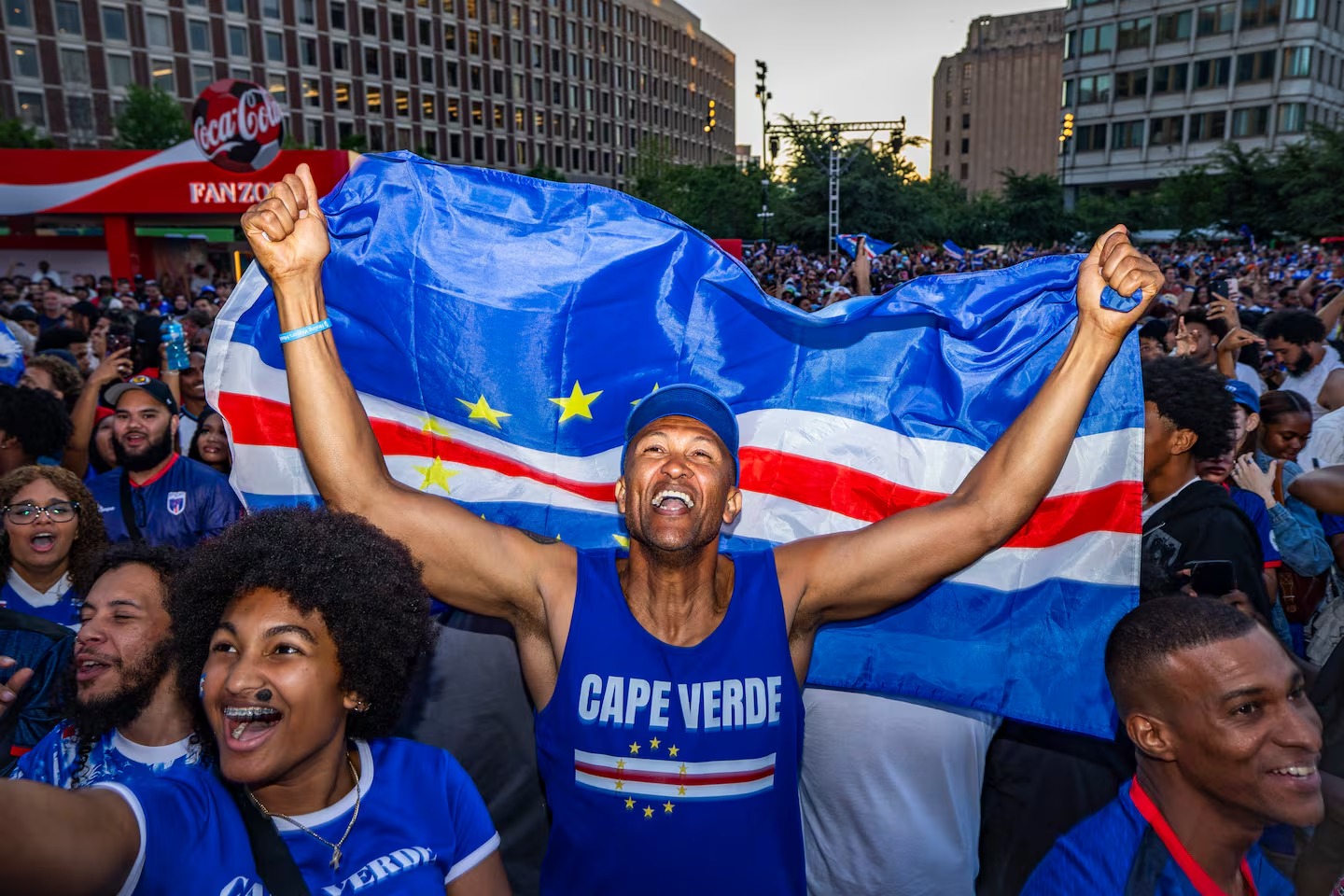
‘It’s wonderful for us as a community’: Cape Verdeans relish new global recognition after World Cup heroics
Over the last two weeks, Cape Verdeans have taken to the internet to celebrate their new reality — “we don’t have to explain where Cape Verde is anymore.”
Read more Longtime Bruins announcer Jack Edwards starting to find his voice again with help from AI
The refrain has whizzed through social media in the days after the country stunned the footballing universe when they held current European champions and 2010 World Cup winners Spainto a draw in their first ever game at the World Cup.
The small island nation off the coast of West Africa — for those who may still be unaware — followed up that performance with another thrilling display against South American powerhouse Uruguay and secured another draw, giving themselves a terrific opportunity to advance to the next stage of the tournament when they matched up against Saudi Arabia on Friday.
Cape Verde communities from Rhode Island to Brockton to Boston are celebrating the historic recognition of their country and its ambitions — their team had made its mark.
And then they made history again Friday night, with a 0-0 draw against Saudi Arabia. With that result, they officially advanced to the knockout round for the first time.
“For us, the joy and pride is that folks now know who we are, the rest of the world knows who we are, as an ethnicity, as a country,” said Darlene Spencer, the board president of the Cape Verdean Association in New Bedford.
Even in New England, where tens of thousands of Cape Verdeans live, the community has sometimes been misidentified. Spencer said that Cape Verdean are often asked if they are Dominican, Puerto Rican, or Indian and constantly have to remind people that they are African.
But after this World Cup, no more.
“Now at least if somebody asks … you can just say, ‘Google it, and everything will come up,’” she said. “You have people on Instagram and Facebook rooting for Cape Verde, it’s amazing. It’s wonderful for us as a community.”
Cape Verdeans have been part of New England history going back to the lucrative whaling trade in the 1800s. In the South Coast of Massachusetts, the industry propelled New Bedford to become one of the wealthiest cities in the world, helped by Cape Verdeans who were brought on to those whaling ships in their home islands back to America to work.
Their presence has shaped the identity and history ofNew Bedford and the region — the first Cape Verdean Roman Catholic community in the Americas is in New Bedford — and their showing at this World Cup is a testament to the community’s perseverance.
That history is now made easier to teach after the team’s magical run, according to Joe DaMoura, executive director of the Cape Verdean Museum in Pawtucket, R.I.
“We don’t have to answer the first question: ‘What is Cape Verde?’ Now, we could go a little deeper to teach them the history and culture,” he said.
“It’s a reaffirmation of what we can do. It’s nice to see the rest of the world jumping on the bandwagon,” addedCarlos A. Almeida, a professor of Portuguese and director of the LusoCentro at Bristol Community College in Fall River.
Cape Verde’s success at the World Cup and the unbridled joy it has inspired across New England has also shone a light on the diversity of communities that make up the region.
Look to the Moroccan fans in Revere, Haitian supporters in Greater Boston, Ghanaian communities in Worcester and Providence, Portuguese soccer obsessives on the South Coast, andthe Cape Verdeans who took to the streets in Brockton amid their country’s success on football’s grandest stage:They have all shown out for their heritage during this World Cup at a time when it has not been easy to celebrate the immigrant experience in America.
“I don’t think people realize how much New England is a melting pot, especially for immigrants from all over the world,” said Yasmina Carvalho, head coach of the women’s soccer team at Bridgewater State University. “It’s just so cool to see that everyone’s kind of being connected through their cultures instead of other things that have been going on in the world today, and that is really awesome to see.”
Carvalho grew up in Brockton and at times would be the only female person of color playing soccer. The success of Cape Verde at this year’s World Cup could be a catalyst for young boys and girls across the diaspora to see themselves in the team and find inspiration to pursue football, she told the Globe.
“It starts with a little kid like me, boy or girl, just looking at the TV and seeing someone who looks like them, number one, visually, but also can connect to their culture, and seeing them be so successful,” she said.
She pointed to Cape Verde’s goalkeeper Josimar José Évora Dias, known as Vozinha, as an example: He is relatively unknown at 40 years old but emerged as a superstar after his man-of-the match performance shut out the mighty Spain in the country’s first game.
“[He] has been going after his dream of soccer for many, many years, and he gets this one opportunity, 90 minutes, and his entire life has completely changed,” Carvalho said. “Those types of stories, I think, will reach out to those young kids who feel like it’s difficult.”
For Herminio Furtado, the head coach of men’s soccer at Brockton High School and the semi-professional team Brockton FC, Cape Verde’s World Cup run has illustrated what the community can achieve at the highest level when investment is poured into young people.
“The success of the national team is proof that indeed we do have talent and it’s a kind of untapped talent that we have in this community and I’m so happy that people will take a deeper look at what we have and continue to provide more opportunities for our young people,” he said.
Another source of inspiration: Kevin Pina, whose fizzing strike against Uruguay was Cape Verde’s first ever goal at a World Cup. As a young player, Pina spent some time in Massachusetts. Former Cape Verde national team player Carlos Moraissaw him play at a park and felt he had the potential to be a top player.
“They have a leadership [quality], like a leader inside the field,” he said. “They have a good sense of position in the field.”
For Spencer,the head of the association in New Bedford, Cape Verde’s achievement at this World Cup can only boost the motivation of young people across communities.
“Any young person that sees this gives them the motivation … ‘I can do this … I can be that person, whether [in] soccer or basketball, or anything’,” she said.





Post Comment