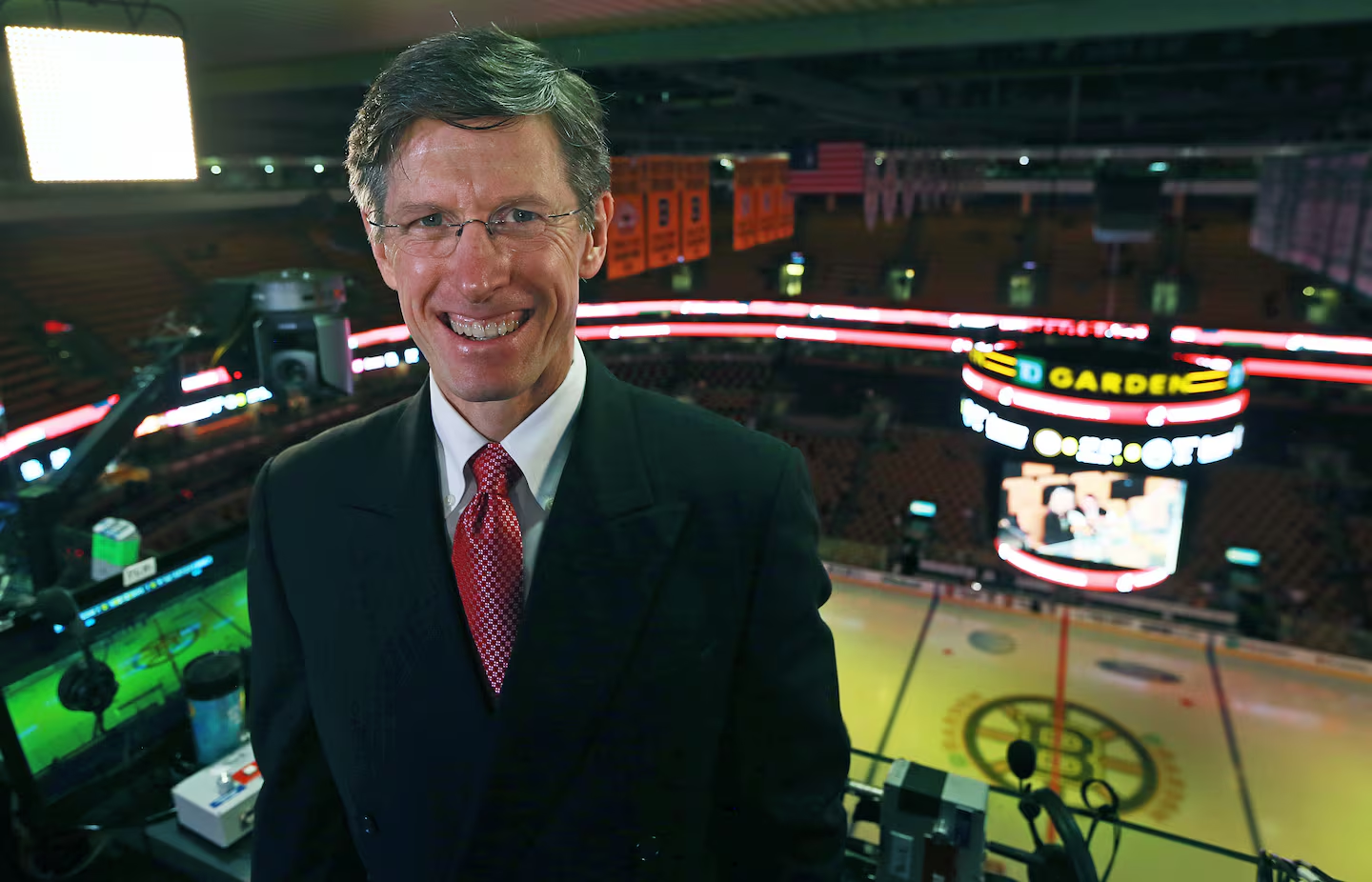
Longtime Bruins announcer Jack Edwards starting to find his voice again with help from AI
A legendarily engaging conversationalist, Jack Edwards asks to text now when a reporter reaches out for comment for a future feature story regarding a different subject.
“I prefer text messages because my verbal skills are eroding and I can’t express my ideas as well as I once could,” the former NESN Bruins play-by-play voice explains, via, yes, text.
Edwards, as most loyal Bruins fans probably know, suffers from a mysterious medical condition called apraxia.
The condition, which he first noticed in the summer of 2022 and became obvious to NESN viewers not long after, causes halting and slower speech and the occasional slurring of words.
Edwards, his speech slowing further, retired following the 2023-24 season, later telling the Globe, “I examined my performance and I decided I couldn’t meet my standards. I accept what I cannot change.”
Edwards, now 69 years old, remains in excellent physical health, he says, and is sharp mentally. But he acknowledges that his speech has continued to get worse.
“All is well with me,” he texts, “considering the circumstances of my mouth not working.”
But while he has lost much of his familiar voice, he has not lost hope, in part because of the natural optimism that he largely retains, and in greater part because of the wonders of science and technology.
Edwards has been working with a therapist, Michelle Ganann, at Spaulding Rehabilitation Hospital to master an AI-aided voice-clone app that duplicates what his voice sounded like during the height of his time in the Bruins broadcast booth.
The app, called a speech assistant, is created by the software company ElevenLabs, the company that cloned actor Val Kilmer’s voice for the movie “Top Gun: Maverick.”
The app’s AI knows what the most familiar version of Edwards’s voice sounds like because it has been loaded up with hours of audio from his time in the Bruins broadcast booth.
“It’s all expressive me! It’s a miracle because my voice is much thinner than it once was and I mispronounce words a lot,” he texts.
“NESN vice president of content Josh Jun threw open the doors of the vault and NESN furnished five hours of pure Jack to ElevenLabs. “All kinds of expressions, from reading tracks of promos to yelling at referees to the postgame rant I went on in 2011 after the Game 7 overtime victory against Montreal.”
Here’s part of that, during which he compared the victory to the Boston Tea Party:
“Well, a couple of hundred years ago, a bunch of rowdy radicals charged out of some Boston bars, went down to the dock and dumped the king’s tea into the salty sea. And in doing that, it struck a chord, that rings true even today: That when confronted with imperious conceit, fighting the good fight is not only the right thing to do — it can be a heck of a lot of a fun.
“And who has more fun than us?”
That’s probably a lot for an AI-driven app to sort out, he is told.
“It is quite the range of expressions,” he texts.
It works like this: Edwards opens the app on his iPad or phone and types in what he wants to say. Then he hits a play button. After a few seconds, the words he typed, in his voice, replicated with help from the audio the AI has been fed, come out.
“I have phrases I say all time as presets,’’ he texts. “If I don’t like the pace or tone, they are adjustable, and the app can recreate them.”
Edwards used the app during his speech at his induction into the Massachusetts Broadcasters Hall of Fame this month.
The app is similar, but not identical, to the ElevenLabs device former Channel 4 sports reporter Alice Cook uses to “talk” after losing her voice to ALS. Cook, as documented by colleague Kevin Paul Dupont, in April 2025, uses the app on an iPad connected to a Bluetooth speaker.
Edwards has a Bluetooth speaker, but hasn’t used it.
“I use my iPhone when I’m mobile and a keyboard and iPad when I’m in conversation at a table,” he texts.
Meanwhile, Edwards is doing all he can to save his real speaking voice. He’s currently taking part in a clinical trial at Mass General Brigham called transcranial magnetic stimulation.
“The doctors in this study think it MIGHT rewire my brain,” he texts.
Edwards emphasizes that he is wary of artificial intelligence on most fronts, but appreciates seeing at least one benefit firsthand.
“I fear AI is going to get out of control, as most people in the US do,” he texts. “This is a good side of AI. I will keep doing my daily drills and participating in the clinical trial at MGB in hopes that I can recover some of my faculty of speech.
“In the worst-case scenario where it doesn’t come back, this is a way of expressing myself fully, albeit slower because I have to type it out. I need patient conversation partners. My family and friends are compassionate.”
Read more Ranking the World Cup group games in Foxborough, from worst to best



Post Comment