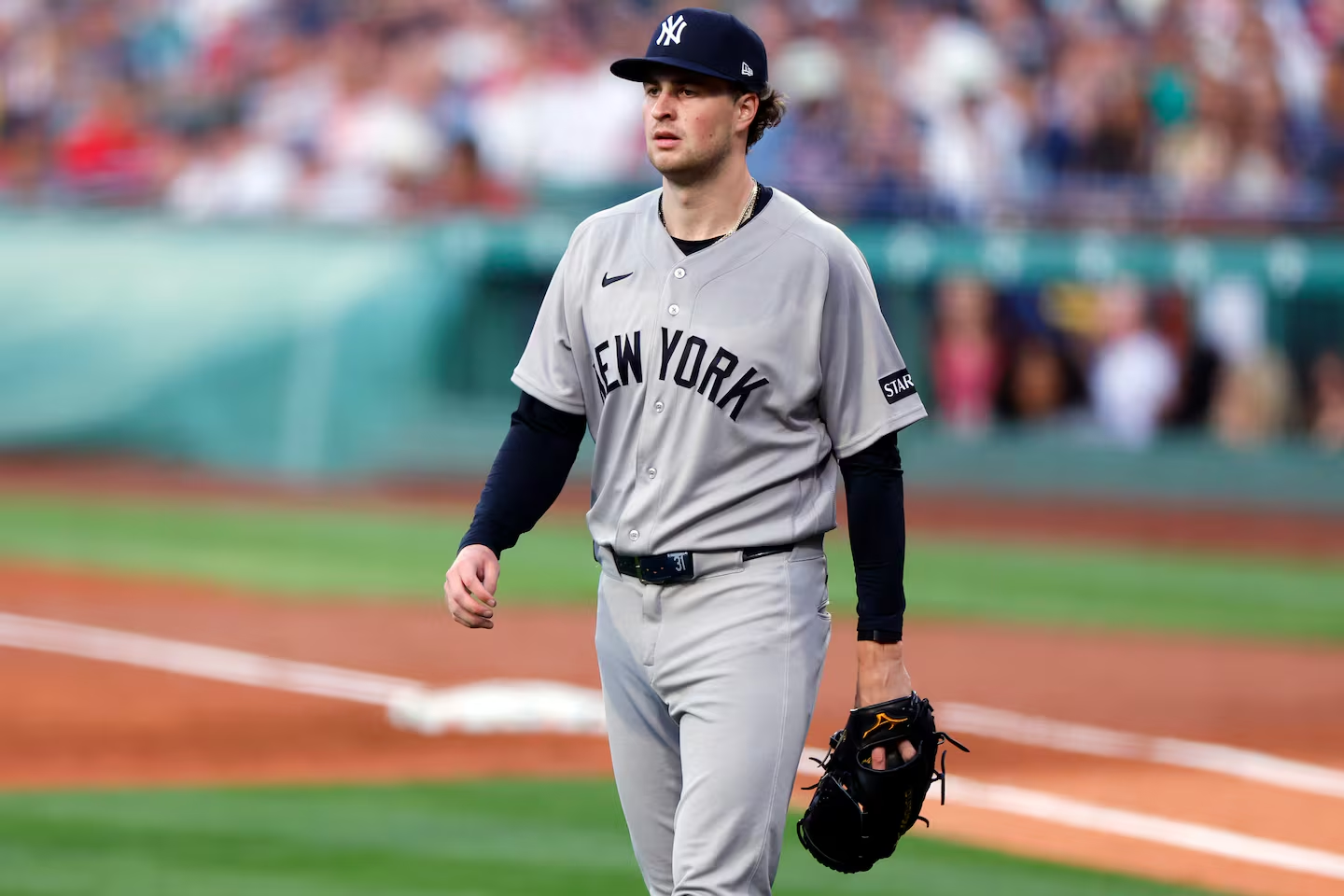
After once pitching in a Red Sox uniform at Fenway Park, Cam Schlittler’s one that got away — to the Yankees
Eight years later, it represents a tantalizing glimpse of possibility. On Aug. 24, 2018, Cam Schlittler took the mound at Fenway Park wearing the home whites of the Red Sox.
Then 17 and entering his senior year at Walpole High School, the rail-thin, 6-foot-6-inch righthander had been invited to take part in the Rivalry Classic, a scouting showcase for Northeast prospects organized by scouts Ray Fagnant of the Red Sox and Matt Hyde of the Yankees. Participants wore the uniforms of the two scouts’ organizations.
While Schlittler pitched for the Sox that day, the future offered a different path. Schlittler is now making his mark with the Yankees. The 25-year-old has emerged as a snarling, high-octane mound force.
He put himself on the map against the Sox last year in the winner-take-all Game 3 of the American League Wild Card Series and has proven in 2026 the postseason dominance was no fluke. Though Schlittler (8-4) allowed four runs, all unearned, in a 6-3 Yankees loss Thursday night at Fenway, he lowered his ERA to an AL-best 1.62.
“I think he’s probably been the best pitcher in the American League,” said Yankees manager Aaron Boone. “He’s pitched like a top-of-the-rotation guy.”
With his emergence, a natural question has followed for Red Sox fans: Why didn’t the Sox draft a kid who played high school and college ball in Fenway’s shadow, instead leaving him for the Yankees to take in the seventh round (No. 220) in 2022?
Back up.
When he pitched at Fenway in 2018, Schlittler’s fastball sat in the mid- to high-80s, and he didn’t have an arsenal to complement it. No one at the Rivalry Classic that year —including Schlittler — believed him to be ready for pro ball without college.
Still, scouts in attendance as well as Northeastern coach Mike Glavine recognized his potential.
“He was throwing 84 to 88 [miles per hour] in high school,” said Glavine. “I don’t want to sound old school or like the old coach yelling at the cloud here, but the one thing Cam always had was command. Even when you have that long, lanky body, and it’s hard to repeat your delivery, his command was always very good.
“He always had that piece. And so when you talk about molding that clay, we can refine his stuff and get him stronger in our program.”
That’s exactly what happened. Schlittler took considerable strides in college, emerging prominently on the scouting map with a dominant sophomore year (8-1, 1.88 ERA over 76⅓ innings) for the Huskies.
But after that season, the largest workload of his life caught up to Schlittler during a so-so Cape League campaign. As a junior, while he made some strides with his arsenal, his performance wasn’t as overpowering as the previous season
Read more Players’ reaction to MLB’s latest labor deal proposals make interrupted 2027 season more likely
His stuff, led by a fastball that mostly sat at 90-93 m.p.h., suggested a work in progress —clear big league potential, but plenty of uncertainty.
How much more strength and power would he gain in pro ball? Would he have a mix to start or just be a reliever?
“I thought going into that draft, he was going to be a pick probably right around the fifth round, to be honest,” said Glavine. “On the flip side, I see why maybe teams wanted to wait a little, too, because they were hesitant [about his junior year], and maybe that’s why he fell a couple rounds.”
The Yankees, Glavine recalled, probably had the most extensive scouting process with Schlittler. But Glavine made clear that the Red Sox’ coverage of his program was and is more extensive than most. The Sox saw plenty of Schlittler.
According to sources familiar with the team’s draft board in 2022, the Sox pegged Schlittler as a seventh-round talent. But when the team actually picked in the seventh round — one spot before the Yankees ended up taking him — Schlittler wasn’t a consideration.
The Sox had concentrated most of their draft budget in 2022 on three high school position players at the top of the draft: first-rounder Mikey Romero, second-rounder Cutter Coffey, and supplemental second-rounder Roman Anthony.
With little left to spend under MLB’s draft bonus pool system, the Red Sox selected a string of pitchers between rounds six and eight who signed four- to five-figure bonuses. Most notably, in the seventh round, they selected Caleb Bolden out of TCU with the 219th pick and signed the righthander to a $7,500 bonus.
One pick later, the Yankees took Schlittler and signed him for $205,000.
The Yankees deserve significant credit for prioritizing the selection before any of the other 29 teams saw fit to grab Schlittler. But as much as they loved Schlittler and believed in his potential to start, they never could have imagined his emergence as an All-Star and ace.
Even Glavine, who saw more of Schlittler than anyone, admits amazement at how far the pitcher has come while leaning on three elite fastballs (four-seam, sinker, cutter) running from 97-100 m.p.h. — a great reminder of the draft as an exercise in unknowable possibility.
“I love watching him every time he’s out there,” said Glavine. “He still has the same mannerisms, the same look, the same sort of grouchy attitude [as at Northeastern]. … It’s funny to watch because that’s all the same. But then you’re just looking at the physical stuff and he’s just a different guy.”
Read more Three things to know about Dillon Mitchell, the Celtics’ second-round pick



Post Comment