Same-sex marriage is dividing Republicans again
In early June, firebrand Representative Andy Ogles did something he often does: Post a message on social media that was sure to shock. “Homosexuality has no place in America. Happy Nuclear Family Month.”
Read more Trump turns America 250 kickoff into a campaign-style rally on the National Mall
But unlike some of his other recent virulent posts — for example, about Muslim Americans — this one drew condemnation from many members of his own party, including Mike Johnson, the House speaker. Ogles deleted the post on X, which he said was sent by a staffer, and called it “stupid” and “hurtful.”
The post’s brief life spoke to the divisions within the Republican Party on same-sex marriage. Obergefell v. Hodges, the Supreme Court decision protecting same-sex marriage, turns 11 this year, and there is little indication that establishment Republicans are questioning it. At the same time, Christian conservatives like Ogles, now a crucial part of President Trump’s coalition, are pursuing that goal with renewed energy and ambition, often using the push for transgender rights as a new front in the debate.
“Ten years ago, no one would have tweeted anything like that,” said Ross Hemminger, president of the Log Cabin Republicans, a gay rights group. “Now we have come full circle, having arguments about what we thought was settled.”
Support for same-sex marriage is declining, reversing a yearslong trend. This month, Gallup released a poll showing that Republican support now stands at 37%, a decline of 18 percentage points from a high in 2022. Support among independents declined, too.
And a few Republican lawmakers are also pushing resolutions against same-sex marriage. Since 2025, bills and resolutions have been introduced in about a dozen states, either urging the Supreme Court to overturn Obergefell or proposing marriage categories limited to heterosexual couples, according to Lambda Legal, a gay rights group. Nearly all died in committee.
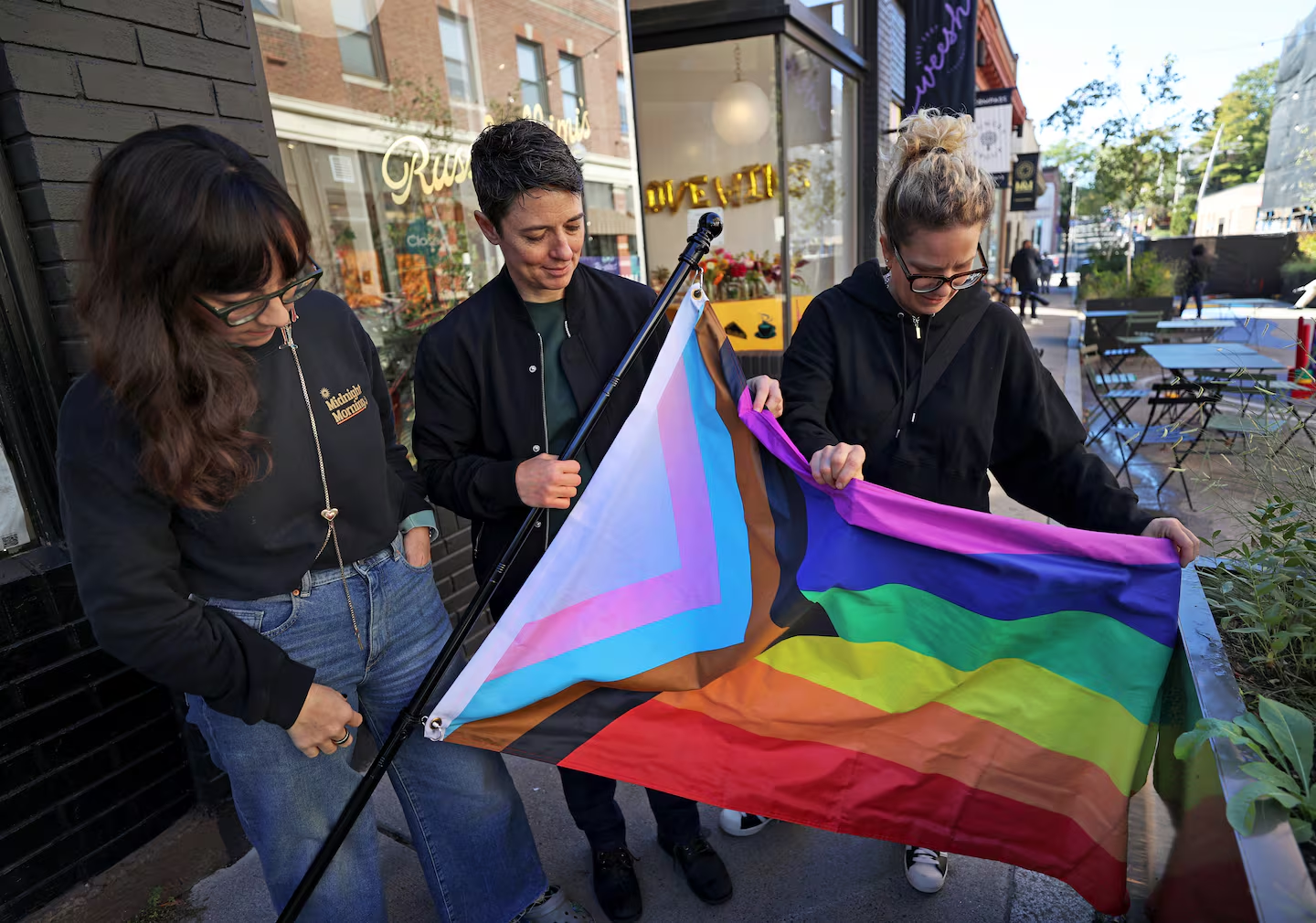
Republican states have even started to rebrand Pride Month, the June commemoration of the Stonewall uprising and the signature moment for the gay liberation movement, calling it Fidelity Month or Nuclear Family Month. Ogles’ now-deleted post referred to the rebranding in Tennessee, where this year the legislature passed a resolution that defines a family as including “one husband and one wife.”
“There is a resurgence in the evangelical wing of the party,” said Austin Gilpin, a gay political consultant in Washington who works for Republicans and Democrats. “They are flexing their muscles because they feel like they can get away with it.”
The question is: What it will amount to? Will it be just a way to rally voters for the midterms, or the seeds of a serious backlash?
A Messy Coalition
Gay conservatives, mostly men, have worked alongside conservative Christians for years inside the Republican Party, disagreeing on social issues but agreeing on other policies, including those related to the economy.
It’s not been an easy alliance, but, Gilpin said, they need each other.
“Neither one has the power to muscle the other out of the room,” he said. “The coalition is just messy.”
The real danger for gay Americans, Gilpin said, would be a concerted effort through the courts to take aim at same-sex marriage as a right, much like the successful effort to overturn the right to abortion.
But the conservative legal community “does not seem interested in relitigating the marriage issue,” he said. (The Alliance Defending Freedom, a conservative legal group that litigated the Supreme Court decision allowing a Colorado cake baker to refuse service to a gay couple, said it was not working on any cases related to same-sex marriage.)
The real point of the counterprogramming in Republican states, Gilpin argued, is to fire up the base during a difficult primary season.
At the same time, Christian conservatives, culturally and politically ascendant, are renewing their attempts to get the issue of same-sex marriage back on the Republican Party agenda.
In January, Christian activist Katy Faust began the “Greater Than” campaign aimed at reversing Obergefell, arguing that it puts adults’ right to marriage above what she says is the best interest of children — to grow up with a mother and father. In an interview, she said that more than 100 organizations have joined the campaign.
Faust, 50, has made versions of this argument for years. But a younger Christian activist, Allie Beth Stuckey, whose podcast has a large following particularly among young women, is making it, too.
On her June 1 show, called “‘Pride Month’ is Here — but Christians Are Gaining Ground,” she said that Obergefell had not only redefined marriage but also gender and parenting. Although some people argue that rights should be extended to gay men and lesbians but not to trans people, she disagrees.
“It’s the same math,” she said.
The Obergefell decision, she said, “has implications not only on our perception of reality; it has implications for women’s rights, women’s spaces, women’s scholarships. It has implications for children.”
Read more NCAA approves age-based eligibility model, but legal challenges loom
Many people, including moderate conservatives and gay Republicans, say giving everyone the right to marry is paramount for personal happiness and social stability, and is fundamentally fair. Stuckey did not respond to a request for comment.
The Role of Trans Rights
Gay Americans fought to be accepted inside the traditional institutions of marriage and parenting.
People understood that as “we just want to be like you; we want our families to be protected like yours,” said Marina Lowe, an official of Equality Utah, an LGBTQ+ advocacy group, characterizing the argument in an interview.
The trans and nonbinary rights movement, however, is different, because it challenges people’s concepts of gender. “It was, ‘Maybe I don’t even have a gender you recognize,’” Lowe said. “And that’s much more of a head-scratcher for society as a whole.”
Jonathan Rauch, the author of a 2004 book in favor of same-sex marriage, said right-wing influencers distorted the trans issue, focusing relentlessly on unpopular niche issues like trans athletes.
But he said that some activists in the LGBTQ+ movement also pressed an uncompromising version of trans rights, which has never been supported by a majority of Americans.
“The tactics became pretty bullying — ‘if you’re not on board, you’re a bigot,’” said Rauch, a senior fellow at the Brookings Institution. Over time, he said, that dragged the marriage issue back into the culture war as American society had become ever more polarized.
“It was a political marker of where you stood on ‘woke,’” he added.
Samuel Lau, a spokesperson for the Human Rights Campaign, an LGBTQ+ advocacy group, disputed the argument that activists have been bullying on trans rights.
“I don’t think it’s a ‘gone-too-far’ situation,” he said. “There was this idea that the path toward full equality, including marriage, was just going to continue unbothered for the rest of time. And that’s never how it has worked across any civil rights movement.”
He said Republicans explicitly exploited the issue of trans rights — when “not enough people feel familiar with who trans people are” — to undermine LGBTQ+ rights more broadly.
“It’s very clear that this is a political strategy for them,” he said, referring to Republican strategists. “This downturn in support for marriage among conservatives is exactly what they wanted.”
There is also a generational issue.
“People coming into the party now don’t remember the fight for marriage, because they were children,” said Hemminger, of the Log Cabin Republicans. “All they know is that there is this whole trans thing.”
Hemminger said Gen Z men were also more likely to be religious than older generations of men, and perhaps more socially conservative. Hemminger, who graduated from high school in Ohio as an openly gay man in 2008, remembers his generation as not particularly religious, and more or less tolerant of his sexuality.
“People said, ‘Who cares who someone marries?’” said Hemminger, who is now 36. “Now it’s young people leading the charge on ‘Gay marriage was a bad idea.’”
Same-Sex Marriage and Acceptance
Despite the arguments being made by Christian conservatives and the findings of the Gallup polling, Gavin Smith, a gay Republican Town Council member in Lexington, South Carolina, said he has not seen any evidence of rising opposition to gay couples among voters. When he ran for the council in 2023, he knocked on more than 3,000 doors in his deep red district, almost all with his husband, Matthew.
“I can think of one or two people who slammed the door in my face,” he said. “Overwhelmingly, people were kind, and this community has completely embraced me and Matthew.”
He, too, thought the Gallup poll showing Republican backlash was related to trans issues, which he said he also has questions about.
“From where I sit, I just don’t see this major grassroots movement trying to overturn gay marriage,” he said. “If anything, most people really don’t care.”
This article originally appeared in The New York Times.


Post Comment