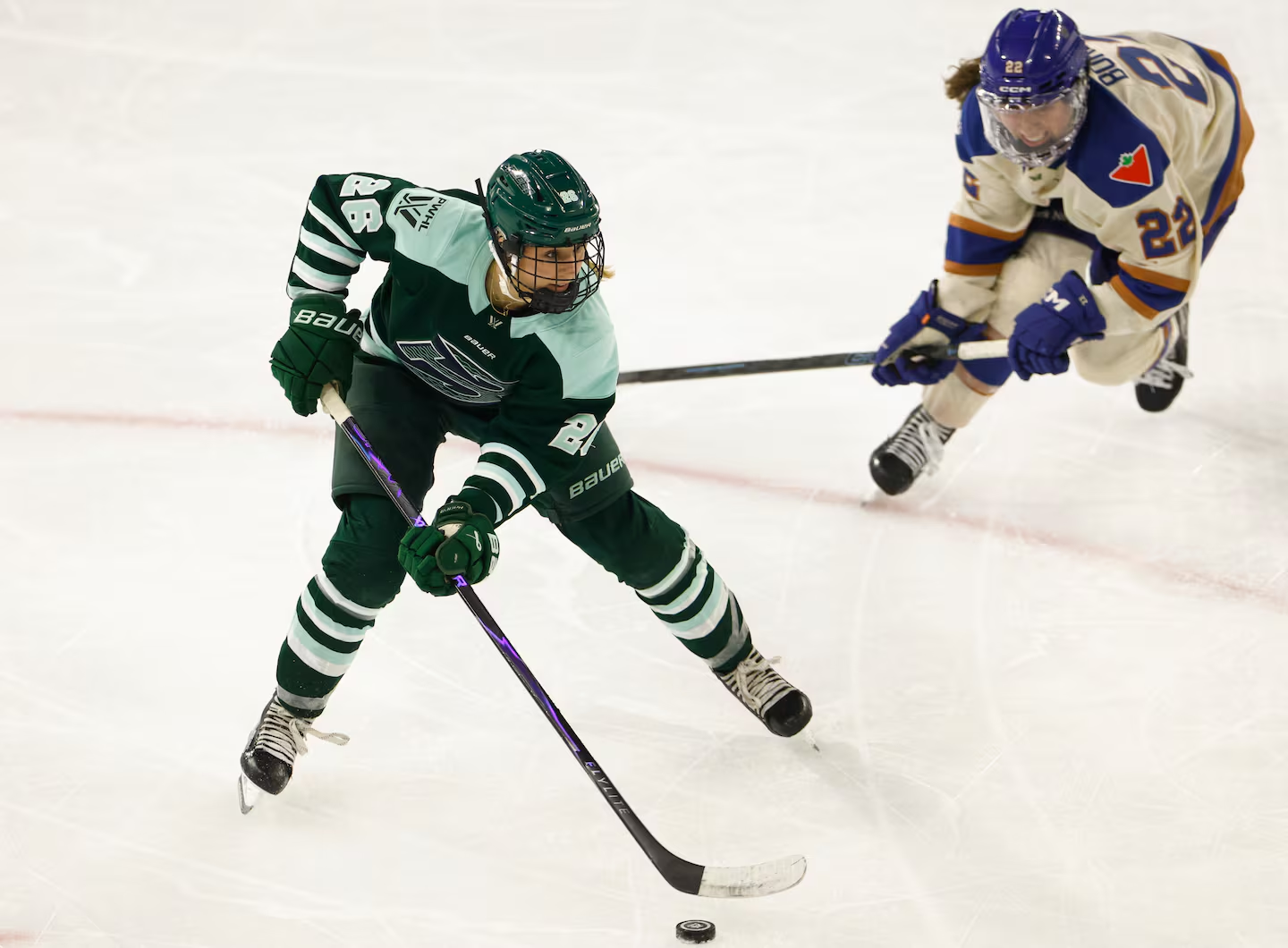
The Fleet couldn’t replace Alina Müller in the PWHL Draft. So, who’s going to score goals next season?
DETROIT — Picking 10th in this year’s PWHL Draft, the Fleet had no chance of landing an elite goal scorer capable of replacing Alina Müller.
Read more The Dubliner closed for England’s World Cup game. The head chef swears it’s just a coincidence.
They focused instead on drafting players with high ceilings, tall and physical defenders, and scrappy forwards — qualities that could allow young players to shine in Boston’s system.
So, who will carry the offensive workload?
A team that struggled to score in crucial moments this past season, the Fleet lost two of their top three scorers — Müller (Hamilton) and Jessie Eldridge (Montreal) — and most of the elite free agents signed elsewhere.
The nine players the Fleet lost in expansion and free agency accounted for 26 percent of Boston’s goals (19 of 74), and almost 30 percent of the team’s offensive output (60 of 202 points).
General manager Danielle Marmer is banking on the hope that an expanded 12-team league, where the top talent is more spread out, will create room for the Fleet’s middle-six forwards to grow into bigger roles.
Goals, she said, will come from players who just need a bigger spotlight.
“When we had six teams, it was so tight that even your star players struggled to be the star,” she said. “Then all of a sudden, eight teams happened, and it was almost like there’s a little bit of breathing room.”
Does that mean the talent pool is diluted, and the on-ice product is worse? Not necessarily. Spread-out stars means the players further down the lineup have more incentive to overperform, creating a more competitive landscape.
That’s why Marmer was willing to give up a second-round draft pick to retain Ella Huber. The Fleet’s second-round pick (10th overall) in 2025, Huber had four goals and two assists in 30 regular-season games, plus two helpers in the playoffs.
The Detroit expansion team announced on June 15 that it had signed Huber to a one-year deal as part of the expansion process. The following day, the Fleet traded for Huber, returning her to Boston in a pick swap (Nos. 22 and 34 for Huber and No. 27).
Based on Huber’s college production (15-33–48 as a senior at Minnesota), she likely would have been a first-rounder in this year’s prospect class, so Marmer feels she got the steal of the draft by giving up the 22nd overall pick for her.
“She’s a top-six forward,” Marmer said. “With more teams, I think this [year] is going to feel more like how she felt in college hockey.”
The Fleet also will look to veterans like Susanna Tapani (9-9–18 last season), Liz Schepers (5-4–9), and Shay Maloney (3-4–7) to up their production to fill the hole Müller left.
But what’s irreplaceable about Müller is her playmaking. She led the Fleet this past season with 17 assists (tied for 2nd in PWHL, one behind leader Britta Curl-Salemme), factoring in a quarter of Boston’s goals.
Abby Newhook could fit nicely in that facilitator role. The Fleet’s 2025 fifth-round draft pick, Newhook overperformed as a rookie, often appearing on the first line and top power-play unit. Teammates and coaches lauded her IQ, and the fact that she always seemed to be in the right place at the right time.
Newhook had seven goals and seven assists and was named to the PWHL’s All-Rookie Team.
“[Newhook] is an incredible playmaker,” Huber said during the playoffs. “I think that’s what maybe some people didn’t know about her coming into this year, and now you can really see it at this level.”
Operating under the assumption that this was the last time the PWHL would expand so significantly, at least for a while, Marmer has an eye on long-term planning in selecting players who haven’t reached their potential.
Under new coach François Méthot — who has experience in development and skills training — the Fleet plan to play the same suffocating, high-pace style they had success with this past season, and the players they drafted fit that model.
“Maybe not all of their game translates, or maybe it doesn’t translate perfectly, but there are pieces of it that are going to allow them to play the way we want to,” Marmer said.
Marmer looked for big, strong, stay-at-home defenders who can eat up minutes and balance the workload of their more mobile blue liners, Haley Winn and Megan Keller.
Marmer found those qualities in first-round pick Grace Dwyer (10th overall) and third-round pick Leah Stecker (27th). Sixth-round pick Maeve Kelly (70th) is tall, mobile, and a bit more offensive-minded than Dwyer and Stecker.
In selecting forwards, Marmer prioritized speed that she hopes will help on the Fleet’s relentless forecheck. She sought players who can create offense by forcing turnovers, including Jaden Bogden (fourth round, 46th overall) and Jenna Goodwin (fifth round, 58th).
“I didn’t want to blow this up and start over,” Marmer said. “We had such a great year, and we certainly have some different elements in our core, and some different players on our hockey team, but I wanted to be able to build off of what we did last season.”
Read more How Americans are feeling about the country’s 250th anniversary, according to new polls



Post Comment