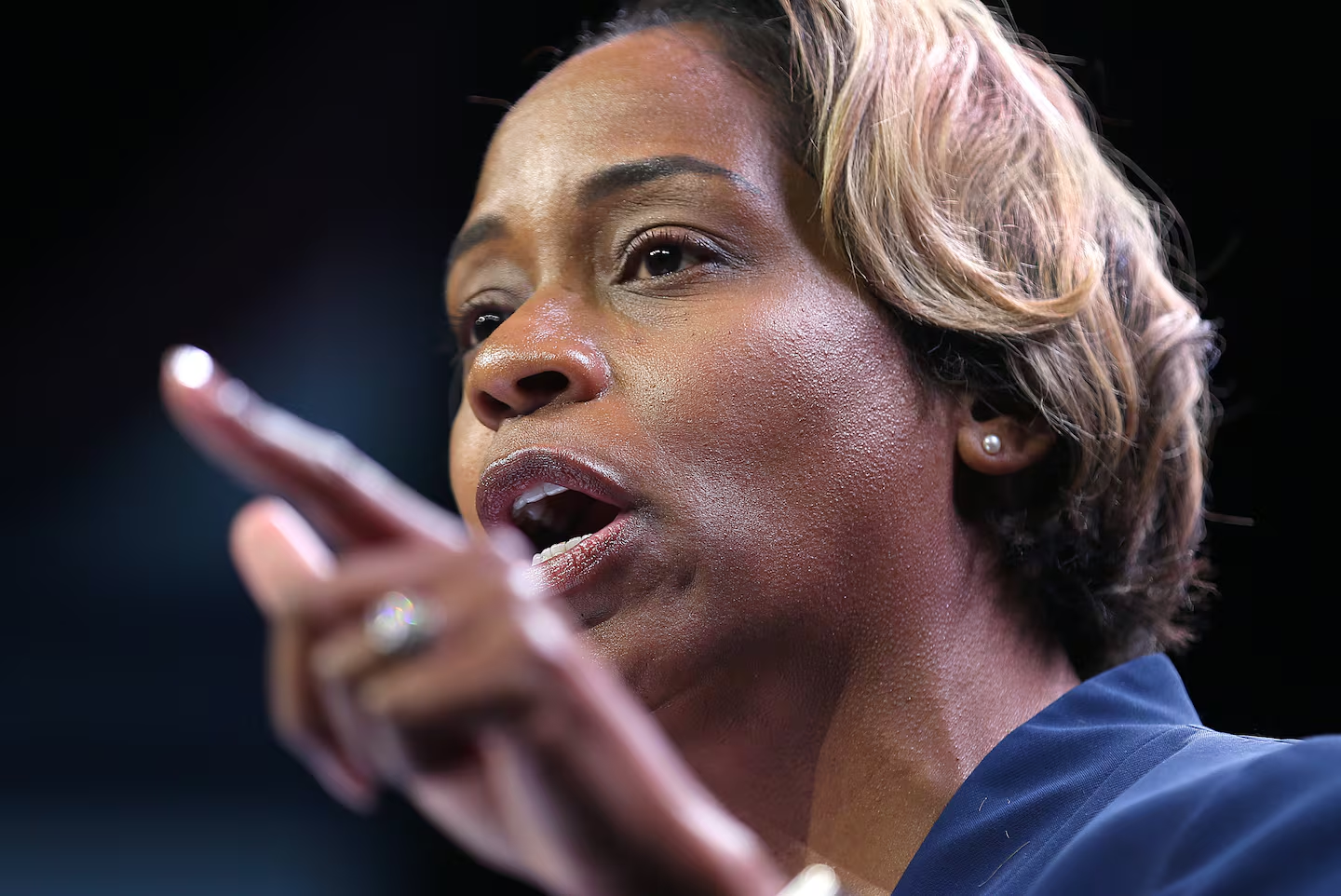
After ballot question setbacks at the high court, Attorney General Andrea Campbell goes on the defensive
Attorney General Andrea Campbell acknowledged Tuesday her office got a series of ballot questions “wrong,” leading to two being struck down by the state’s highest court, but argued that “no one should expect us to get a perfect result.”
Read more How Americans are feeling about the country’s 250th anniversary, according to new polls
The court rulings drastically altered the landscape of this year’s election, where advocates and opponents were gearing up for what were expected to be costly fights over a proposal to slash the state’s income tax and another to create one of the strictest rent control policies in the country.
The rulings put a spotlight on Campbell’s office’s handling of the ballot questions through their earliest stages. All such initiatives must first go through the attorney general for legal review, including whether they adhere to an obscure part of the state Constitution known as Article 48 that governs the ballot question process.
That provision of the state Constitution also requires the attorney general to write a “fair, concise” summary for voters for ballot questions.
In both the rent control and state income tax cases, the Supreme Judicial Court found Campbell’s office made mistakes. Last Thursday, the court said the income tax proposal couldn’t go before voters because Campbell’s office used flawed and unclear language in the summary. Then on Tuesday, the SJC ruled the question shouldn’t have been certified for the ballot because it included an exemption for religious institutions.
On yet a third proposed ballot question, the high court earlier this year also suggested Campbell wrongly certified language aimed at limiting the stipends paid to legislative leaders, which ultimately helped knock the measure off the ballot, too.
“We had six challenges, we got three wrong. I think that’s a great record,” Campbell, a first-term Democrat, told reporters Tuesday. “That just tells me we have more to do to be better. Any institution, whether it’s media outlets or any industry, if they can get 100 percent right every time — wow. That doesn’t happen. We own these mistakes.”
The attorney general’s office received a deluge of submissions for the November election, and ultimately certified a record 44 proposals. Of those, 11 ballot questions, plus a referendum to repeal a gun law, were on track to make the November ballot before a series of legal challenges thinned the field.
Four of the ballot questions drew legal challenges from opponents. The Supreme Judicial Court ruled that two questions — one that would repeal legalization of recreational marijuana and another that would scrap the state’s party primary elections — could move forward.
But in its ruling on the income tax ballot question, the high court said the constitutionally required summary written by Campbell’s office was “significantly misleading” because it inaccurately described one of its major impacts.
The summaries are critical aspects of the ballot question process. They are meant to provide a brief, accurate summary of the proposal to voters and not sway people in either direction.
In an 18-page decision, Justice Serge Georges Jr. ruled Campbell’s summary was not “fair” because it erroneously told voters the question would not lower the tax rate on long-term capital gains when, in fact, it did.
Read more A Kennedy scion loses in a crowded, pricey New York City congressional primary
The summary came together in a string of emails last August between Grace Gohlke, an assistant attorney general in Campbell’s constitutional and administrative law division, and Kevin Martin, a lawyer at Goodwin Procter who represented the ballot question’s proponents.
Campbell did not say Tuesday whether she personally signed off on the summary, only telling reporters that she reviews “them all.”
“I’m not going to mention my private team,” Campbell said. “My team works really hard. You want to name me, name me. But to make it personal for the lawyers who are doing the best they can, and who make mistakes — anyone makes mistakes. You guys, as you write articles, will make mistakes.”
But, she added: “The buck stops with me.”
In a statement last week, a spokesperson for Campbell said lawyers in her office found it “difficult to summarize succinctly” a large portion of state taxes that includes wages and salaries. In her appearance on GBH’s “Boston Public Radio,” host Jim Braude questioned that response.
“The statement from your office, I have to say, was hard to take for me,” Braude said to Campbell. “… Your job is to summarize succinctly.”
Campbell pushed back, telling Braude that neither the proponents nor the opponents of the income tax question challenged the summary her office drafted.
“All the attorneys and the staff who worked on these issues take their job seriously, and anytime they get a result that’s opposite of their analysis, they review it closely and always look for ways in which we can do better,” Campbell said.
In the rent control decision, the Supreme Judicial Court ruled the attorney general’s office should not have certified that the measure passed constitutional muster because certain matters, including its exemption for religious institutions, cannot be subject to an initiative petition.
The ballot question proposed a limit on annual rent increases, but exempted several categories, including facilities operated “solely” for religious purposes.
Campbell again defended her office’s decision to certify the question by pointing to other exemptions included in the ballot question, including those for nonprofit housing.
“Their exemption for religious uses was a minor one within the broader petition,” Campbell said. “The court disagreed.”
Read more Inside the ‘simple job’ in government that Graham Platner held before challenging Susan Collins


Post Comment