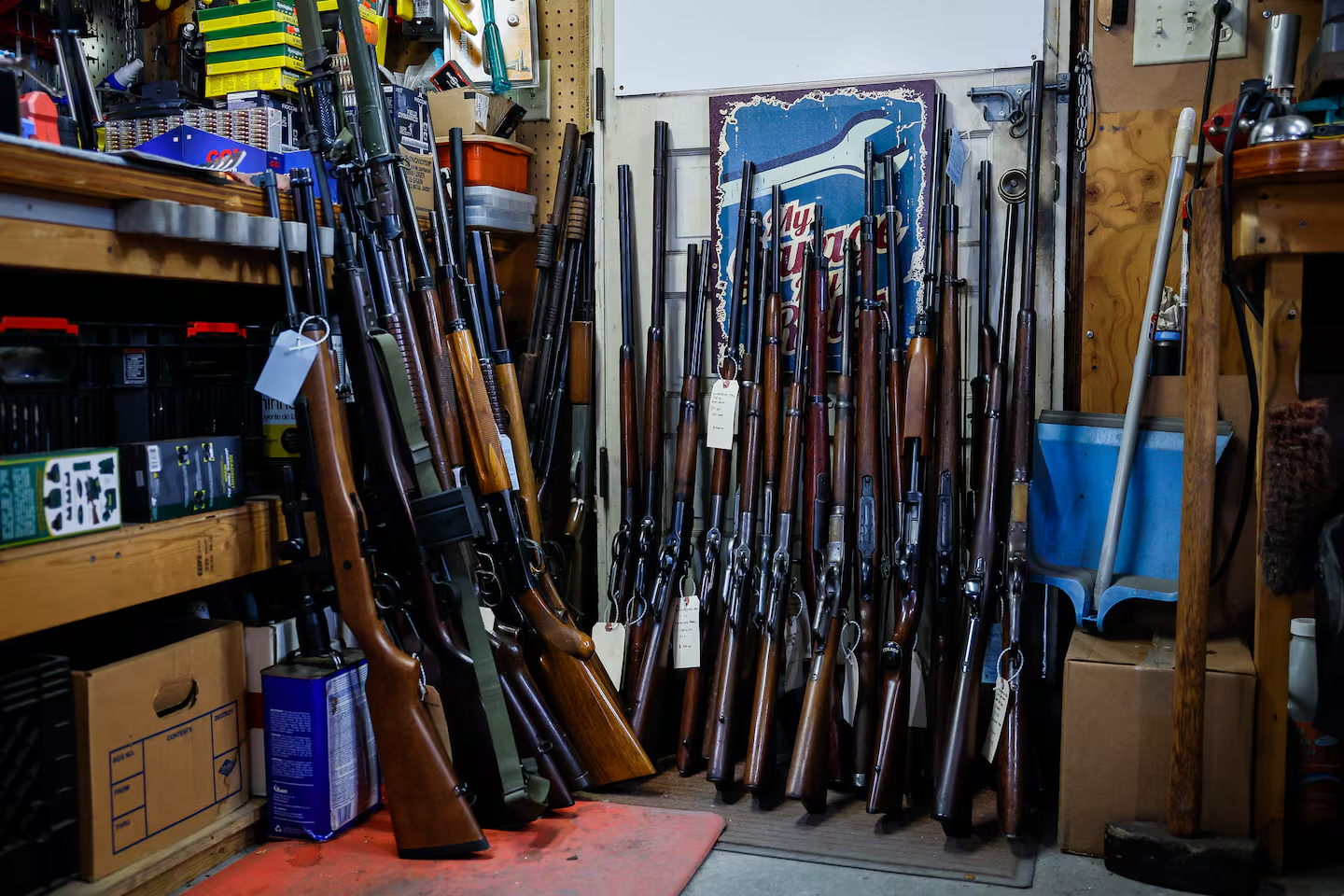
Gun rights advocates want to convince voters to undo a sweeping Mass. firearms law. They hope it spurs something bigger.
If gun rights activists can make it in Massachusetts, the thinking goes, they may just make it anywhere.
Read more With housing costs sky high, Congress finally puts aside partisanship and acts to increase supply
Second Amendment supporters have put a referendum to repeal some of the state’s gun ownership prohibitions before Massachusetts voters this fall that could also serve as a trial balloon of sorts for using the ballot box to peel back restrictive firearms laws.
The ballot initiative is a rarity nationally in this election cycle and comes amid a bevy of gun-related court challenges, including one from opponents of the new Massachusetts restrictions. But many of those legal cases are in a holding pattern, either awaiting rulings from the Supreme Court or still working their way through the judicial system.
Toby Leary, owner of Cape Gun Works in Hyannis and the chair of the campaign to repeal the Massachusetts law, said a successful referendum in one of the country’s bluest corners could “set the stage for other states that have veto referendums like this.”
“This will get national attention when we win on Nov. 3,” Leary said. “It will empower people to not just accept what the Legislature is giving them.”
But victory in November is very much more if than when, particularly in a state where elected officials have long boasted of having one of the lowest gun death rates in the country and strict rules for owning firearms to match.
The dynamic means national gun groups are certainly watching, but not yet committing to helping the local fight to overturn the law. Democrats in the Legislature pushed to tighten the state’s laws after the Supreme Court in 2022 struck down provisions that were considered cornerstones of Massachusetts’ existing gun safety laws.
Leary and his group are trying to persuade voters that a law passed in 2024 stretches well beyond reasonable firearms regulations and steps on constitutional protections. Democrats have hailed it as a measure that would save lives.
“If [they] find a strategy that is worthwhile, yeah, absolutely, let’s export it,” said Bill Sack, senior director of legal operations at the Second Amendment Foundation, a nonprofit organization that supports gun rights. “And let’s do it again.”
Across New England, voters and lawmakers have largely opted not to undo gun control laws, and in some cases, to strengthen them.
Maine voters approved a “red flag law” last year that allows a judge to temporarily restrict access to guns, building on another law passed in the wake of the deadly mass shooting in Lewiston. In New Hampshire, state lawmakers battled this year over legislation that would have blocked public colleges and universities from prohibiting weapons on their campuses. The bill ultimately died last month.
The Massachusetts proposal to repeal one of its landmark gun laws is unusual in this year’s election cycle. Experts both for and against the referendum said they were unaware of any other similar statewide repeal efforts happening in the country this year.
JP Thomas, organizing director for the Brady Campaign to Prevent Gun Violence, warned that gun-rights advocates are trying to use Massachusetts as a test case to “erode gun safety laws across the country because they know that they’re losing.”
“They are looking for a way to change the times,” Thomas said.
The law that Leary and his group, the Civil Rights Coalition, want to repeal is wide-ranging.
For the first time, Massachusetts now regulates so-called ghost guns, or untraceable weapons often made at home from 3-D printed parts. It also expanded Massachusetts’ own red flag law to allow school administrators and licensed health care providers to ask a court to temporarily remove weapons from someone deemed a threat to themselves or others.
And it put in place new training and licensing mandates, including requiring applicants to take a basic firearms safety course that covers secure gun storage, suicide prevention education, disengagement tactics, and live-fire training.
The referendum will ask voters whether they want to keep the law, meaning a “yes” vote would uphold it.
State Representative Michael Day, a Stoneham Democrat who helped write the law, said the intent was to allow people to “safely and responsibly” own firearms.
Read more Trump heads to Capitol to speak with GOP senators who have grown increasingly frustrated with him
“Nothing that we passed in this law is putting impositions on responsible gun owners,” Day said. “That’s the message that’s being perverted by these . . . strident folks who are trying to flip the law.”
The restrictions drew immediate pushback from Second Amendment rights activists, who called them an overreach of government powers. In the months after Governor Maura Healey signed the law in July 2024, Leary and his coalition collected tens of thousands of signatures to place the referendum on the ballot.
The campaign said at the time that it had also collected enough signatures to suspend the statute until this fall’s vote, but Healey used her executive power that October to declare the law an “emergency,” effectively blocking advocates from pausing it.
The campaign has relied on donations from local gun clubs as well as Smith & Wesson, a weapons manufacturer founded in Springfield, which announced in 2021 that it was moving its headquarters to Tennessee in part because of proposals then to make the state’s gun laws even more stringent. The company — which in 2024 donated $50,000 to the repeal effort, the largest single contribution the campaign has reported — did not respond to multiple requests for comment.
Leary said his campaign hasn’t received any financial support from national gun groups, such as the National Rifle Association or Gun Owners of America.
“It’s funny because our opposition puts right on their website that the gun lobby is funding this whole campaign,” Leary said. “I wish they were.”
Chris Stone, director of state affairs at Gun Owners of America, indicated the group is taking a wait-and-see approach on the ballot measure.
“If gun owners and patriots in Massachusetts are successful, people all over the country will look at what they’ve done and try to do the same thing,” Stone said.
A spokesperson for the NRA did not respond to a request for comment.
The ballot campaign’s internal polling from February found voters were largely split on the measure, with 34 percent saying they would vote to uphold that law and 28 percent would repeal it.
But Massachusetts voters have traditionally backed increased gun control. A UMass Amherst/WCVB poll from 2022 found 53 percent of Massachusetts respondents “strongly” supported banning the manufacture and sale of assault weapons and high-capacity magazines. Another 68 percent at the time “strongly” supported raising the minimum age to purchase assault weapons and high-capacity magazines.
Ruth Zakarin, a longtime opponent of gun violence, and chair of the campaign to uphold the law, said voters in Massachusetts need to send a “strong message” by keeping gun restrictions in place.
“We know that if [the] Second Amendment gun rights community feels successful with this effort, either by winning it or even coming close, that that will embolden them to try the same technique in other states that have strong gun laws,” Zakarin said.
Massachusetts’ tight gun laws have already faced a series of court challenges.
One lawsuit challenging training requirements was voluntarily dismissed after lawmakers delayed the effective date of the new rules until April. Another case taking aim at the expanded restrictions on assault-style weapons was folded into a separate, long-running legal saga brought by the National Association for Gun Rights.
Justices with the Supreme Judicial Court are weighing another lawsuit over whether Massachusetts could continue to ban gun licenses for people under 21.The court took the case under advisement after oral arguments in March.
Jim Wallace — executive director of the Gun Owners’ Action League, the local affiliate of the NRA that is lending aid to several of the court cases — said gun owners “have to try to get our rights back any way we can.”
“We’re going to fight on all fronts,” he said, “and some may take longer, some might be quicker.”


Post Comment