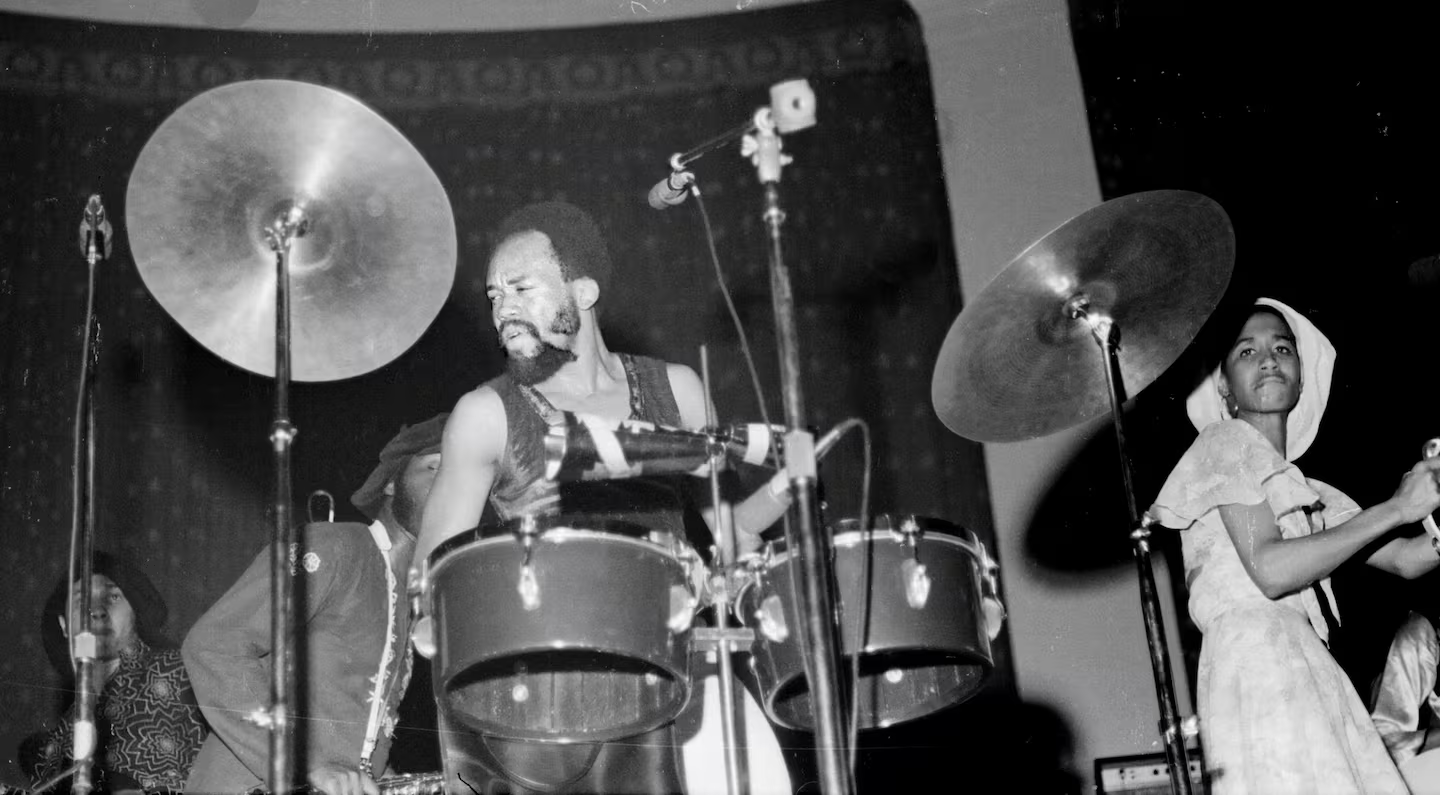
Questlove explores another titan of Black music in Earth, Wind & Fire documentary
Ahmir “Questlove” Thompson knows how to make a music documentary. After winning the Oscar in 2021for the superb, celebratory Harlem Culture Festival documentary “Summer of Soul (…or, When the Revolution Could Not Be Televised)” he delved into darker waters with “SLY LIVES! (a.k.a The Burden of Black Genius),” a documentary on musician Sly Stone. Both films explored their subjects from the perspective of a director who is a musician himself; the scenes flowed like a symphonic movement one minute, and a jagged beat sample the next.
Read more The latest in college pricing: Tuition at 10% of your income
Questlove’s latest film, “Earth, Wind & Fire (To Be Celestial vs. That’s the Weight of the World)” debuts on HBO on June 7 after opening this year’s Tribeca Film Festival. For this “Questlove Jawn” (as his onscreen credit reads), the director looks at the group Maurice White led until his death in 2016. White is the focal point, and we follow his journey from his earliest days in Jim Crow Tennessee to the arenas where EW&F’s greatest hits were performed.
Band members past and present make up most of the talking heads, along with artists like Stevie Wonder and Flea. President Obama and Michelle Obama show up, too, offering funny insights on the high school dances that played the EW&F classic “Reasons” as a slow dance song. “It’s a long song,” notes President Obama. Indeed, it’ll get you five minutes of desperate adolescent grinding on the dance floor.
The origins — and meanings — of several songs are peppered throughout the film and serve as catnip for fans. “Reasons” is dissected by its singer, Philip Bailey, the EW&F’s co-lead singer, whose incomparable falsetto was attempted by every Black guy I knew (myself included). “How can you believe this is a love song?” he asks. If you listen to the lyrics, you’d realize it’s about a casual hookup. “I’m longing to love you just for a night,” Bailey sings. Like the French language, his silky falsetto can make anything sound romantic.
The singer playfully apologizes to anyone who used this sex song as their wedding song.
If you wanted to know what the “ba-de-ahs” in “September” mean, as well as the importance of the song’s “21st night in September,” Questlove’s interviewees have you covered. From off camera, the director admits having his mind blown in response to Stevie Wonder’s admission that a certain EW&F song inspired his 1976 “Songs in the Key of Life” classic, “I Wish.”
“Earth, Wind & Fire” delves into the music, but it must also reckon with Maurice White’s humanity and the traumatic events that shaped him. Abandoned by his mother in his hometown of Memphis, Ten., when he was 5, White lived with those wounds his entire life. The effects were often damaging, to himself and the people around him. One of his sons remembers something his mother told him about why White was so distant. Because of his father’s trauma, the “door in his heart can only open so far.”
Read more ‘Toy Story 5’ rakes in biggest box-office debut of the year with a franchise-best $160 million
For the singer, true deliverance and love came only from his music. White’s plan was to start a group that would not just be for Black people. His vision included speaking to all people about his beliefs in meditation and the celestial powers of the universe through music, and to give them something to dance to as well. EW&F certainly did that, but Questlove doesn’t ignore that the message was being delivered in a Black, occasionally Afrofuturistic package.
The group’s origins in the Bay Area included co-creator Verdine White, the bass playing brother Maurice met when his mother came to retrieve the then 18-year old from Memphis to bring him to her home in Chicago. That’s where he discovered he had a family of siblings. Verdine is one of the film’s most interesting talking heads, as is Marilyn White, Maurice’s longtime romantic partner. Both of them discuss the joys and pains of loving a complicated man.
As with all his films, “Earth, Wind & Fire” has a long parenthetical subtitle that evokes Lina Wertmuller movies, or perhaps Kubrick’s “Dr. Strangelove or: How I Learned to Stop Worrying and Love the Bomb.” Like that film’s title, the subtitles of Questlove’s films reveal his thesis statements. “To Be Celestial vs. That’s the Weight of the World,” features a play on “That’s the Way of the World,” one of the group’s most recognizable hits and the title song from the 1975 movie of the same name.
By changing “way” to “weight,” the subtitle telegraphs the battle between White’s desire to surrender to the universe through meditation and other techniques, and the emotional trauma he carried that emotionally kept him earthbound. In his last movie, Questlove questioned “the burden of Black genius” that resulted from Sly Stone’s success. Here, the burden emanates from within the genius.
I admit that I’m slightly less enthusiastic than I was about Questlove’s earlier films (I gave “Sly LIVES!” 3-1/2 stars; “Summer of Soul” was my number one movie of 2021). This one feels a bit more conventional than those two. But Questlove still delivers a worthwhile film filled with insight, knowledge, empathy, and yes, Blackness. It’s a good thing that you can watch it on HBO, because you won’t be able to stop yourself from singing. Don’t hurt yourself trying to hit Bailey’s high notes, folks.
Read more Natalie Lemle digs into debut novel ‘Artifacts’
★★★
EARTH, WIND & FIRE (TO BE CELESTIAL VS. THAT’S THE WEIGHT OF THE WORLD)
Directed by Ahmir “Questlove” Thompson. On HBO June 7. 119 min. TV-MA (language)




Post Comment