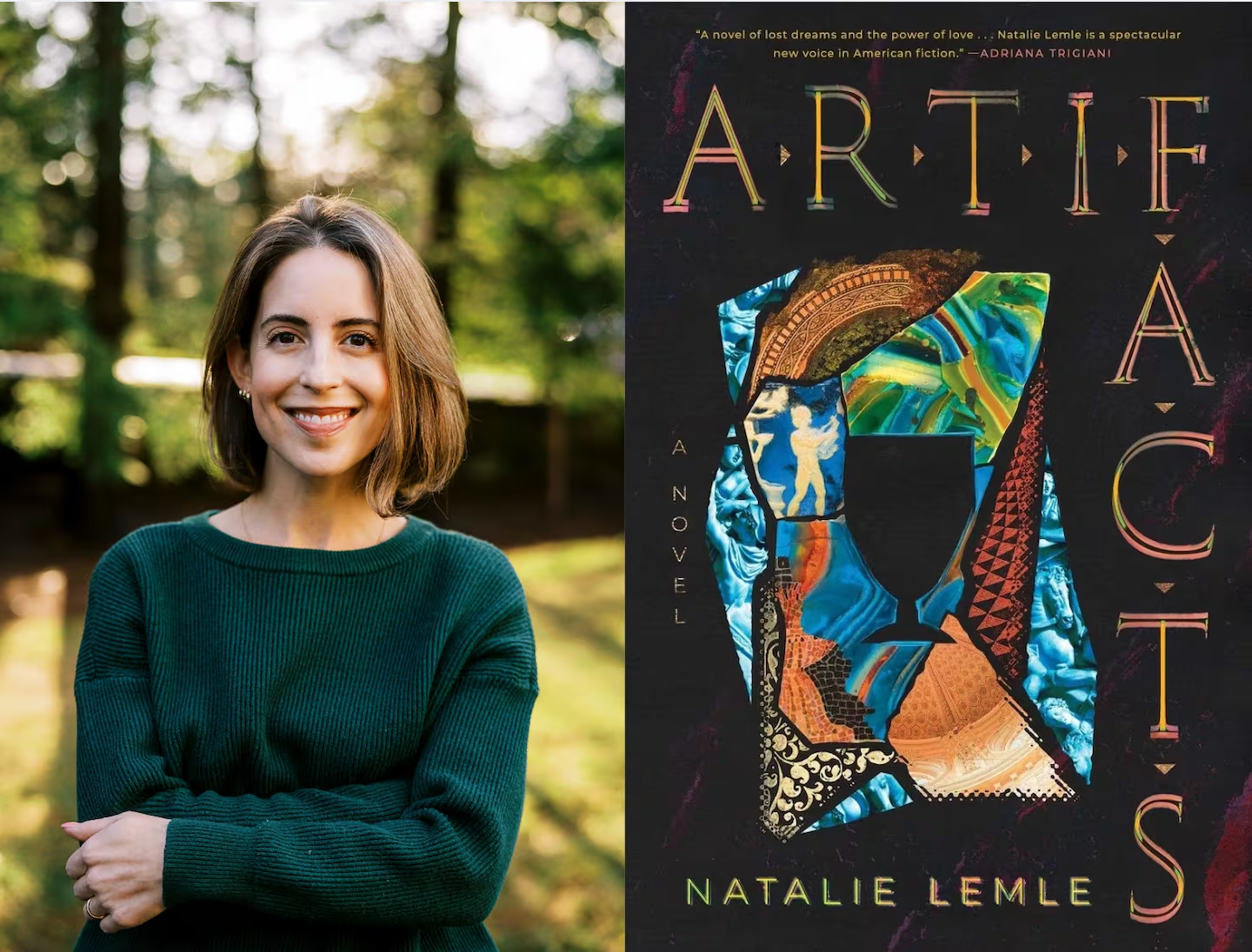
Natalie Lemle digs into debut novel ‘Artifacts’
In “Artifacts,” Boston writer and art adviser Natalie Lemle digs into the complex world of antiquities.
Lemle’s debut novel, which published May 19, follows trusts and estates attorney Lena Connolly, who is enlisted to defend a museum curator after the Italian government claims a dichroic glass cup— a rare material that can change colors in different lighting —was stolen and sold. The story switches between timelines, following Connolly’s undergraduate dig in Italy in 2004, when she planned on becoming an archeologist, and her museum work 18 years later.
The book is informed by Lemle’s professional background. She founded and serves as the chief advisor for art_works, a company that curates and commissions art that is“sensitive to environment, stimulates meaningful connections, and activates poignant art experiences,” according to the business’ website. In 2024, she graduated from Emerson College with an MFA in creative writing.
Ahead of her talk at Once Upon a Bookstore in Fall River on June 21, Lemle discussed her writing process, the ambiguities in the art world, and how her academic experiences informed the story.
Q. You majored in art history, the Classics, and Italian studies at Tufts. Did this background inform your work on the book?
A. I could never have written this book without that background, and one of the reasons my main character is an undergrad in the book is because I was so obviously influenced by my undergraduate education, and I really do love all of the things that Lena loves, even if we’re not the same person. I did take a class on the archeology of the Italian Alps during the Roman era, and the materials from that class are the basis for the fictional Italian dig that is in the mountains.
Q. What appealed to you about the Italian Alps as a setting for the book?
A. The border in that area has, over centuries, been porous. When we look at the timeline or the provenance of an object that may have come from that region, you could conceivably make an argument that an object belongs to France. Just the politics around deciding where something should be returned to, if at all, is really interesting to me, and I wanted there to be a lot of ambiguity around who might be able to claim that cup.
Q. What made you decide to write about archaeology and art history in a work of fiction?
A. I’ve come to believe that fiction really is an amazing medium to explore some of these thornier corners of the art world. There’s so much moral ambiguity in the world of cultural heritage and antiquities. Even in the contemporary art world, where my day job is, it’s a relatively unregulated market, whether you’re talking about contemporary art or ancient art. There’s a lot of subjectivity, there’s a lot of gaps, there’s a lot of discretion, so things are often happening behind closed doors.
Read more Watch: Matt Damon goes full ‘Odyssey,’ sneaks onto ‘Kimmel’ in a mini Trojan horse
Q. How would you describe your process for writing “Artifacts”?
A. Initially, I think it was just trying to tell a story about where objects belong, who gets to decide, but as I drafted and revised — and I probably revised this book from A to Z more than 40 times — the plot started to come into more focus.
The thing that stayed consistent throughout the process is the characters and the themes, but I was somewhat open-minded on how the story could be told, and I loved working on it so much that I could have probably kept revising it. I loved living in this made-up world of artifacts.
Q. The book goes back and forth in time from 2004 to 2022. What influenced this decision?
A. Originally, it was motivated by me wanting to make Lena remembersomething that happened many years prior. I wanted her to maybe have forgotten certain things, or to be piecing things together.
The distance between the 18 years also makes Lena more interesting emotionally in the present. She wanted to be an archeologist as an undergraduate, but then she became a corporate lawyer, so she’s coming to terms with who she is, and the lost dreams that she had as a 19-year-old, and trying to reconnect with that part of herself.
Q. What do you hope readers take away from the book?
A. I’m so fascinated by cultural heritage, repatriation, restitution, all of these really complicated cases. I think it’s something that we may think you have to have a certain level of education or access to understand or to care about. What I hope a reader would take away is that these objects have value because people want them, and they are more political than we think. A country that is staking a claim on an object, that object might represent for them some nationalist identity that they want to have out on the global stage. These are things that can be used as pawns, they’re objects that you don’t have to have a degree in classics to have them matter in some way, and also to be used in nefarious ways.
In researching the book, it is shocking what is happening, and it can affect all of us, and it’s an area that I think more people should know about and talk about.
Lemle will be in conversation with “All That Life Can Afford” author Emily Everett at 2 p.m. on June 21 at Once Upon a Bookstore (418 Quequechan St., Floor 2, Fall River). Free, onceuponabookstore.com
Read more Anne Hathaway is pregnant with her third child
Interview was condensed and edited for clarity.





Post Comment