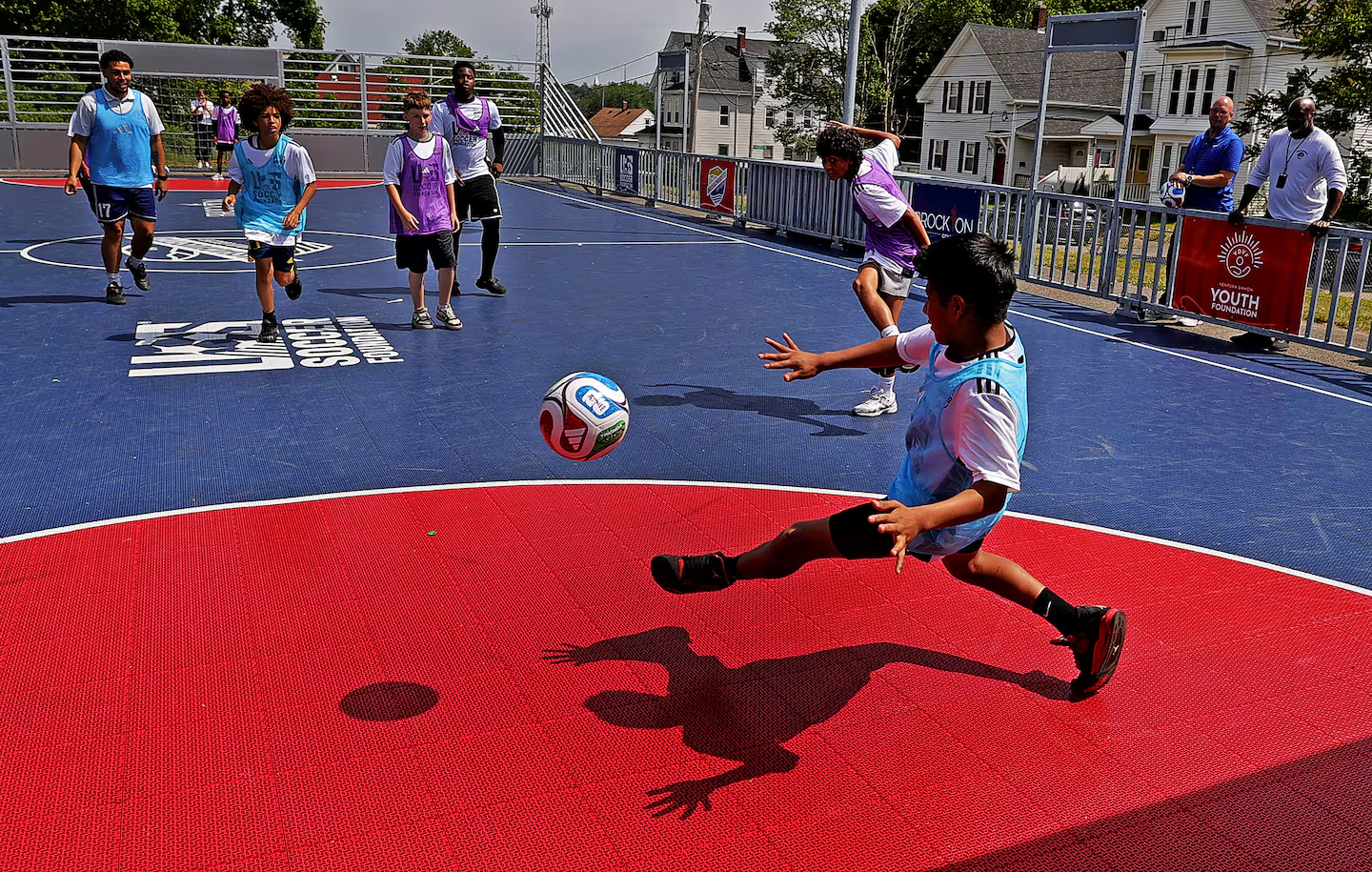
Small spaces, big dreams: How the World Cup is spawning ‘mini-pitches’ across New England
At 10 years old, on a summer trip to visit relatives in Timóteo, Brazil, Felipe Pinto discovered a simple truth about soccer: The game requires very little to flourish.
Read more Secret vetting and blocked promotions: Inside Hegseth’s war on diversity in US military
The Brockton native fell in love with the beautiful game on what soccer-mad Brazilians call a “quadra” — a fenced-in expanse, no bigger than two tennis courts, tucked between the city’s apartment blocks. With just a few players on each side, they played with whatever they could find. Sandals and backpacks served as goalposts, and the ball was often nothing more than mismatched socks stuffed inside one another and bound with rubber bands. Free from parents, coaches, or referees, they kicked until dusk and ran until their feet blistered, Pinto recalled.
“When you’re a child, that cramped space can feel like a giant stadium, like thousands of people are cheering you on,” Pinto said. “It was just us kids, having fun.”
Now 25, Pinto is at the forefront of an ambitious effort to bring such soccer to the masses here in New England through a network of smaller soccer courts known as “mini-pitches.”
In the frantic runup to the World Cup, local organizers and soccer nonprofits scoured the region for abandoned lots and forgotten public spaces — any corner just large enough for a game. By year’s end, with money from the US Soccer Foundation and corporate sponsors of Boston’s World Cup host committee, they plan to transform 17 of these overlooked sites into vibrant hard-court pitches, stretching from Brockton to Pawtucket, R.I., among the 1,000 being installed by the US Soccer Foundation this year.
It’s been a project decades in the making, a slow but steady effort to rival the passions for soccer in the United States with that of the rest of the world, starting with the World Cup tournament here in 1994 and the growth of Major League Soccer ever since. Now, by stripping soccer back to its essential roots, organizers hope to build a deeper, cross-generational passion for the sport across the region that will fuel its growth for years to come.
Ultimately, these mini-pitches are meant to serve as pocket sanctuaries — places that will unite communities and give kids of all backgrounds and incomes a healthy outlet. They’re also meant to ensure this summer’s World Cup leaves a permanent footprint in the region, creating a legacy that lasts for generations after the final whistle.
The strategy also makes economic sense.
The mini-pitches are relatively simple to install, using interlocking acrylic tiles laid directly over existing concrete or asphalt surfaces. At roughly $100,000 each, they are a bargain compared to a full-sized grass or turf field, which can run anywhere from $1 million to $4 million. All told, the 17 pitches planned for New England will cost $1.7 million in private funding — a rounding error compared to the massive public and private spectacle of the World Cup unfolding at Gillette Stadium and across Boston.
“Yes, soccer is having a moment in this country, but we need to have a moment for all these kids as well,” said Alex Bard, associate vice president of operations at the US Soccer Foundation. “We want to make sure we are reaching every kid and every family who loves soccer — not just those with money to attend the games.”
The origins of the mini-pitch initiative date back to the 1994 World Cup.
At the time, organizers saw the event as a rare opportunity to grow the game, and they used $50 million in proceeds from the tournament to create the US Soccer Foundation. Its plan at the time was to develop hundreds of soccer fields in underserved neighborhoods.
However, that quickly ran into logistical and financial hurdles. Buying up large acreage, grading land, and maintaining grass fields in urban neighborhoods was often cost-prohibitive. Yet organizers realized America was dotted with underused spaces — including cracked asphalt schoolyards, abandoned tennis courts, and vacant lots — that could be converted into smaller soccer pitches for less than one-tenth the cost of a full-sized field.
Now, with momentum from this World Cup, the foundation aims to spend more than $35 million on mini-pitches across the country by the end of this year. Boston is one of those cities. The foundation joined forces with Boston Soccer 2026, the local host committee for this summer’s tournament, which is supporting the mini-pitch initiative with money from its donors and official sponsors.
“It’s a significant investment,” said Tanisha Sullivan, head of external engagement at Sanofi, a French drugmaker that is funding mini-pitches in Framingham and Cambridge and is a sponsor of Boston’s host committee. “These mini-pitches can be part of really helping to bring communities together, they can be part of really helping to build pride in the community, because we’re talking about in many instances spaces that are underutilized.”
Read more Game 74: Red Sox at Mariners lineups and notes
The initiative is already delivering on that promise.
On a bright spring morning, two days before the World Cup kickoff, nearly three dozen middle school students poured onto a newly opened mini-pitch at Brockton’s Mulberry Street Park to play pickup soccer. The vibrant scene marked a stunning change. Just weeks earlier, it was an underused basketball court marred by cracks and encroaching weeds. The children filling the pitch mirrored the surrounding neighborhood: a diverse mix of Haitian, Cape Verdean, and Brazilian families, among others.
Timothy Carpenter, Brockton’s superintendent of parks, likened the mini-pitch to “a winning lottery ticket.”
Carpenter estimated a standard grass field would have cost Brockton nearly $1 million — not including ongoing upkeep — while an artificial turf field would have topped $3.5 million. By contrast, the city’s cost for this mini-pitch was minimal: it simply had to remove the old backboards and prep the site for lighting. The $100,000 bill — for covering the new surface with tiles, lines, and goals — was picked up by the US Soccer Foundation and the nonprofit Massachusetts Youth Soccer, the state’s governing body for youth soccer.
“Overall, the impact to the city’s budget was basically nil … and from what I hear, it’s definitely being used, from afternoon to dusk,”Carpenter said.
The Brockton mini-pitch never would have happened without Pinto — the son of Brazilian immigrants, a soccer coach, and founder of a sports drink business and youth sports foundation.
For as long as Pinto can remember, soccer has been a sanctuary.
“Those four corners have always been my safe place,” said Pinto, who also played soccer while studying business management at Wentworth Institute of Technology, becoming the first in his family to graduate from college. “No matter what craziness was happening in the world, I could always find a sense of community and pride on the pitch.”
At the same time, Pinto has grown increasingly frustrated with the commercialization of soccer and youth sports generally — particularly the explosive rise of private clubs whose high fees can discourage working and poor families.
It’s a booming industry. Even with fewer children overall playing sports, American families spend up to $40 billion per year on youth sports, the nonprofit Aspen Institute estimated in 2022, with travel as the biggest expense for families. Private clubs charge $3,000 to $4,000 a year in registration fees alone, Pinto said, then expect families to drop another $600 on uniforms that change each year.
“It gets obnoxious,” Pinto said. “We need to bring soccer back to the game — about the badge on the uniform, the respect between teams and the life lessons that can be learned.”
Fittingly, the idea for the Brockton mini-pitch was born on a soccer field. During a club match last fall, an opposing coach told Pinto about Project Goal, a Providence-based nonprofit working with the US Soccer Foundation to build mini-pitches across Rhode Island. The conversation struck a chord: Pinto immediately flashed back to his childhood in Brazil, remembering the endless hours he spent playing with relatives on the quadra. He started making phone calls that very day.
“He was like a dog with a bone,” Carpenter recalled. The two ultimately targeted an underused basketball court at Mulberry Street Park as the perfect spot.
As for Pinto, he occasionally drops by the Mulberry Street mini-pitch on evenings. So far, he is heartened by what he sees: diverse groups of children playing a free-flowing game that vividly reminds him of the spontaneous pickup matches he played as a child.
Read more Money can’t always buy happiness. Just ask some of baseball’s biggest spenders, the Sad Six.
Sometimes, Pinto can’t resist lacing up his shoes to join them.
“Out here, we all speak the same language,” he said. “The ball is our language.”





Post Comment