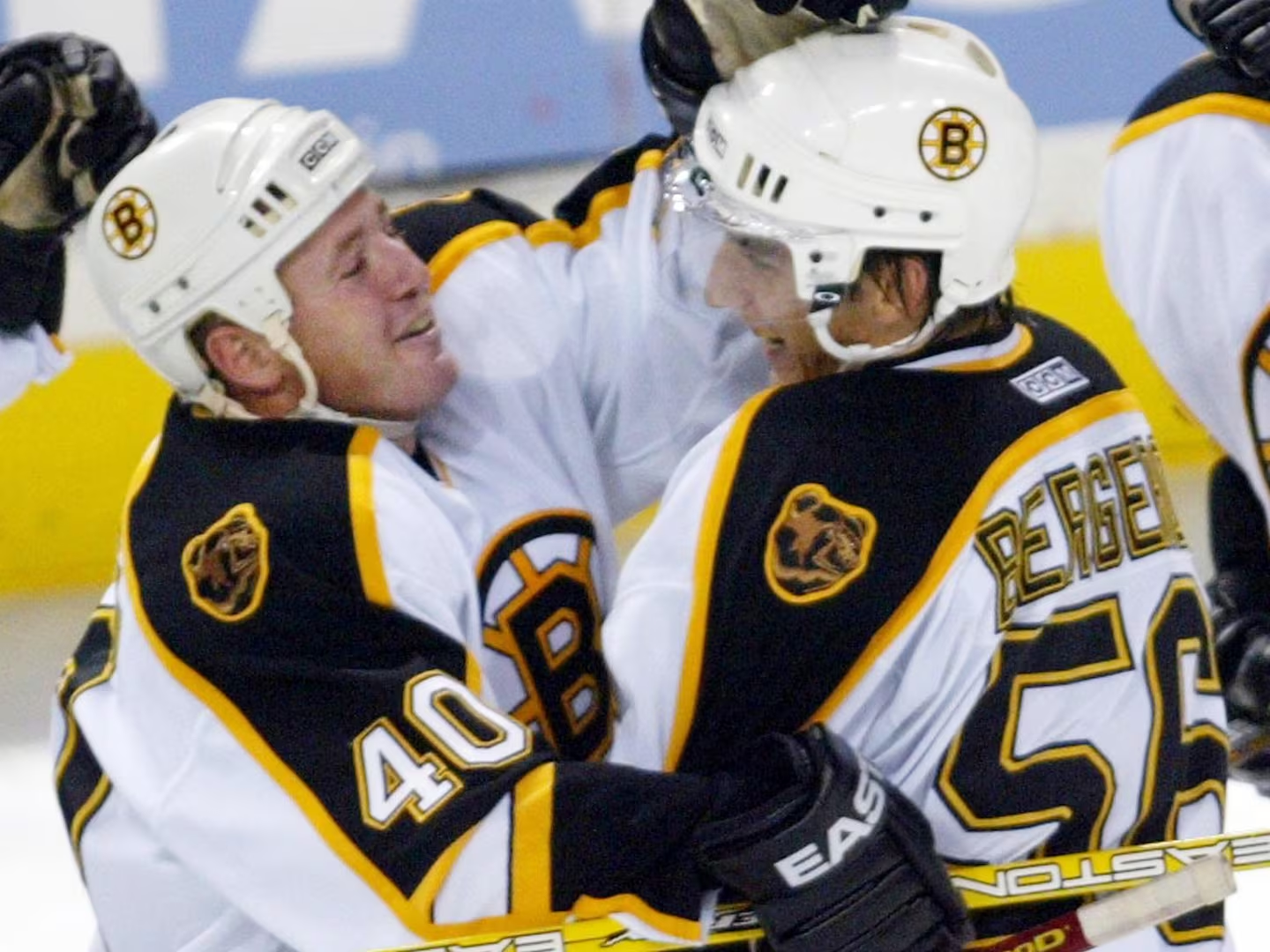
Patrice Bergeron has Martin Lapointe to thank for 37 being the number retired by the Bruins
That No. 37 we now know Patrice Bergeron will hoist to the Garden rafters carries a bit of fun history, dating back to long before his Stanley Cup win with the Bruins in 2011, his 1000-plus games, his 1000-plus points, his record half-dozen Selke Awards, his captaincy …
Bergeron unquestionably has the bona fides, Olympic gold included. The 40-year-old’s august list of credentials is expected to grow one giant skate stride longer Monday afternoon when the Hockey Hall of Fame reveals its class of 2026.
But as for that No. 37, which the Bruins announced Thursday would be retired, it’s not where the 18-year-old Bergeron began the storied journey in 2003 that carried him from Causeway Street and beyond. He wore No. 56 in that first training camp, and that, friend and mentor Martin Lapointe bluntly told him on the eve of his rookie season, was no number a friend could let a friend pull over his broadening shoulders.
“Like, what are you going to do with your number?,” an animated Bergeron, imitating Lapointe’s voice and demeanor back then, recalled Thursday.
Bergeron, the newly arrived forward, had just signed his first Bruins contract.
“Well, uh…,” Bergeron told Lapointe, channeling the voice of his teenage self, “I don’t … uh … I don’t care.”
“You can’t play with 56,” Lapointe told him, Bergeron mimicking his mentor’s tone of disgust from nearly 23 years earlier.
“Well, to be honest,” Bergeron told Lapointe, “I’m not one that’s going to say …”
“What number do you want?!,” insisted Lapointe.
“No, really, like I …” said his young buddy from Quebec, yet to make his NHL debut.
“What number do you want?!”
“So, finally, I’m like, ‘Uh, I played with 37 last year [in juniors] and I had a good year,” noted a still hesitant Bergeron. “So, I guess it’s … it’s … it’s good luck for me, so 37, if they have one?”
He pulled on No. 37 that day and wore it with distinction for his 19 NHL seasons with the Bruins. Lapointe no doubt will be back on Garden ice this upcoming season (date TBD), the night his formerly shy mentee places it in the rafters in perpetuity, alongside 13 other legendary Bruins of the last 100-plus years.
Bergeron was informed Monday, some 72 hours before the Bruins made the news public, that the franchise decided to retire his number. Now a husband and father of four young kids, he spoke with the Globe on Thursday about his latest honor, still sounding very much like the humble and gracious kid who arrived here decades ago amid zero fanfare and equal expectations.
Selected in Round 2 of the 2003 NHL Draft, No. 45 overall, Bergeron carved out a roster spot that September as a winger. Over the next two decades, while he became the NHL’s top two-way center of his era, his ego and demeanor remained in lockstep with the teenager who once struggled to say, sure, he’d take No. 37 if it was available.
“To be alongside all of them is very, very humbling,” said Bergeron, musing over how it will feel to see his name up there with the likes of Ray Bourque, Johnny Bucyk, Cam Neely, Rick Middleton, and the other franchise stars. “It brings back a lot of memories and you feel kind of lucky, all the people you’ve had a chance to meet along the way–the players, the teammates and the friendships you’ve made.
“It hasn’t fully sunk in yet, to be honest.”
Bergeron will be made available for a presser Tuesday at the club’s Warrior Ice Arena practice facility in Brighton, the day after the Hall of Fame’s decision, to talk more about the upcoming number retirement ceremony and potentially his HHoF enshrinement. Prior to his Thursday chat, the Bruins respectfully requested that he not be asked about his thoughts on his potential to be named to the Hall.
“It’s just, we all know how modest he is,” said a team spokesperson, “and he’d be the last guy to want to talk about something that hasn’t happened. That’s not Bergy.”
What set Bergeron apart on the ice was his keen, uncanny sense of timing and spatial awareness. Rarely was he not in position, be it on offense or defense, in an NHL that ratcheted up ever faster over the arc of his career. He arrived from junior hockey with those skills intact — in part why coach Mike Sullivan eagerly kept him on the roster — and refined them over time. His ability to anticipate play was at the core of why he has the most Selke Awards as No. 1 defensive forward.
Bergeron credits his development to all his coaches, from juniors on up, including Claude Julien, bench boss here for the ‘11 Cup win. He played some 10 seasons under Julien’s tutelage.
“I think Claude helped me a lot with my defensive game,” he said. “You know, my two-way game. There were no gray areas in his game. It was very layered, meaning there was always someone there to bail you out and that really worked great with my style of hockey. I learned a lot from him, but I learned a lot from a lot of coaches along the way — I don’t want to take anything away from other coaches as well.”
The days ahead will mean a lot of looking back. For the speech he’ll have to prepare for the night his sweater is retired, Bergeron said he plans to call up video and learn from what those ahead of him had to say. He was on the bench when Willie O’Ree, Neely, and Middleton had their nights. He was in the building in civilian threads in January when longtime teammate and captaincy predecessor Zdeno Chara’s 33 went to the heavens.
Had it not been for Lapointe’s not-so-subtle nudge, it could have been No. 56 attached to Bergeron’s legacy, After all, it’s the player who makes the number and not the number that makes the player.
Throughout that September 2003 camp, recalled Bergeron, Doug Doull wore No. 37. In the days leading to opening night, Doull was demoted to AHL Providence, leaving 37 up for grabs that day Lapointe told his young buddy to think, and think again, about what number he wanted to wear.
Doull, a rugged winger, eventually came back to the varsity that season. No. 37 otherwise occupied, he pulled on the 56 tossed his way by the trainer.
“No way would I ever have said anything about what number I wore,” said Bergeron, who knows a thing or two about crediting assists. “So I can thank Marty for that, big time.”
Read more Scotland’s World Cup run in Boston is sadly over. It’s something we won’t soon forget.




Post Comment