Forty years later, a look back at how the death of Len Bias impacted the Celtics on and off the court
It’s been 40 years since the Celtics took a gifted University of Maryland forward second overall in the 1986 NBA Draft.
Read more Scotland’s World Cup run in Boston is sadly over. It’s something we won’t soon forget.
Yes, the NBA champions owned the second pick less than two weeks after beating the Rockets in six games because of a Red Auerbach masterpiece trade that sent popular guard Gerald Henderson to the Seattle SuperSonics for a 1986 first-round pick.
Len Bias was the Celtics’ choice, a potential franchise-changing forward who would ease the aging road for Larry Bird, Kevin McHale, and Robert Parish. Bias already had an NBA body and dominated the ACC in his final two seasons, averaging 23.2 points as a senior.
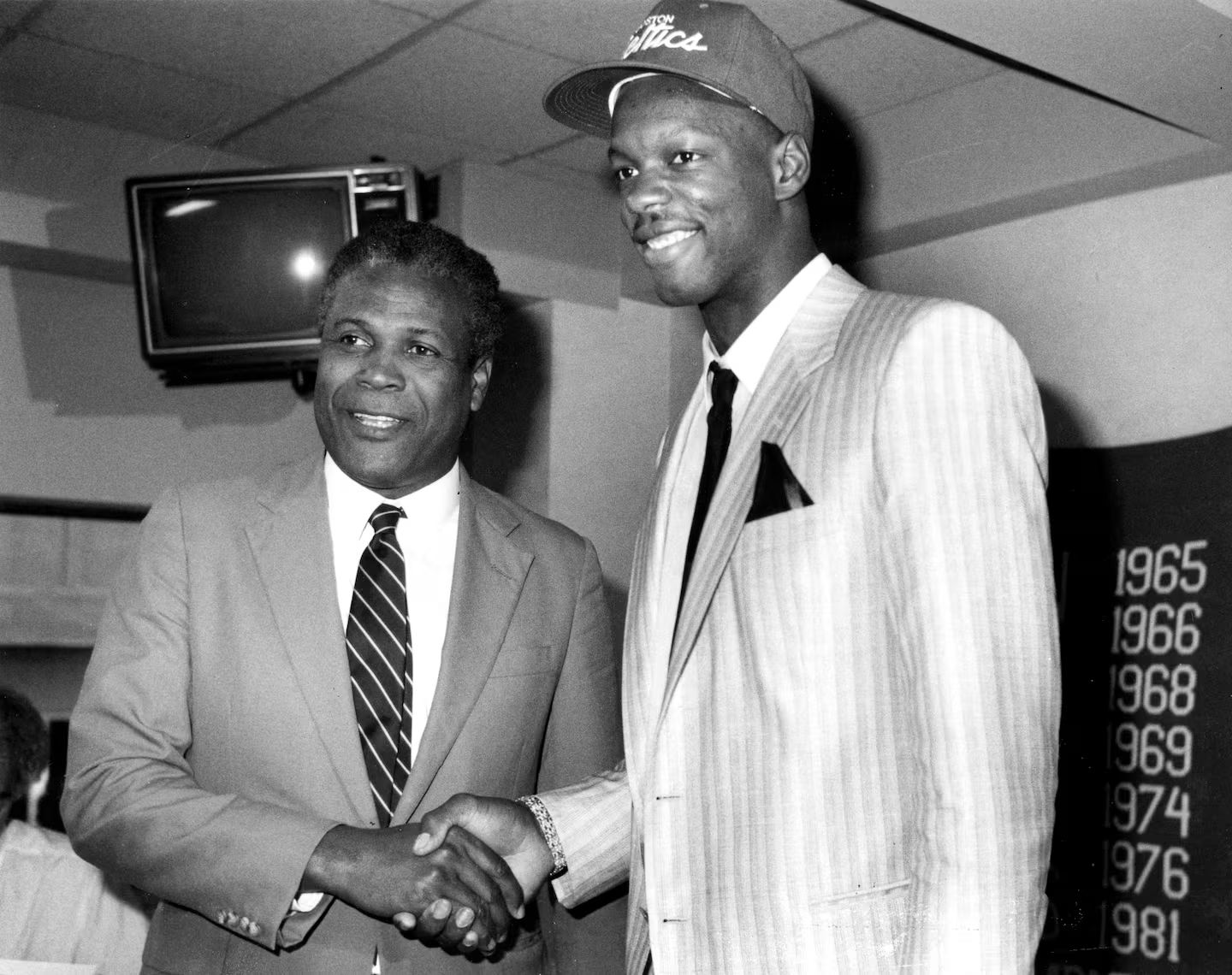
He was NBA-ready, the perfect addition for a Celtics team that desperately needed youth after winning three titles in six years. Two days after the Celtics selected him second after North Carolina’s Brad Daugherty and one day after he met with the media in Boston after signing a $1.6 million Reebok deal, Bias was dead. The official cause was a cardiac arrhythmia caused by cocaine use after a night of using the drug following his return to the Maryland campus. He was 22 years old.
Bias’s death changed how America approached drug use and how the NBA evaluated the backgrounds and habits of draft prospects. The Celtics franchise suffered greatly after losing Bias, moving forward without a potential cornerstone.
Unfortunately, Bias wasn’t the only tragic story from the 1986 draft, just the most tragic. It is considered the most disappointing and calamitous class in NBA history. For example, only five of the 24 first-round picks played 10 years or more. The 1985 draft saw 15 of the top 24 picks play at least 10 years, including the first 10. In 1987, 15 of the top 24 picks played double-digit seasons.
No, this was a 1986 problem. Chris Washburn, William Bedford, and Roy Tarpley were also felled by drug problems. Daugherty played only eight seasons because of injury. Kenny Walker, Brad Sellers, and Walter Berry were busts.
College superstars Johnny Dawkins, Dwayne “Pearl” Washington, and Billy Thompson couldn’t meet lofty expectations. Saint Joseph’s standout Maurice Martin played just 69 games because of knee problems. John Williams suffered from weight issues and depression and missed an entire season because of a lack of conditioning.
Perhaps the best player drafted, Russian superstar Arvydas Sabonis, passed on the NBA until 1995 and he’s the lone Naismith Memorial Hall of Famer from that ill-fated first round. Several teams were just guilty of poor scouting with Mark Price, Dennis Rodman, Jeff Hornacek, and Nate McMillan taken after the first round.
As for the Celtics, the devastation from the loss of Bias reverberated through the franchise for a decade. There was so much excitement from team president Auerbach, who as a Washington, D.C., resident, had been scouting Bias for years. And his friendship with Maryland coach Lefty Driesell led to a bond that led Bias to hope the Celtics would draft him. He wanted to be in Boston.
“Whatever Red saw, Red felt, and Red anticipated, usually it was pretty spot on and led to pretty good results,” Celtics PR maven Jeff Twiss, then a young Celtics front-office employee, said of the team mentality before the ’86 draft. “Inside, I’m sure [Bias] was overexcited about being drafted by the Celtics and coming to Boston. But on the outside he very much portrayed it as a very business and very distinguished manner.”
After conducting multiple one-on-one television interviews at the Blades & Boards Club restaurant inside Boston Garden on June 18, 1986, Bias shook Twiss’s hand and told him, “We’re going to have some fun this year.”
That’s the last time Twiss saw Bias.
“I only really saw Lenny for about one hour of my life personally during that hour of live shots,” Twiss said. “He was thrilled to be selected by us. He was welcomed by Red. He has a chance to learn from Bird, from Parish, from McHale, from [Dennis Johnson], from Danny [Ainge], from [Bill] Walton. He would not have had to put pressure on himself to be the man. We already had six of those.”
The loss of Bias meant the Celtics had a void of youth on their roster. The second overall pick would never play a game for the franchise and the Celtics got old quickly. After 1987, they would not get back to the NBA Finals for 21 years.
“The impact without him there and without another solidifier or bona fide pick in that draft or anybody else to come in and succeed Bird, McHale, and Parish or Walton, was nonexistent,” Twiss said. “I remember the consensus in our office is his death probably sent us back 10 years. And as history has dictated, McHale gets hurt with his foot, Bird’s back problems, Walton ends up retiring, and the multitude of injuries crept up in the late ’80s on us and bit us in the rear, without Lenny.”
Off the court, Bias’s death raised drug prevention awareness while the NBA beefed up its educational programs for entering players. What crushed Celtics fans about the tragedy was Bias’s eagerness to come to Boston and learn from the greats. He approached this process with humility. He was going to get to play in those great Lakers-Celtics rivalries. He was going take the torch from Bird and lead the Celtics into a new decade. He was going to be the face of the franchise. And it was all gone, roughly 60 hours after he was drafted — one of the great sports tragedies of all time, one that still draws raw emotion from those who watched Bias flourish in college, that famous steal and reverse dunk against North Carolina, and those who envisioned him competing with Michael Jordan for league supremacy.
“That draft class had a wealth of potential,” Twiss said. “And they threw it away. There were various examples of that. The league had horror stories in the 1970s and [early] ’80s of drug usage and we got away from that theme when Bird and Magic [Johnson] and others came into the league and said let’s bring basketball back on the court and forget these underlying nasty issues. That reared its ugly head again in the ’86 draft.”
Auerbach was inconsolable about Bias’s death but spoke to reporters at length just hours after the news was revealed. The coming years were filled with what-ifs. And the club dealt with even more misfortune when 1987 first-round pick Reggie Lewis died of a heart attack during a summer workout in 1993.
Twenty-two years separated the Celtics’ ’86 championship and their next one in 2008, and many of those years were difficult for the franchise, filled with losing seasons, draft lottery Ping-Pong ball disasters, and the disastrous Rick Pitino era. That dreadful stretch began June 19, 1986, when a generational talent made a decision that cost him his life.
“The death of Lenny Bias gives the classic, ‘What if?’” Twiss said. “What if he lived? What if he could have helped us out? Would he have replaced McHale in the starting lineup and Kevin goes back to sixth man? Would he have given Bird 30 minutes a game instead of 38? Would he have helped Robert Parish in rebounding? A lot of those questions we’ll know. We’ll never, ever know.”
A GM’S PERSPECTIVE
Dunleavy eyes present and future
The Warriors are in a precarious position as they enter the upcoming fruitful draft with the 11th pick. They are desperately trying to get Stephen Curry more help with a player who can contribute right away. Team president Mike Dunleavy would love to get a cornerstone player who won’t take years to develop. But he has to think about the post-Curry Warriors future, and that day is eventually coming.
“I think there will be a tremendous amount of activity in terms of calling, reaching out, and seeing if things are available,” Dunleavy said of draft night. “I do think because the strength of the draft, teams are valuing the picks even more than they ever have. I also think with the new lottery odds, the draft picks are going to be more valuable moving forward. I think teams see it that way.
“In the end, I think trades are probably going to be less and less because of teams being less willing to trade picks. So between the aprons and the new lottery rules, my guess is you’re going to start to see less trades over the next few years.”
One major impact on the draft in the past five years is the number of players who decide to go back to school if they don’t think they will be a lottery pick. The NIL money is too plentiful for players to take a chance on slipping in the draft when they can boost their stock with another year.
Alex Condon, Tounde Yessoufou, Jeremy Fears, and Braylon Mullins opted to return to school. All would have been first-round picks.
“You’re just starting to see much older players be in the draft. I think sometimes people overreact a little bit to say, ‘Oh, this guy is older, be careful, older players don’t do well,’ ” Dunleavy said. “I think we’re just in a different age where there’s more older guys that have stayed in the draft. Therefore, it means that these guys can still be good. They just didn’t come out earlier. I think teams are just much more open to drafting older players, particularly in the second round.”
The Warriors will get a quality player at 11 but they would prefer he be in next year’s rotation. Upgrading immediately and preparing for the long term are difficult endeavors simultaneously.
“Right now we’re in a spot where we’re not going through the progression the right way,” Dunleavy said. “We’re sitting here saying, let’s keep turning the ball over, let’s make a bunch of threes, try and overcome it, let’s trade for guys with more talent that can overcome these mistakes we’re making.
“I’d rather back it up, clean those things up, and then build a roster from there where it’s, like, okay, we’re doing these things, and we have really good players, and now we have a chance to be in the conversation.
“That’s the way I envision it. I think it’s frankly more of a refocus on what we need to do.”
ETC.
Which class was better?
This 2026 NBA Draft has drawn comparisons to two in the previous 30 years, the 1996 class highlighted by Allen Iverson, Ray Allen, Steve Nash, and Kobe Bryant, and the 2003 class with LeBron James, Dwyane Wade, Carmelo Anthony, and Chris Bosh.
Two draft experts were asked about the ’96 draft and its impact on the next basketball generation.
“I lived through ’96. I still probably equate that as the best draft that I’ve been part of, just based on what eventually happened to the talent level,” ESPN front-office insider and former Nets executive Bobby Marks said. “Iverson, [Stephon] Marbury, Ray Allen, Kobe, Nash, Peja [Stojakovic]. I mean, the list goes on. We, you know, drafted Kerry Kittles, who turned out to be a good NBA player. It was a high-level draft.
“I’ve talked about ’96 a lot, just because of the guards in this year’s draft, because Darryn [Peterson], and then the group between five and nine, five and 10 here. It’s interesting, we’re going to probably get a run of freshmen up top. Of course, back then it was a little bit different. I don’t know if I want to put it on historic level here, but I think this is probably one of the best draft classes that we’ve seen from top to bottom in a very long time.”
Peterson, Brockton native AJ Dybantsa, Duke’s Cameron Boozer, and North Carolina freshman Caleb Wilson are expected to be the top four picks, but the depth of the ’26 draft is considered elite. The Celtics could get potentially a rotation player at 27.
“You look at the first top 10 picks, probably nine or maybe 10 will be freshmen,” ESPN high school basketball expert Paul Biancardi said. “I was coaching in ’96, and I was coaching in ’03, but I think the ’03 class, to me, is maybe still the best class based on what they’ve done and what we know. We won’t be able to judge this group, you know, for at least three to five years, but I would have to say, in a big picture concept, this has to be a top-three class. Maybe four.”
Layups
Joe Mazzulla does not like the idea of having a coaching tree but his staff is attracting attention for head coaching jobs as top assistant Tony Dobbins is a candidate for the vacant position with the Mavericks. Dobbins has worked with Jaylen Brown on improving his game as well as other Celtics. The Mavericks have been looking for a coach since new team president Masai Ujiri and Jason Kidd agreed to part ways. It’s uncertain what the Mavericks are seeking in a coach but it’s a critical position considering the bright future of Maine native Cooper Flagg. Dobbins, 44, played collegiately at Virginia Tech and Richmond and then internationally before joining the Celtics as an assistant in 2018 … There is one more coaching vacancy after the Bulls opted for Trail Blazers interim coach Tiago Splitter to lead their rebuild. Portland had been interviewing candidates to replace Splitter, who led the Blazers to the playoffs after a four-year absence. New owner Tom Dundon has made headlines with his cost cutting and offering Splitter a below-market deal to return as coach. Portland has some decisions as Robert Williams and Matisse Thybulle are free agents. Damian Lillard will also return after a year absence while Jrue Holiday and Jerami Grant are entering the final year of their contracts … The Wizards are hoping Alex Sarr will be healthy by the beginning of training camp after the former No. 2 pick suffered a broken foot during a workout this past week. Sarr is coming off an encouraging season and is expected to take a step forward as the Wizards will add a top pick in the draft Tuesday. They have the first overall pick. … A happy retirement to Lakers public address announcer Lawrence Tanter, who is stepping down after 43 years with the club. Tanter narrated several generations of Lakers basketball, giving his signature “Quiet Storm” voice to announce buckets by Kareem Abdul-Jabbar, Magic Johnson, James Worthy, Shaquille O’Neal, Bryant, and James. And he was professional in his approach, unlike several PA announcers around the league who treat NBA games as And-1 events, imploring fans to chant “defense” or offering remarks after big plays. Tanter set a standard for PA announcers and his voice will be missed at Crypto.com Arena.
Read more Lebanon fighting continues despite ceasefire, threatening US-Iran agreement



Post Comment