Trump’s name was stripped from the Kennedy Center. Now what?
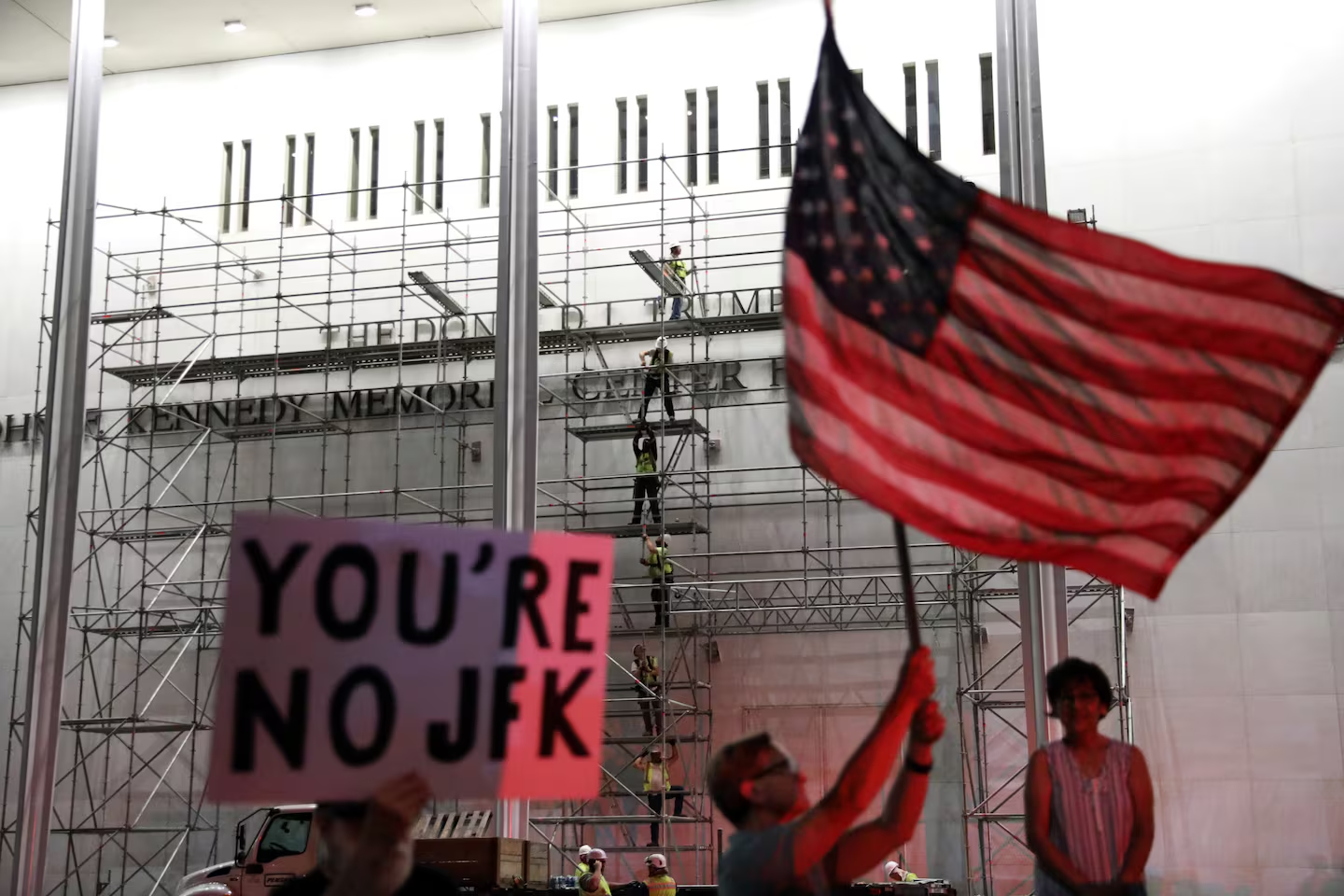
WASHINGTON — There were cheers at the Kennedy CenterlastFriday night, but the audiencewasn’t lauding some revelatory work of art. Rather they encouraged a more unorthodox spectacle: construction workers up on60-foot scaffolding removing President Trump’s name from the face of the building by order of a federal judge.
Read more Boston Fleet re-sign forward Olivia Mobley and goaltender Amanda Thiele
Despite prying the letters from the building, a larger question remains: What’s next for the nation’s premier performing arts center?
After all, the president has sought to close the Kennedy Center for two years amid a massive renovation. For now, its performance calendar is sparse beyond July 3, consisting mostly of movie outdoor movie screenings.
The federal judge who ordered the removal of Trump’s name, Christopher Cooper, has also blocked the closure. On Tuesday, he ruled the Kennedy Center board must present a plan to the court for staying open by Friday. (As of Friday afternoon, the board had yet to file.)
Change has been the norm since February 2025, when Trump fired every member of the center’s board of trustees who had been appointed by Joe Biden, plus longtime chairman David Rubenstein and the center’s president Deborah Rutter. Days later, Trump was voted the new chairman by a board made up solely of his allies — a panel which, in December, approved adding Trump’s name to the arts venue. He has since gone about reshaping the Kennedy Center’s programming, personnel, and aesthetics to his liking.
Following Cooper’s ruling in late May that Trump could not close the Kennedy Center, the president vowed on social media to work“with Congress to transfer this failing Institution back to them so they can make a determination as to what to do with it.”
“We remain fully compliant with the court’s directive while we evaluate legal options regarding the Board’s unanimous vote,” vice president of Kennedy Center public relations Roma Daravi said in a statement, referencing a trustee vote to appeal the judge’s ruling.
Experts on the Kennedy Center told the Globe that although the court wins were important, the center’s future remains murky. The damage Trump has done, they said, could take years to repair.
“What the lawsuit did was [it] stopped the worst case scenario,” said Andrew Taylor, director of the arts management program at American University. “But that doesn’t mean there’s a good scenario ahead.”
Already, Trump’s imprint on the Kennedy Center has had lasting effects. Swaths of artists and ensembles have cancelled shows or cut ties with the center, citing Trump’s politicization of the institution.
For Brett Egan, president of the DeVos Institute of Arts and Nonprofit Management, any revitalization of the Kennedy Center would first and foremost necessitate restoring its standing with performers.
That includes showing “there are guardrails in place to prevent a takeover like this from ever happening again,” he said, adding that may require revisions to the center’s bylaws or founding legislation.
Audiences have also fled. Kennedy Center subscription sales had dropped 36 percent by June 2025, costing the center millions in revenue. Attendance of major productions hit pandemic-level lows in October.
Trump has, at times, directly involved himself in the Kennedy Center’s programming. Justifying his involvement, Trump derided the center’s “woke” acts and promised to usher in a “golden age.” Among Trump’s personal programming picks: a run of “Les Misérables,” the World Cup selection draw, and playing host at the 2025 Kennedy Center Honors.
“I would say to anyone who is running any cultural organization that the most crucial thing is to think about the programming you’re offering and to make sure it’s excellent and vibrant and speaks to a broad group of audience members,” said Michael Kaiser, who was president of the Kennedy Center from 2001 to 2014.
Read more A duck led the Tartan Army parade in Providence? Yes, and she’s famous in Rhode Island.
Since Trump’s takeover, more than 100 Kennedy Center staff have been fired.
Kaiser said employing staff with Kennedy Center experience is “critical” because the organization is “very complicated” and maintains high standards. For example, all aspects of an attendee’s visit “must be seamless,” he said, down to practical considerations like parking, security, and food service.
Senator Sheldon Whitehouse of Rhode Island, the top Democrat on the committee with jurisdiction over federal buildings, led an investigation last year intowhat he called “cronyism and corruption” at the Kennedy Center. showed the Kennedy Center, under Trump-installed president Richard Grenell, offered discounted event rentals to conservative organizations, directed contracts to Trump’s political allies, and spent lavishly on hotel rooms, meals, and entertainment.
“This was like a mob bust-out gone wrong,” Whitehouse, an ex-officio member of the Kennedy Center board, told the Globe. “Their job, basically, was to go in there, take a going concern, loot it as much as they could for the benefit of themselves and the Trump family and right-wing organizations, and all of that. But they got carried away, and they didn’t realize that they were putting the damn thing out of business.”
Grenell has previously said Whitehouse’s findings were rife with “partisan attacks.”
The version of the Kennedy Center Whitehouse uncovered heavily contrasts with one experienced by Bryan Rafanelli, a Boston-based event planner and former board member. Rafanelli, a Biden appointee who was on the board for just 28 days before being dismissed by Trump, described the Kennedy Center of old as a bipartisan, “well-oiled machine.”
“That first board meeting, I sat there with Democrats and Republicans alike. Actually, one of my favorite clients in the world serves on the board and they’re a big supporter of” Trump, said Rafanelli, who has designed White House events for the Obamas and the Bidens.
A key “unwritten rule” during his time as president, Kaiser said, was that the Kennedy Center is “an apolitical place.”
“Even though a large number of the board are presidential appointees, and even though we have 14 members of Congress and such, we never talk about political issues,” he said. “If it got to be political, then you’re not going to have the ability to bring in a [wide] range of art.”
In March, the Kennedy Center Board voted to close the building for two years to clear the way for a major renovation. Grenell, a longtime Trump political operative, was replaced by Matt Floca, who previously served as a facilities manager. The center also shed more staff, leaving a skeleton crew to run a venue that once hosted about 2,000 performances a year by the likes of Beyoncé, Aretha Franklin, and Bruno Mars.
The closure would have meant shuttering a space that had served as a living memorial to John F. Kennedy since 1964. Kaiser said the best way to honor Kennedy is ensuring the center is a “building full of life.”
For Egan of the DeVos Institute, the Kennedy Center’s symbolic significance runs even deeper.
“When you dismantle a physical institution that is the premier symbol of a field, the pain is not only the loss of a building and of a season’s programming,” he said. “The pain is the loss of a mutual belief in the importance of art and culture as a non-negotiable element of a functioning civil society.”
As for the institution’s next steps, Whitehouse said that “if the Board of Trustees were honestly committed to restoring the Kennedy Center as an institution and putting the interests of the institution first, it could turn around pretty quickly.”
“We saw firsthand that putting the Trump name on it was toxic, and now with the Trump name back off, I think there’s a real opportunity to restore the institution,” he said. “But it’s hard to see how that happens if the loyalty of trustees remains primarily to Donald Trump rather than to the institution itself.”


Post Comment