Week 1 review: The World Cup has delivered in a big way, and other takeaways
The first week of the World Cup is complete, and whether you’re a superfan shelling out several thousand dollars for tickets or just a casual fan tuning in as a curiosity, the takeaway is the same:
Read more Three hundred miles from shore, their sailboat sank. They’re back this week to finish the race.
This tournament has delivered.
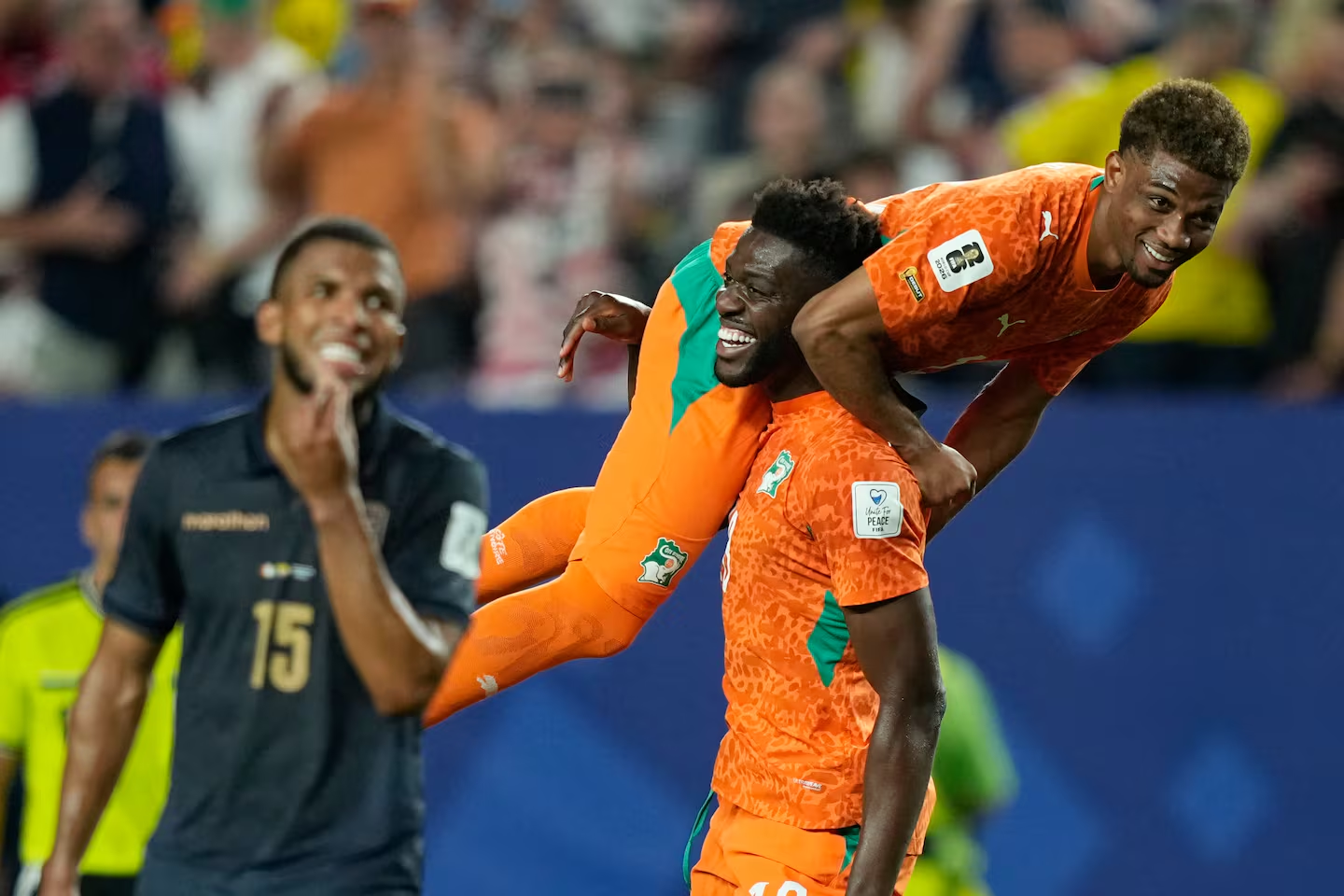
There have been dramatic finishes, such as Japan tying the Netherlands in the 89th minute, Ivory Coast defeating Ecuador in the 90th, Ghana overcoming Panama four minutes into extra time, and Qatar tying Switzerland in extra time.
A few Davids have hung tough with Goliath, with tiny Cape Verde tying Spain and Congo tying Portugal (a rough start for the Iberian Peninsula).
The United States dominated its first match, crushing Paraguay, 4-1.
And the stars have shined. Norway’s Erling Haaland, France’s Kylian Mbappé, and England’s Harry Kane each scored twice, while Argentina’s Lionel Messi notched his first World Cup hat trick (we won’t mention the potential red card that Messi got a pass on).
Some of the logistics, such as traffic, parking, and security, still need to be ironed out, and the ticket prices are absurd, but the soccer has been phenomenal.
Other takeaways from Week 1 of the World Cup:
⋅ The blending of cultures is always one of the best aspects of the tournament, but of course politics has gotten involved.
Senegal captain Kalidou Koulibaly questioned after a 3-1 loss to France why his countrymen can’t attend the games.
“The federation did the work for us to have parents or our close family with us,” Koulibaly, a defender for Chelsea, told The Athletic. “I think that every team can have their people, so I don’t understand why people from Africa cannot have their people.”
Cape Verdeans were supposed to be able to pay $5,000, $10,000 or $15,000 to be granted a tourist visa, but the documents didn’t come through for players’ families.
“My mum could not be here either for a visa issue, and the money we had to pay for it. We did not manage to do this in time,” said goalie Vozinha, whose Instagram account has ballooned from 30,000 to more than 13 million followers after the tie with Spain.
⋅ However, I’m having a hard time getting worked up over a dust-up with the Iranian team and its travel plans.
Before the tournament, Iran was forced to switch its training home from Tucson to Tijuana, Mexico, because of US travel bans. For Monday’s opener against New Zealand in Los Angeles, Iran had hoped to arrive Saturday and leave Tuesday, but instead was told to arrive Sunday and leave immediately after the game.
Iran coach Amir Ghalenoei called his team the “most oppressed team in the whole World Cup” after the 2-2 draw, and while that may be true, Iran’s travel arrangements don’t seem overly punitive.
Read more Trump approval on Iran low even as tentative deal to end fighting emerged, new poll finds
Soccer is a grueling sport, but is it really that hard to get on a plane after a match and fly, what, 45 minutes from Los Angeles to Tijuana? Especially when the next match is five days away? NFL teams routinely fly out the day before the game, and immediately fly home after players slam into each other for three hours. British journalist Simon Evans, who used to write for Reuters and now produces The Soccer Business newsletter, chimed in that European teams commonly fly home immediately after Champions League games, too.
Iran is getting tougher treatment than others, but it shouldn’t affect the soccer.
⋅ The temperatures in Dallas, Houston, and Atlanta may be scorching, but fans should bring sweat shirts to matches. The three NFL stadiums in those cities are keeping their roofs closed and blasting the air conditioning for the entire five-week World Cup to create a cool, greenhouse environment in which to grow natural grass.
German fan @FreddyLA7, whose tour of the United States has become a social media sensation, attended Germany-Curacao in Houston and posted that he was “freezing to death in here. We’re sitting below the AC. It’s so cold.”
Of course, the matches inside the frigid domes still are stopped twice for “hydration breaks,” which bolsters the case that these are really meant for selling commercials.
⋅ Speaking of @FreddyLA7, his tour through the southeastern United States has been endearing, from his discovery of Waffle House, Buc-ee’s, and SEC football stadiums, to the generous hospitality shown by J.J. Watt and country music artist Ella Langley.
But now the opportunists are coming out, trying to get a piece of Freddy’s social media clout, and the journey is losing its charm. Loads of free stuff now shows up on Freddy’s doorstep, he gets VIP treatment everywhere he goes, and Circa Las Vegas even offered a free hotel room and use of a private jet. Way to take something wholesome and ruin it, America.
⋅ The best prop so far — the blue trash bags from the Japanese fans. Japan has a reputation as the tidiest team at the World Cup, always leaving its locker room impeccably clean after matches, and the fans follow suit. In the 2-2 draw to the Netherlands, Japanese fans first used the blue trash bags as noise makers to cheer on their team, then to dispose of their waste after the match.
⋅ The sprinklers are running constantly at the venues, during pregame warm-ups, hydration breaks and halftime. But when a sprinkler malfunction Tuesday in Foxborough spewed gallons of water onto the field at halftime of the Norway-Iraq match, the grounds crew turned off the sprinklers for the rest of the evening, to noticeable effect. Norway manager Stale Solbakken said the ball stopped rolling.
“It’s really dry, tinder dry, after five minutes, so all of the passes we want to pass through wound up in duels,” Solbakken said after the match, via translation. “The ball stuck to the grass. It’s not an excuse. It’s a fact. Things moved too slowly. The game is influenced by the really dry grass, which is what we experienced today. That’s why they water it, to speed up the game.”
⋅ How petty is FIFA in “protecting” its sponsors? In Foxborough, a piece of tape covers the “Gillette” name on approximately 64,000 seats. At Levi’s Stadium in Santa Clara, Calif., they taped over the names on the condiments in the press box.
⋅ According to Opta Stats, Monday’s action marked just the second time in history (June 15, 1958) in which there were four draws in one day.



Post Comment