He’s worked concessions at Fenway Park for 50 years. What keeps him coming back?
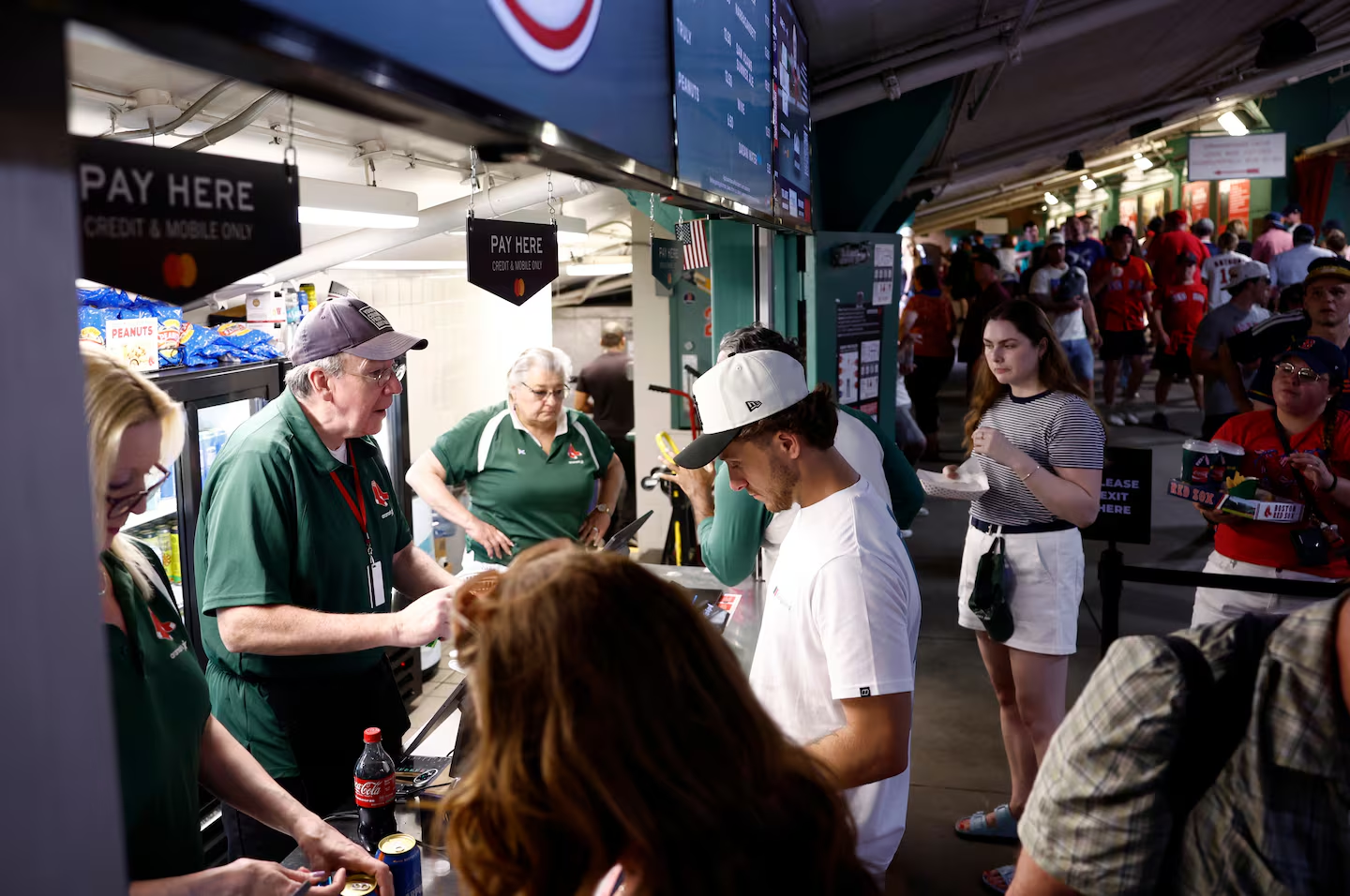
Hours before the Red Sox take the field, Peter Dankens winds through the mostly empty corridors of Fenway Park, to the concessions stand behind first base, and begins his own ballgame.
Read more World Cup expansion may dilute the tournament, but it gives small nations a moment in the spotlight
Already, the coolers at Baseline Beer are stocked with frosty Narragansetts and Truly Hard Seltzers, bags of peanuts piled high on top. It’s quiet now, but just wait: As the gates open and thirsty fans start lining up, Dankens, 64, will step up to the plate — or, rather, a sleek point-of-sale system — and crack cans through the bottom of the seventh inning.
It’s a familiar routine for Dankens, Fenway’s longest-serving concessions worker. He started at the ballpark 50 years ago, at age 14, when hot dogs cost 55 cents and the Sox were the team of Yastrzemski and Rice. “I always loved it,” said Dankens, a bespectacled man with a toothy grin and gray hair covered by a ballcap, “and I just never left.”
He’s in good company. The two women who work beside him aren’t far behind on the seniority list: Michelle Doherty, 60, a platinum-blonde Woburn native with the thick accent to match, and Alicia, a silver-haired tough-talker (who declined to give her last name on the grounds of striving to be “a nobody at all times”) have each worked at Fenway for 47 years. Their barback, Raresh Ivancov, 37, a Romanian immigrant with a long goatee, is a rookie by comparison; he started five years ago, at the suggestion of his wife, who sells frozen lemonade across the concourse.
As it is for many of his colleagues, Fenway is a second job for Dankens. He works full-time as an advertising compliance officer at John Hancock, where his bosses are understanding when he needs to take a vacation day to work an afternoon home game.
It can be exhausting balancing the two jobs.He plans to retire from John Hancock in a few years — but not from his post behind the green door at Gate D, Stand 9, until he’s physically unable to continue.
“Fenway,” he said, “I’m gonna stay forever.”
But why? Sure, there are perks — “I’ve seen enough baseball to last me the rest of my life,” Dankens said — but it’s not always an easy job. Workers are on their feet for hours, including during sweltering summer months with no air conditioning. Customers are usually friendly, but not always; by Alicia’s math, “you’ve got 95 percent nice people, and you’ve got 5 percent chuckleheads.” Evening or weekend plans? If there’s a home game, forget it.
And yet, many of the ballpark’s 1,000-odd concessions workers are long-timers. Derek Swartz, vice president of operations at Aramark, which runs Fenway’s concessions, said that roughly 350 workers have been there 10-plus years.
“It’s like the mafia,” Dankens said.
Longevity was a common refrain last season, when concessions workers, seeking a new union contract, undertook their first-ever strike. In December, they finally reached a deal with Aramark, securing pay bumps, new seniority provisions, and limits on self-checkout machines.
(John Henry, the principal owner of Fenway Sports Group, which owns the Red Sox, also owns The Boston Globe. The Red Sox contracts with Aramark to sell food and drink.)
Last year’s fight was a bruising one, but now, Dankens and his fellow outfielders — way outfield — are back to business as usual. So what is it, exactly, that keeps so much of this roster coming back, season after season?
“It’s just family here,” said Dankens. “Everybody looks out for everybody.”
Watch this foursome during a shift, and you’ll see what he means. During a recent Friday face-off against the Tampa Bay Rays, sharing the snug booth with dimensions not unlike a dugout, they took on the steady stream of jersey-clad patrons with the hustle of shortstops. Under fluorescent lights, they bellowed out well-worn directives to the line — “ID, honey.” “Hit the blue button, and tap.” — and swiveled between the counter and the coolers, hardly pausing to look as they reached in. Fans looking for grub have to go elsewhere; selling food, much less hoisting it overhead through the stands, is a young man’s game.
This crew’s long tenures mean they get first pick on where in the ballpark they want to work. “You know which stands make the most, which stands make the least, which is the best place to be,” Dankens said. He earns about $150 in wages each game, but the real money comes from tips. That makes a bustling location like the one behind first base, where the line hardly lets up, a coveted spot.
If Dankens, Doherty, and Alicia are the ones loading the bases, then Ivancov is the one running them, constantly in and out of the walk-in fridge in the back. He squeezed behind the trio to refill the coolers, placing the more popular brews (Sam Adams Summer Ales, Harpoon IPAs) up top, so his colleagues need not reach or bend more than they must. “It’s my job to make sure that they’re okay,” he said.
The way Dankens tells it, there has always been a sportsmanlike subculture behind the scenes at Fenway. He grew up a few houses down from Fenway’s concessions manager in Revere, and many kids on the block got their first job at the ballpark — a glamorous gig for a middle-schooler.
On his first day — April 13, 1976, the same day the electronic scoreboard debuted — “I was petrified,” he said. He was a porter, cleaning and schlepping food to different stands. In lieu of real training, other kids initiated him into the big leagues.
“I didn’t have any older brothers,” he said, “and everybody just took care of me.”
Read more Elizabeth Warren endorses former Wu aide in state Senate primary challenge
These days, he tries to return the favor, greeting his coworkers as he passes them around the ballpark. When Ivancov was naturalized last year, Dankens attended his citizenship party. Last summer, when a fellow beer server died of cancer, Dankens and other workers raised money for his family.
The deep ties don’t end there. Alicia ended up at Fenway because her mother was friends with the concessions manager’s wife. “My mother said that my job was to support myself, and so I have,” she said. And she’s kept coming back, even with a day job working for a software company. “It’s what I do,” she said of her Fenway gig. “It’s my habit.”
Doherty, who is No. 9 on the seniority list — “like Ted Williams,” she joked — started coming to Fenway alongside her parents, both longtime concessions workers.Her mom, now in a nursing home, “was the boss of the vendors eventually,” she said, and some old-timers still remember her. “They still come up and say, ‘How’s mom?’”said Doherty, who until recently also worked as a paralegal.
The three of them try to share their winsome streak with the fans, even when the Sox are on a losing one. “Bring us some luck tonight, will you?” Doherty said to one customer. Alicia checked the ID of an Australian visitor: Was it his first time in Boston, she asked? It was. Were people being nice? They were.
Over the years, they’ve accumulated loyal customers, who treat them like Fenway institutions on par with the Green Monster and the Pesky Pole. “He’s become such a good friend that we now exchange Christmas cards every year,” said Ann French,a longtime customer who made a pilgrimage to Dankens’ booth with her husband, Alan Brock, for bottles of Dasani at the Rays game.
“In the beginning,” said Brock, “he wouldn’t even ask what I’m gonna drink, because he already knew.”
It doesn’t take long to pick up the sense of ballpark camaraderie. Just ask Charlie Dankens, Peter’s 24-year-old son. He is in his third year at the ballpark, and spends many of his shifts cashiering or making food, with some distance from his dad and his Fenway fanaticism. But he’s starting to understand it.
“It’s a very fast-paced, very chaotic environment,” he said. “But through that, you really build relationships with people so fast.”
Those bonds were on full display during last summer’s union fight, during which Dankens’s face appeared on faux baseball cards that the union handed out, noting his half-century tenure.
Even though his full-time job means he doesn’t rely on the Fenway wage raises as much as some of his coworkers, Dankens has no regrets about standing with his team.
“I felt like I had an obligation to them,” he said.
But it’s also still a job. As the game wore on, the workers kept track of the inningson Dankens’s phone, perched on the counter. “Three glorious outs” before they were done for the night, Alicia said at the top of the seventh; the cutoff for ballpark beer sales is at the bottom.
Then, as quickly as it began, Dankens rolled down the shutter. They tallied what was left in the fridges and assessed their tips — it was a good night, though they were tight-lipped about exactly how good — and went their separate ways.
As “Sweet Caroline” engulfed the ballpark — Where it began… — Dankens hustled through the concourse, eager to beat traffic back to Andover. (In this line of work, he said, there is one trade secret he abides by: “no one will ever tell you where they park.”)
Dankens clocked out at 9:29 p.m. andwaited for his son inside an entrance on Ipswich Street, steps away from the neon lights and revelry. He watched as his coworkers made beelines for the exit, not caring to see if the Sox could hold onto their 2-0 lead. (They did.)
“How’s the baby?” Dankens asked adepartingcoworker, fist-bumping others. See you tomorrow, a colleague called to him.
Read more R.I. lawmakers vote to block governor from opting into Trump school choice program
“Do it all over again,” Dankens said.


Post Comment